
The Commitments of Traders report, often called the COT report, is a weekly CFTC report family that shows how open interest is distributed across trader classifications in covered futures markets. Depending on the report, the data is available in futures-only or futures-and-options-combined form. The report is a delayed aggregate snapshot of positioning, which makes it useful for market context rather than live order-flow analysis.
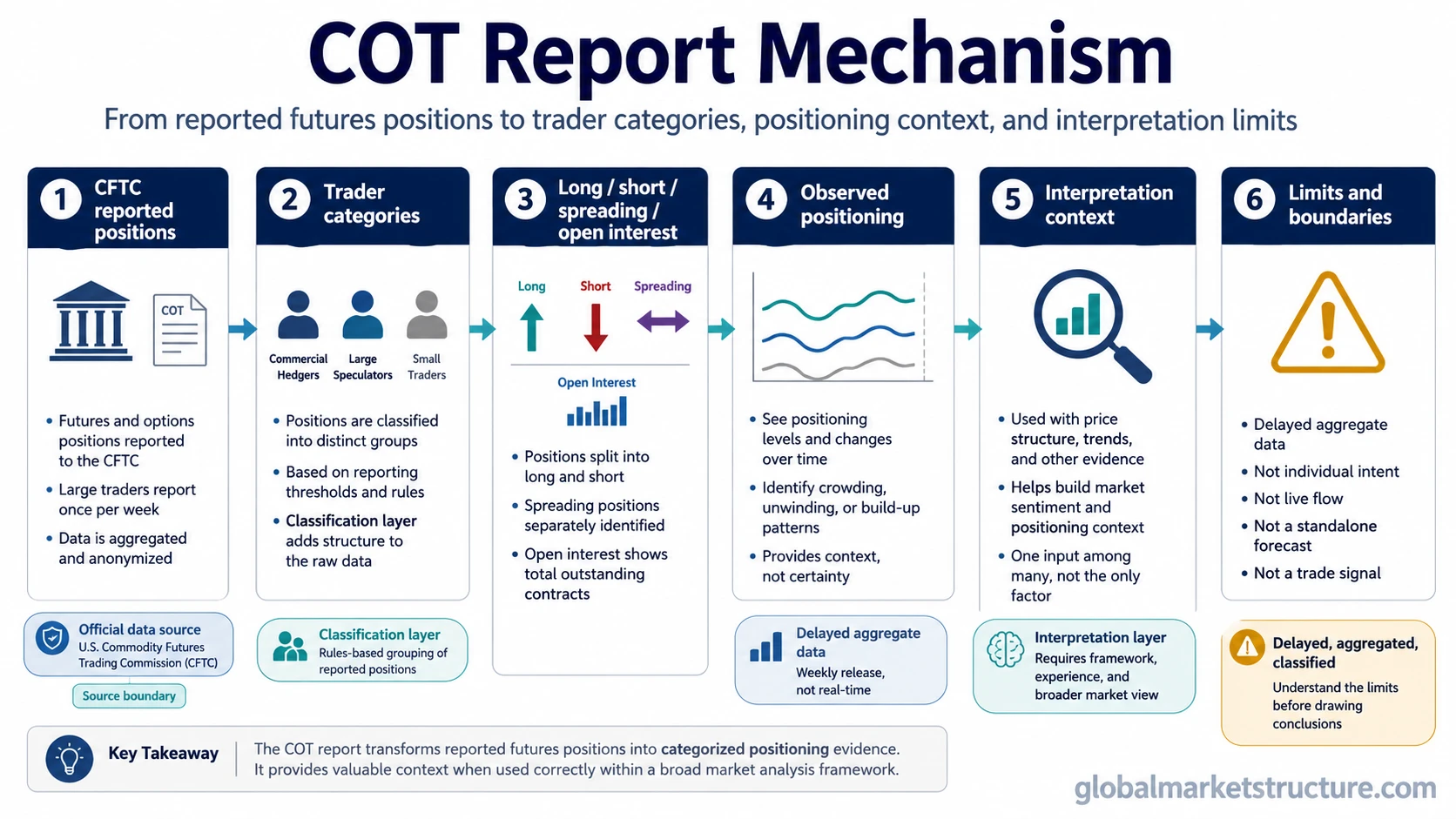
What the Commitments of Traders Report Shows
COT reports organize reported market positions by trader category. Depending on the report format, the published fields can include long and short positions, spreading, open interest, changes from the previous report, percentages of open interest, and trader counts.
The CFTC Commitments of Traders report is the official source for current and historical COT data. The CFTC states that the reports break down Tuesday open interest for markets meeting its reporting criteria, while the weekly Futures-Only and Futures-and-Options-Combined reports are generally released Friday at 3:30 p.m. Eastern Time. Holidays can alter the schedule. The CFTC explanation of the COT reports should be used when report definitions, release timing, or field structure need to be verified.
| Reported item | What it records | Interpretation boundary |
|---|---|---|
| Long positions | Reported long exposure within the relevant trader category. | Position size alone does not establish the motive behind the exposure or what price will do next. |
| Short positions | Reported short exposure within the relevant trader category. | Short exposure can arise from speculation, hedging, intermediation, or other portfolio activity depending on the participant and market. |
| Spreading | Reportable positions involving offsetting long and short exposure where that field applies. | The exposure may represent relative-value or spread positioning rather than a simple directional view. |
| Open interest | The outstanding contracts represented in the market and report. | It provides scale for the position data without explaining why the exposure exists. |
| Week-to-week change | The change in reported positions from the previous report. | The change describes the reporting interval and should not be treated as current intraday flow. |
| Share of open interest and trader counts | The proportion of market open interest represented by categories and, where reported, the number of traders. | Concentration and participation still require context from the market, report family, and historical comparison. |
Main Types of COT Reports
COT is a report family rather than one uniform classification system. The market being studied determines which report family and trader categories are relevant. Several families are published separately as futures-only and futures-and-options-combined reports.
| Report family | Primary market or classification lens | Main reportable categories | Position views |
|---|---|---|---|
| Legacy | Traditional COT classification across covered futures markets. | Commercial and Non-commercial, with Non-reportable positions shown separately. | Futures Only and Futures-and-Options Combined |
| Supplemental | Selected agricultural markets with additional commodity-index information. | Commercial, Non-commercial, and Index Traders. | Futures-and-Options Combined |
| Disaggregated | Agricultural and natural-resource markets with more detailed participant classification. | Producer/Merchant/Processor/User, Swap Dealers, Managed Money, and Other Reportables. | Futures Only and Futures-and-Options Combined |
| Traders in Financial Futures | Financial contracts such as rates, currencies, and equity-index futures. | Dealer/Intermediary, Asset Manager/Institutional, Leveraged Funds, and Other Reportables. | Futures Only and Futures-and-Options Combined |
How Trader Categories Should Be Read
The category names describe the CFTC reporting classification applied within a particular report family. They are useful because a producer, dealer, asset manager, leveraged fund, and other large participant can interact with the same futures market for different reasons.
The report identifies the category in which positions are reported. The exact reason for an individual position is not contained in the aggregate COT table.
Commercial, Non-commercial, Managed Money, Swap Dealer, Dealer/Intermediary, Asset Manager/Institutional, Leveraged Funds, or another category defined by the applicable report.
Whether the exposure reflects hedging, speculation, relative value, intermediation, crowding, or another portfolio objective requires additional context.
Non-reportable positions are the residual positions associated with traders below the CFTC reporting thresholds. They should not be treated as a homogeneous group with one motive.
How to Read a COT Report
Confirm whether the question belongs to Legacy, Disaggregated, Traders in Financial Futures, or Supplemental reporting, then identify whether the data is futures-only or futures-and-options combined.
Separate the Tuesday as-of date from the later publication date. The report describes positions at the reporting snapshot, not activity occurring after that date.
Compare long, short, spreading, and open-interest data using the fields available in the selected report.
Look at how the category has changed from the previous report and how large the exposure is relative to the market and its own historical pattern.
Price response, volatility, liquidity, open-interest behavior, and other positioning evidence determine whether a large or changing position is being absorbed, extended, or becoming more fragile.
What COT Can Establish
COT can establish that reported exposure was concentrated in particular trader categories at a specified point in time. It can also show whether those reported positions and open interest changed from the previous report.
The report does not reveal live orders, individual trader motives, positions established after the reporting date, or every hedge embedded elsewhere in a participant’s portfolio. A category can contain participants using different strategies, so large reported exposure is positioning evidence rather than a complete explanation of market intent or future direction.
Common COT Report Misuses
| Interpretation error | Why it can mislead | Better reading |
|---|---|---|
| Treating Commercial traders as automatic smart money | A reporting category does not rank participants by forecasting ability. | Read the category in the context of the relevant market, report family, and possible hedging or business exposure. |
| Treating large long or short exposure as a forecast | The same position can coexist with trend continuation, crowding, hedging, or later position reduction. | Compare position size and change with price response, open interest, volatility, and liquidity. |
| Reading the latest release as live flow | The report reflects the earlier as-of date rather than positions established after that snapshot. | Use the report as dated positioning evidence and verify current market conditions separately. |
| Assigning one motive to an entire trader category | Aggregate categories can contain participants with different portfolio objectives and exposures. | Keep the reported classification separate from the analytical explanation of why participants may hold the positions. |
COT Report Example in Positioning Context
Illustrative example: speculative positioning can rise for several reporting weeks while price continues to advance. That observation establishes that reported exposure is becoming larger. It does not establish that the move is near exhaustion.
If additional speculative exposure is accompanied by continuing price acceptance and stable market conditions, the position can remain supported. A different interpretation becomes more relevant if exposure remains concentrated while price stops responding, volatility rises, liquidity weakens, or positions begin to contract. The report identifies the positioning background; subsequent market behavior determines whether that background is becoming consequential.
COT vs Related Positioning Concepts
| Concept | Primary information | Boundary from COT |
|---|---|---|
| Market sentiment | Mood, expectations, and risk attitude across market participants. | COT records categorized futures positioning rather than general sentiment itself. |
| Crowded trade | Concentration of similar exposure among participants. | COT can provide evidence of concentrated reported exposure, while crowding requires a broader judgment about concentration and exit risk. |
| Fear and Greed Index | A composite sentiment reading built from multiple market inputs. | It belongs to a different evidence family from regulatory trader-position reporting. |
The COT report sits inside the broader positioning and sentiment cluster within capital flows and positioning. Its role is to supply dated, categorized positioning evidence while the surrounding pages own sentiment, crowding, composite indicators, and broader flow interpretation.