
ETF creation and redemption is the primary-market mechanism that allows large blocks of ETF shares to be created or removed when authorized participants exchange a defined basket of securities or cash with the ETF issuer.
Many readings of ETF flows depend on this operational layer. A normal ETF trade on an exchange does not automatically create or redeem ETF shares. Creation and redemption usually become relevant when secondary-market demand, supply, premiums, discounts, and basket liquidity create a reason for authorized participants to use the primary market.
The connection between ETF demand, redemption pressure, and underlying basket activity is conditional. Creation and redemption can matter for market-structure interpretation, but they should not be treated as standalone price signals or direct forecasts of market direction.
Key Points
- ETF creation and redemption happens in the primary market, usually through authorized participants.
- Most investors trade ETF shares in the secondary market, which is separate from the creation/redemption process.
- Creation can increase ETF share supply, while redemption can reduce ETF share supply.
- The impact on the underlying basket depends on demand persistence, ETF structure, basket liquidity, and whether exchange happens in-kind or in cash.
- ETF flows can be useful market-structure information, but they are not standalone buy or sell signals.
What ETF Creation and Redemption Means
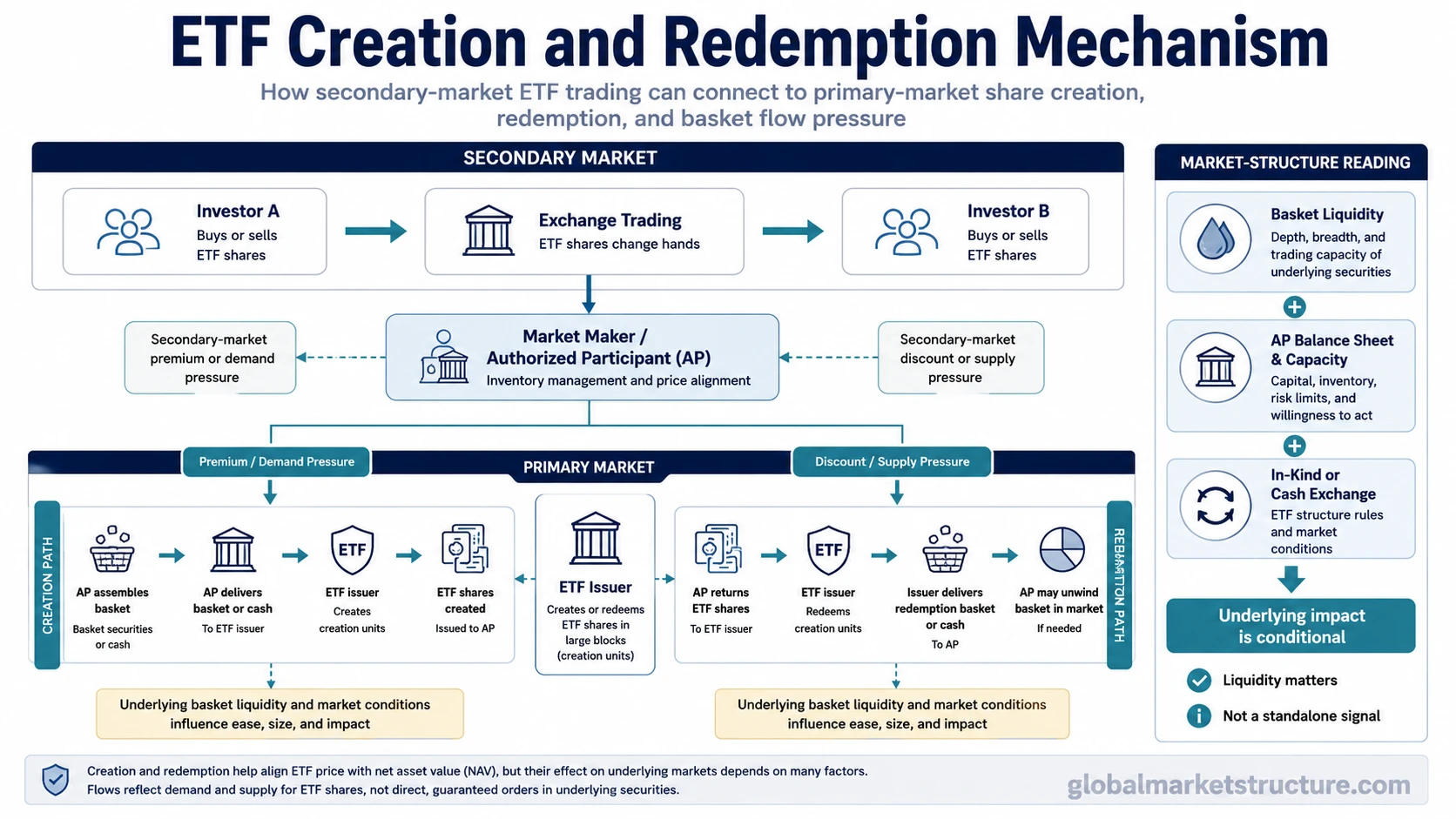
ETF creation is the process by which new ETF shares are issued. ETF redemption is the process by which existing ETF shares are removed. In both cases, the process normally involves authorized participants, often shortened to APs, interacting with the ETF issuer in large blocks rather than in small retail-sized trades.
In a creation, an AP delivers a basket of securities or cash to the ETF issuer and receives newly created ETF shares. In a redemption, the AP returns ETF shares to the issuer and receives the underlying basket or cash. The exact mechanics depend on the ETF structure, issuer rules, asset class, and market conditions.
For market-structure interpretation, the important point is not simply that ETF shares changed hands. The important point is whether demand or supply in the ETF became large or persistent enough to move beyond exchange trading and into the creation/redemption mechanism.
What It Means and What It Does Not Mean
| Reading | Correct Interpretation | Common Mistake |
|---|---|---|
| ETF shares are created | New ETF shares have been issued through the primary-market mechanism. | Assuming every creation automatically predicts a bullish move in the underlying assets. |
| ETF shares are redeemed | ETF shares have been removed through the primary-market mechanism. | Assuming every redemption automatically predicts a bearish move in the underlying assets. |
| ETF trades heavily on exchange | Secondary-market trading volume is high. | Treating high exchange volume as proof that new ETF shares were created or redeemed. |
| ETF trades at a premium or discount | The ETF price has moved away from its estimated net asset value. | Assuming the premium or discount will close instantly or perfectly in all conditions. |
Primary Market vs Secondary Market ETF Trading
The secondary market is where most investors buy and sell ETF shares on an exchange. In that setting, one investor can buy from another investor without any new ETF shares being created. The trade changes ownership, but not necessarily ETF share supply.
The primary market is different. It is where authorized participants interact with the ETF issuer to create or redeem ETF shares in large units. This process can change the number of ETF shares outstanding and may involve delivering or receiving a basket of underlying securities.
This distinction is central to flow interpretation. A large ETF trade may be absorbed by existing liquidity in the secondary market. Creation or redemption becomes more relevant when demand or supply cannot be fully matched by existing ETF shares at prices close to the fund’s underlying value.
Who Authorized Participants Are
Authorized participants are financial institutions that have agreements allowing them to create and redeem ETF shares directly with the ETF issuer. They are not ordinary end investors. Their role is important because they help connect ETF share supply with the underlying basket of securities or cash used by the fund.
APs may act when ETF demand, supply, premiums, discounts, hedging needs, or arbitrage conditions make the creation/redemption process useful. They do not remove all market friction, and their activity can depend on funding, balance sheet capacity, asset liquidity, transaction costs, and stress conditions.
ETF Creation Process, Step by Step
The creation process usually begins when demand for ETF shares is strong enough that the ETF price may trade above the value of the underlying basket. That premium can create an incentive for an authorized participant to create new ETF shares.
- The ETF issuer publishes or defines the creation basket.
- An authorized participant assembles the required securities or cash.
- The AP delivers the basket or cash to the ETF issuer.
- The issuer provides a large block of newly created ETF shares, often called a creation unit.
- The AP can then sell ETF shares into the secondary market, use them for inventory, or manage related exposures.
In market-structure terms, creation can represent a bridge between ETF demand and underlying basket demand. The strength of that bridge depends on whether demand is persistent, whether the ETF structure uses in-kind or cash exchange, and whether the underlying basket can be traded efficiently.
ETF Redemption Process, Step by Step
The redemption process works in the opposite direction. It usually becomes relevant when there is enough supply of ETF shares or enough discount pressure that an authorized participant has an incentive to redeem ETF shares through the primary market.
- The AP gathers a large block of ETF shares.
- The AP returns those ETF shares to the ETF issuer.
- The issuer cancels or removes the ETF shares from circulation.
- The AP receives the redemption basket or cash, depending on fund structure and conditions.
- The AP may hold, sell, hedge, or otherwise manage the received basket exposure.
Redemption can reduce ETF share supply, but it should not be read mechanically as immediate underlying-market selling. The outcome depends on the AP’s inventory, hedging, the redemption basket, underlying liquidity, and whether the redemption is in-kind or cash-based.
How Premiums, Discounts, and NAV Alignment Fit In
An ETF has an exchange price and an estimated value based on its underlying holdings. When the ETF trades above that estimated value, it is commonly described as trading at a premium. When it trades below that estimated value, it is described as trading at a discount.
The creation/redemption mechanism can help keep ETF prices close to underlying value because premiums and discounts may create incentives for authorized participants to create or redeem shares. This is often described as an arbitrage mechanism, but it should not be treated as frictionless or guaranteed.
During normal conditions, liquid baskets and active AP participation can make ETF pricing more efficient. During stressed conditions, wide spreads, thin underlying liquidity, funding pressure, or balance sheet constraints can make the alignment process slower, more expensive, or less reliable.
How Creation and Redemption Affects ETF Flow Interpretation
ETF creation and redemption is best understood as a translation layer between ETF-level demand and possible underlying-market activity. It helps explain how ETF share supply can adjust when demand or redemption pressure cannot be absorbed only by secondary-market trading.
This is narrower than passive flows, which describe broader allocation pressure from index-linked vehicles and passive mandates. Creation and redemption is the operational mechanism inside one part of that flow ecosystem.
The interpretation becomes stronger when ETF flow data, premiums or discounts, share creation/redemption activity, and underlying basket liquidity point in the same direction. It becomes weaker when a flow number is read without knowing whether activity was secondary-market trading, primary-market creation/redemption, hedging, inventory adjustment, or basket trading.
Condition, Interpretation, and Limitation
| Condition | What It May Indicate | Limitation |
|---|---|---|
| ETF demand is absorbed in the secondary market | Existing ETF shares may be changing hands without new share creation. | High trading volume alone does not prove underlying basket buying. |
| ETF trades at a persistent premium | Creation may become more attractive if APs can source the basket efficiently. | Premiums can persist when the basket is hard to trade or market friction is high. |
| New ETF shares are created | ETF share supply has expanded through the primary-market mechanism. | Creation does not automatically mean immediate directional pressure in every underlying asset. |
| ETF trades at a persistent discount | Redemption may become more attractive if the process can be executed efficiently. | Discounts can persist during stress, illiquid basket conditions, or AP balance sheet constraints. |
| ETF shares are redeemed | ETF share supply has contracted through the primary-market mechanism. | Redemption does not automatically equal forced selling of the full underlying basket. |
Common False Readings of ETF Flows
False reading 1: ETF inflows always mean underlying buying. In reality, a reported inflow may need context around secondary-market activity, share creation, AP inventory, and basket execution.
False reading 2: ETF redemptions always mean forced underlying selling. Redemptions can involve in-kind basket transfers, AP inventory decisions, hedging activity, or later basket adjustments.
False reading 3: ETF liquidity removes underlying liquidity risk. ETF shares may trade actively while the underlying basket is less liquid, especially in stressed or fragmented markets.
False reading 4: Creation/redemption is the same as index rebalancing. Creation/redemption changes ETF share supply, while index rebalancing changes index composition or weights and can cause portfolio adjustments by index-tracking vehicles.
How Creation and Redemption Differs From Nearby Flow Concepts
| Concept | Main Question | Difference From Creation/Redemption |
|---|---|---|
| ETF creation and redemption | How does ETF share supply expand or contract? | It focuses on the primary-market mechanism between APs and the issuer. |
| ETF flows | How much money is moving into or out of ETFs? | It focuses on measured flow data rather than the full operational mechanism. |
| Passive flows | How does index-linked capital move through markets? | It covers broader allocation pressure across passive vehicles and mandates. |
| Active vs passive fund flows | Who is making the allocation decision? | Active vs passive fund flows separates discretionary allocation from index-linked allocation rather than explaining the ETF primary-market mechanism itself. |
Practical Scenario: Absorbed Demand vs Creation Pressure
Consider a generic equity ETF that sees a rise in buying interest during normal market conditions. If sellers in the secondary market provide enough shares near fair value, the demand may be absorbed through normal exchange trading. Ownership changes, but ETF share supply may not need to expand.
If demand persists and the ETF begins trading at a premium to the value of its basket, an authorized participant may have an incentive to assemble the basket, deliver it to the issuer, and receive newly created ETF shares. In that case, the flow pressure is more directly connected to the creation mechanism.
Even then, the interpretation remains conditional. The creation process can connect ETF demand to basket activity, but the market impact depends on basket liquidity, hedging, transaction costs, the size of the flow relative to normal volume, and whether other participants are supplying offsetting liquidity.
Limitations and Market-Stress Conditions
The creation/redemption mechanism works best when APs are active, underlying baskets are liquid, spreads are reasonable, and funding conditions allow participants to manage inventory and hedges efficiently.
Under stress, the mechanism can become less smooth. Discounts can widen, premiums can persist, and underlying basket liquidity can become more important than ETF trading volume alone suggests. This does not mean the ETF structure is automatically broken. It means the flow data needs to be interpreted together with liquidity, spreads, depth, and market conditions.
The safest market-structure reading is to treat creation and redemption as one component in a broader flow framework, not as a direct instruction, forecast, or standalone market signal.
FAQ
Do ETF trades always create or redeem ETF shares?
No. Most ETF trades happen in the secondary market, where existing shares change hands between buyers and sellers. Creation or redemption happens in the primary market when authorized participants interact with the ETF issuer.
Who can create and redeem ETF shares?
ETF shares are typically created and redeemed by authorized participants, not ordinary retail investors. These institutions have agreements that allow them to exchange baskets or cash with the ETF issuer in large blocks.
Does ETF creation mean the underlying assets must rise?
No. Creation can show that ETF share supply expanded, but it does not guarantee a positive price move in the underlying assets. Market impact depends on size, liquidity, hedging, inventory, and broader conditions.
Does ETF redemption mean forced selling?
Not automatically. Redemption can involve in-kind basket transfers or cash processes, and the authorized participant may manage the received exposure in different ways. It should not be treated as automatic forced selling without context.