
Short covering is the purchase of a security to close an existing short position. In a conventional stock short sale, the position is closed when the short seller buys shares that can be returned to the lender. That buy-to-close demand can affect price, but the size of the effect depends on how much covering occurs, how quickly it arrives, and how easily the market can absorb it.
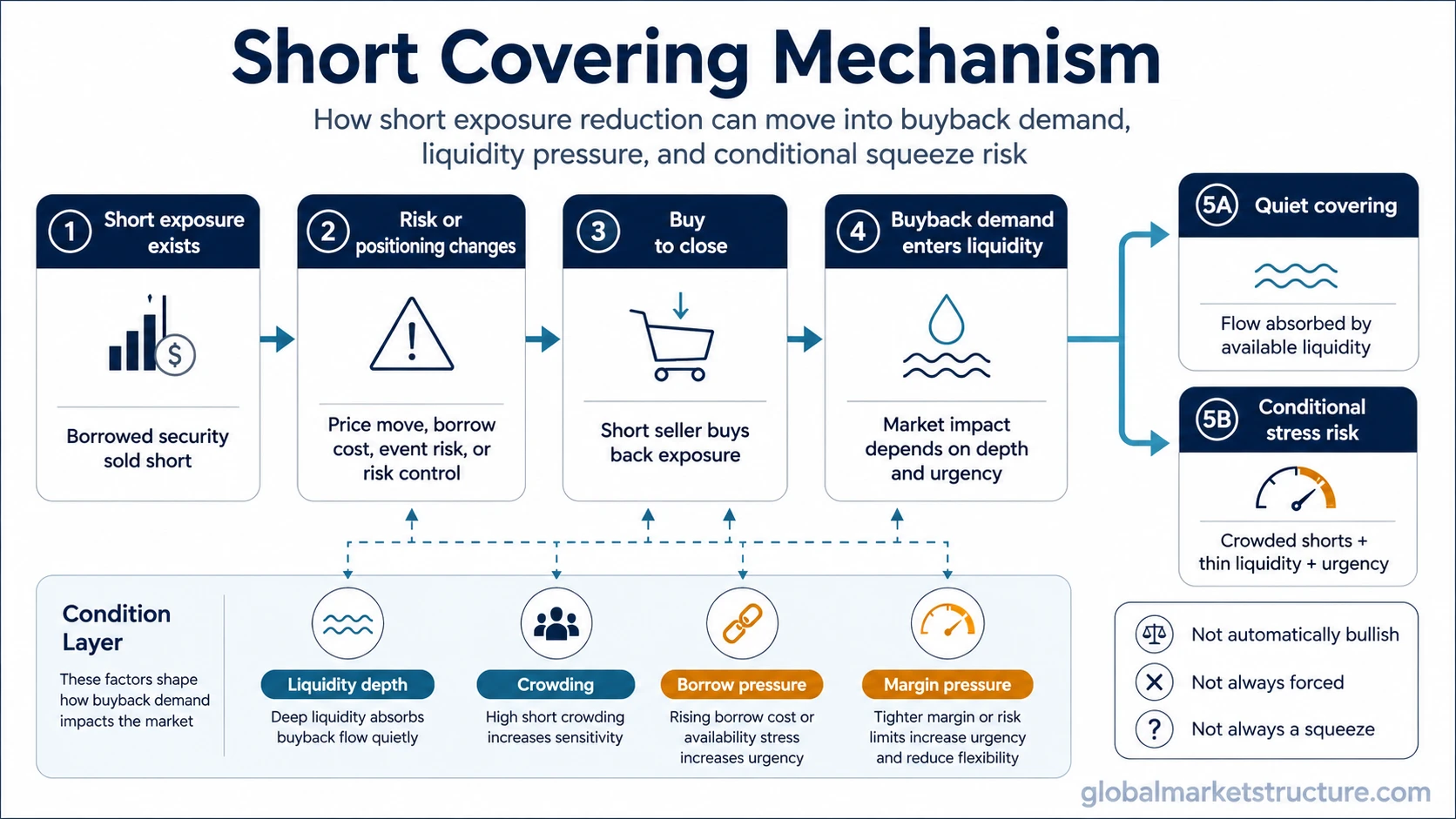
How Short Covering Works
A stock short sale normally begins with borrowed shares being sold into the market. Closing the position reverses that exposure: the short seller purchases shares and returns the borrowed securities to the lender.
The covering trade can close a profitable short after the price has fallen or close a losing short after the price has risen. Buying to cover therefore describes the closing action, not whether the original trade was profitable.
Similar language is also used in derivatives markets, although the mechanics differ. A short futures position, for example, can be closed through an equal and opposite purchase rather than by returning borrowed stock.
Voluntary and Stress-Driven Covering
- The short seller chooses to reduce or close the position.
- The decision may follow a profit target, a changed view, lower expected reward, or a desire to reduce event risk.
- Execution can remain orderly when liquidity is sufficient and there is no immediate financing constraint.
- The position becomes harder or more expensive to maintain as price, borrow, margin, or risk conditions deteriorate.
- Buyback demand can become more urgent when several constraints affect the short side at the same time.
- Price impact becomes more sensitive to available liquidity and the concentration of similar positions.
Conditions That Change the Market Impact
| Condition | Effect on covering | Market-impact implication |
|---|---|---|
| Deep liquidity | Buy-to-close orders can be absorbed more easily. | Price impact may remain limited unless the covering flow is unusually large. |
| Thin liquidity | Available sell-side depth is smaller relative to incoming buyback demand. | The same amount of covering can produce a larger price response. |
| High short interest | More outstanding short exposure exists that could eventually be reduced. | It increases the pool of potential covering but does not determine when that covering will occur. |
| Higher borrow cost or tighter availability | Maintaining the short can become less attractive or more difficult. | Pressure rises if many positions face similar financing constraints. |
| Margin pressure | Additional equity or lower exposure may be required. | Covering can become more urgent when the position is already moving against the short seller. |
| Crowded short positioning | Many participants may need to reduce similar exposure during the same period. | Simultaneous buyback demand can become harder for available liquidity to absorb. |
Short Covering vs Short Squeeze and Short Interest
Short covering is the closing action. A short squeeze is a more specific pressure dynamic in which adverse price movement or borrowing pressure pushes short sellers toward covering and the resulting purchases can add further upward price pressure.
| Concept | What it measures or describes | Boundary |
|---|---|---|
| Short covering | Purchasing to reduce or close an existing short position. | A transaction or position-closing action. |
| Short squeeze | A pressure dynamic in which covering can reinforce an adverse move against short sellers. | A possible outcome of stressed covering, not a synonym for every covering trade. |
| Short interest | Outstanding short positions measured at a reporting point. | A stock of existing exposure rather than evidence that those positions are currently being covered. |
Can Public Data Confirm Short Covering?
Investor.gov describes a conventional stock short as a position that is typically closed by purchasing the security and returning the borrowed shares. The purchase itself does not reveal why the buyer entered the market.
FINRA distinguishes short interest from short-sale volume, so neither series should be treated as direct proof that a particular price move came from covering. In futures, CFTC open-interest definitions help identify whether outstanding positions are being reduced, but open interest alone does not identify whether shorts, longs, or both sides are exiting.
Short Covering, Margin Calls, and Forced Liquidation
Short covering can occur without a collateral event. A margin call is a separate equity or collateral shortfall condition that can make exposure reduction more urgent.
Forced liquidation describes involuntary position reduction under the applicable broker, lender, or risk rules. A forced reduction of short exposure can involve covering, but ordinary short covering does not require forced liquidation.
Interpretation Limits
Covering changes order flow because short sellers become buyers when they close positions. Whether the resulting move persists depends on what demand remains after that covering is absorbed. A rally can continue if other buyers participate, stall when buyback demand fades, or develop into a more severe squeeze if short-side pressure intensifies.