
Forced liquidation is the involuntary closing, sale, or reduction of leveraged exposure when margin, collateral, or risk requirements can no longer support the position. The resulting market flow can be selling or buying, depending on the exposure being closed. Broader market pressure depends on how much liquidation occurs, how concentrated it is, and how easily available liquidity can absorb it.
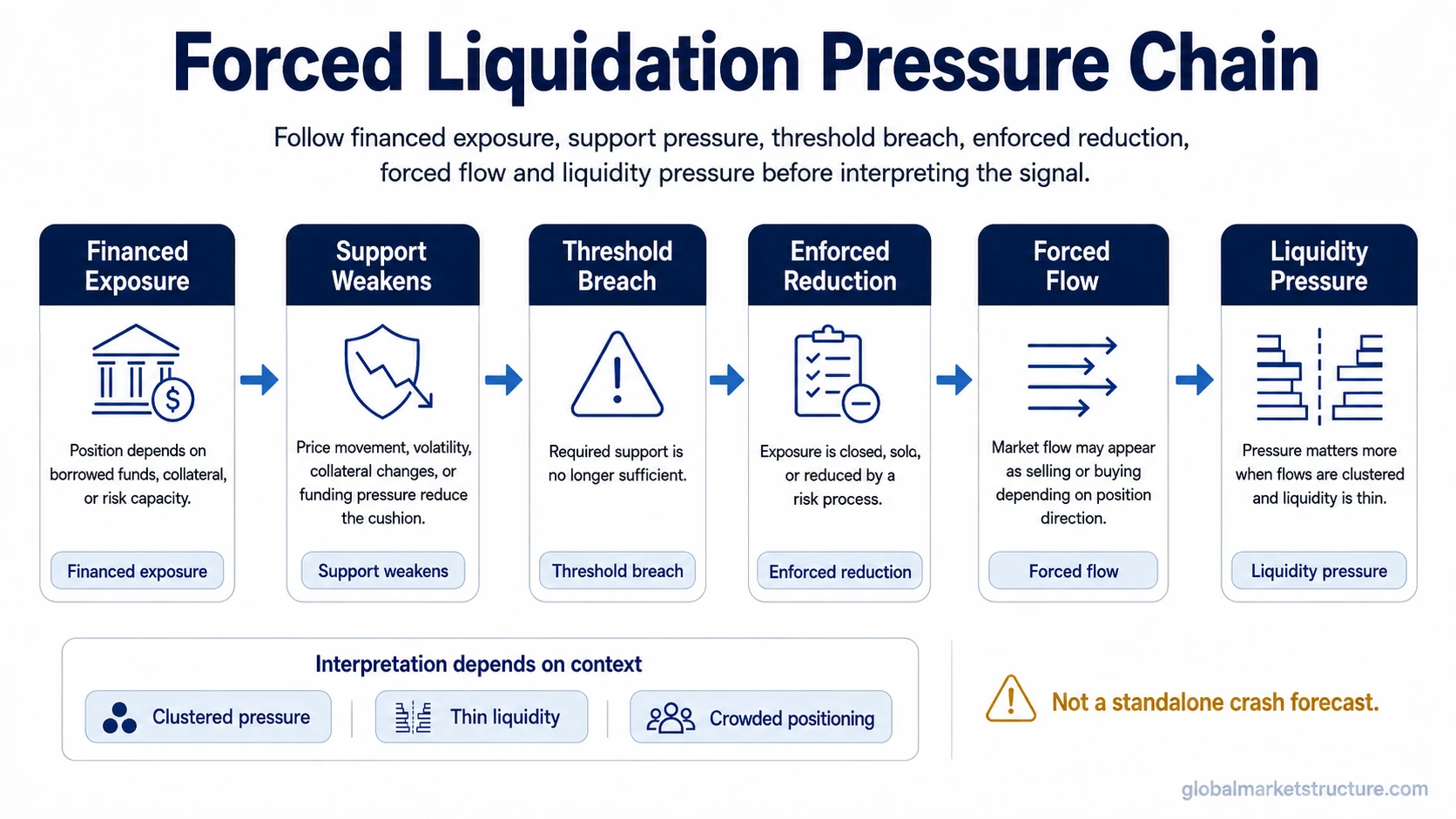
Forced Liquidation in Market Structure
The defining feature is loss of discretion over some or all of the position. Exposure is reduced because an applicable margin, collateral, financing, exchange, broker, clearing, or risk-control condition requires it.
| Concept | Meaning | Boundary from forced liquidation |
|---|---|---|
| Leverage | Exposure that is large relative to the capital directly supporting it. | Leverage creates sensitivity to losses and financing constraints, while forced liquidation describes an involuntary reduction of the resulting exposure. |
| Margin debt | Borrowed funds used to finance securities positions. | Margin debt is financed exposure. Forced liquidation is one possible outcome when the applicable support for that exposure becomes insufficient. |
| Liquidation cascade | A sequence in which multiple liquidations occur while market conditions are already under pressure. | A cascade is a possible clustered outcome rather than another definition of forced liquidation. |
| Forced liquidation value | A valuation concept used in appraisal or distressed-sale contexts. | It concerns the value obtainable under a forced-sale premise rather than the involuntary closing of leveraged market positions. |
How Forced Liquidation Works
The exact rules vary across brokers, exchanges, products, clearing arrangements, and financing structures. The common market-structure sequence is narrower:
- Leveraged or collateralized exposure exists. The position depends on margin, financing, collateral, or available risk capacity.
- Support weakens. An adverse price move, higher margin requirement, collateral deterioration, volatility change, or another risk constraint reduces the available cushion.
- An applicable threshold is breached. The position no longer satisfies the requirement that supports it.
- Exposure is reduced involuntarily. The broker, lender, exchange, clearing process, or risk system closes or reduces the position under its applicable rules.
- The resulting order flow reaches the market. The direction and price impact depend on the position being closed and the liquidity available to absorb the adjustment.
Margin Calls and Forced Liquidation
A margin call identifies a deficiency or requirement for additional support. Forced liquidation describes the involuntary position reduction that can follow when the applicable rules permit or require the position to be reduced.
| Question | Margin call | Forced liquidation |
|---|---|---|
| What is happening? | The account has a margin, equity, or collateral deficiency that must be addressed. | Exposure is being closed or reduced under the applicable rules. |
| Can the account holder still act? | Possibly, depending on the account agreement, provider, product, and timing. | The account holder may no longer control the timing or size of the portion being liquidated. |
| Does a market order necessarily appear immediately? | No. A call identifies the deficiency rather than a universal execution sequence. | Position reduction can create market flow, although the execution process varies by venue and product. |
| Main interpretation boundary | A margin call does not establish that liquidation will occur. | Forced liquidation does not establish that broader market stress will follow. |
Forced Selling and Forced Buying
- Reducing the position generally requires selling the asset or closing the long exposure.
- The resulting flow can add supply to the market.
- Price impact depends on the size and urgency of the reduction relative to available liquidity.
- Reducing a short position can require buying back the security or otherwise closing the short exposure.
- The resulting flow can add buying demand rather than selling pressure.
- Forced closure of short exposure can overlap with short-covering.
What Institutional Sources Establish
The CFTC glossary defines forced liquidation as the liquidation of a customer’s open positions by the brokerage firm holding the account, commonly in an under-margined account. FINRA guidance adds an important boundary for brokerage accounts: firms can in some circumstances liquidate positions without advance notice rather than waiting for a customer to meet a previously communicated deadline.
At the broader market level, the Financial Stability Board notes that large or unexpected margin and collateral calls during stress can amplify liquidity demand across market participants. That supports a conditional market-structure interpretation rather than treating every individual liquidation as a systemic event.
When Forced Liquidation Becomes Broader Market Pressure
One or more positions are reduced because margin, collateral, financing, or risk constraints require it.
Deep liquidity can absorb some forced flow. Thin liquidity, crowded positioning, or simultaneous constraints leave less capacity to absorb the same adjustment.
The broader signal strengthens when liquidations become clustered and coincide with deteriorating liquidity or wider evidence of financing and collateral stress.
Interpretation Limits
An isolated liquidation can remain an account-level event when market depth is sufficient. A cluster of liquidations can create stronger pressure, but the outcome still depends on position direction, available liquidity, the scale of the flow, financing conditions, and how other market participants respond. Platform-specific liquidation prices and procedures should be interpreted under the rules of the relevant account, venue, or product.