
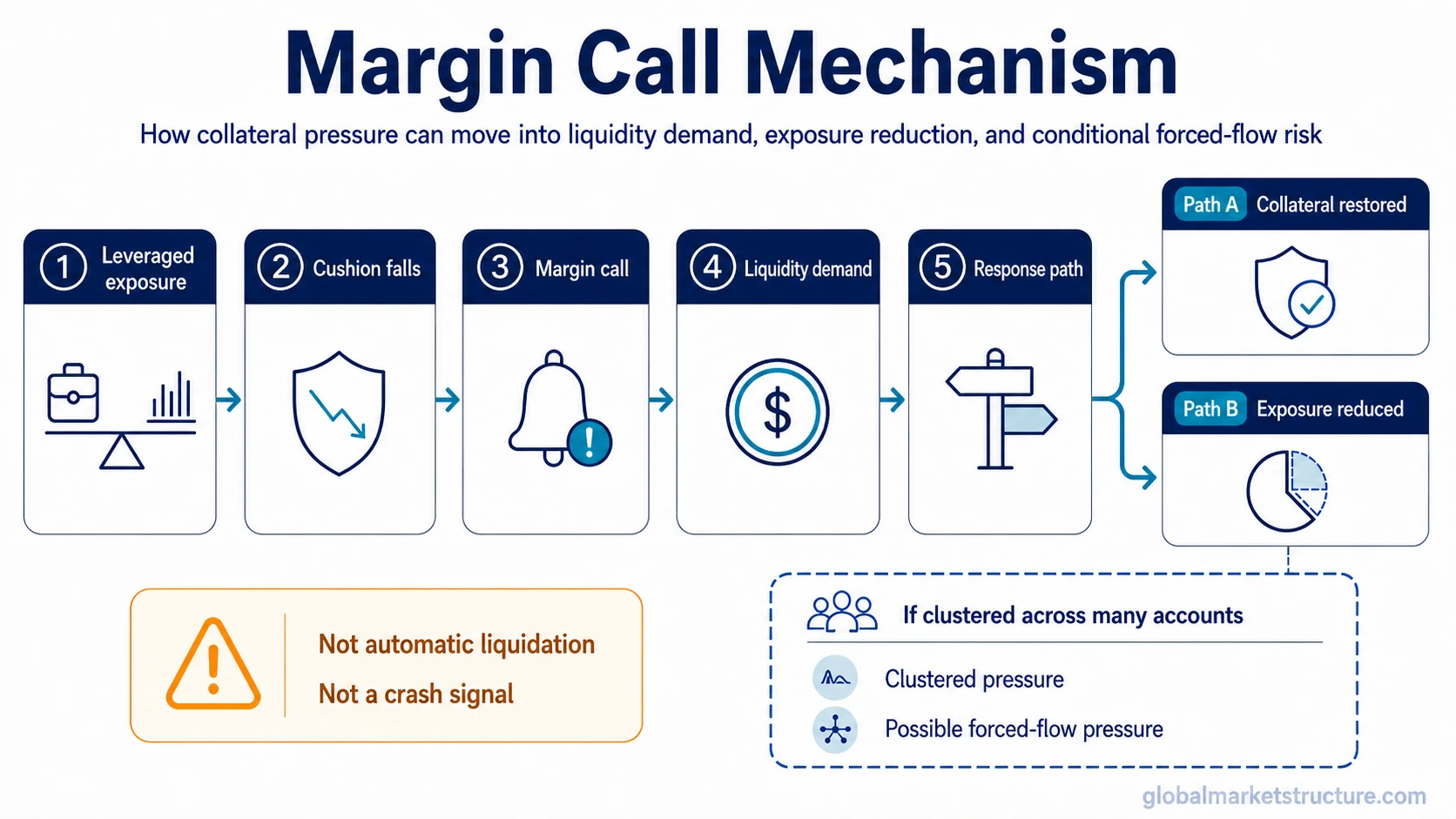
A margin call is a demand to restore required equity or collateral after a margin account falls below an applicable requirement. The shortfall can follow a decline in financed assets, an adverse move in a short position, or a change in the requirement itself. The call identifies an account-level collateral problem. The response depends on the account agreement, product, broker or lender, and applicable rules.
What Triggers a Margin Call
A margin account has to satisfy the margin conditions that apply to the account and position. A financed long position can create a shortfall when asset values decline. A short position can create pressure when the borrowed security rises in value. A call can also result when the applicable margin requirement increases.
For U.S. brokerage margin accounts, FINRA guidance on margin calls notes that calls can follow falling account equity or higher house margin requirements, and that firms can raise those house requirements without advance written notice. Investor.gov also notes that a brokerage firm may sell securities to cover a shortfall without informing the customer in advance. These rules should not be generalized into one universal grace period or broker procedure.
Margin Call vs Related Leverage Concepts
| Term | What it describes | Boundary |
|---|---|---|
| Margin call | A demand associated with an equity, margin, or collateral deficiency. | The call identifies the shortfall condition. It does not describe every action that may follow. |
| Margin requirement | The required level of equity, margin, or collateral. | The requirement defines the condition the account must satisfy. |
| Margin debt | Borrowing used to finance securities positions in margin accounts. | It describes financed exposure rather than the shortfall event. |
| Forced liquidation | The involuntary closing or sale of positions under the applicable account or risk rules. | It is a separate event from the margin call and can occur without the customer controlling the timing. |
| Deleveraging | The broader reduction of borrowed or financed exposure. | A margin call can contribute to deleveraging, but deleveraging can also occur without a margin call. |
A Simple Margin Call Example
Suppose an account holds financed assets worth 100 units with 40 units of equity and 60 units of borrowing. Equity initially represents 40% of the account value.
If the assets fall to 80 while the borrowing remains 60, account equity falls to 20 units, or 25% of the account value. If the applicable maintenance requirement is above 25%, the account has a margin deficiency and a margin call may result under the applicable rules.
The numbers are illustrative. Actual requirements and firm procedures vary by account, product, provider, and jurisdiction.
Margin Calls in Long and Short Exposure
- A decline in the financed asset reduces account equity while the borrowing may remain unchanged.
- A deficiency appears if the remaining equity falls below the applicable requirement.
- A rise in the borrowed security moves against the short position and can reduce available account equity relative to the required margin.
- Additional equity or collateral may be required to continue supporting the exposure.
If a short seller reduces the position by buying back the borrowed security, that adjustment is short covering. A margin call can contribute to that response, but the existence of a call alone does not establish a short squeeze.
What Can Happen After a Margin Call
Depending on the applicable rules, a shortfall may be addressed by adding cash or eligible securities, reducing exposure, or liquidating positions. The available choices and timing are account-specific. A firm may also have contractual or regulatory rights to reduce positions without waiting for the customer to act.
Why Margin Calls Matter for Market Structure
A single margin call is generally an account-level event. The market-structure relevance increases when margin and collateral demands become large or clustered enough to create simultaneous demand for cash, eligible collateral, or lower exposure. The Financial Stability Board notes that spikes in margin and collateral calls during market stress can amplify liquidity demand when they affect a sufficiently large part of the market.
Broader market pressure depends on scale, concentration, available liquidity, collateral conditions, and whether many participants need to adjust exposure during the same period. A local account shortfall can therefore remain local even when the underlying market is volatile.