
Labor force participation rate is the share of a relevant population that is either employed or actively looking for work. In US BLS/CPS framing, it equals (labor force / civilian noninstitutional population) x 100. It differs from the unemployment rate because unemployment is measured only inside the labor force, while participation uses the broader population base.
For macro interpretation, participation helps separate joblessness from labor-force attachment. A low unemployment rate can look stronger when fewer people are counted inside the labor force, while a high participation rate can reflect more people working or actively searching for work.
Key Points
- Labor force participation rate measures attachment to the labor force, not unemployment alone.
- The US formula is (labor force / civilian noninstitutional population) x 100.
- A falling unemployment rate can be misleading if participation also falls.
- Demographics, definitions, age groups, and source methodology matter when comparing participation rates.
- LFPR supports macro context; it should not be treated as a recession, policy, or asset-direction forecast.
Labor Force Participation Rate Definition
Definition: Labor force participation rate measures the percentage of the relevant population that is in the labor force. The labor force includes people who are employed and people who are unemployed but actively looking for work.
Formula: Labor force participation rate = (labor force / civilian noninstitutional population) x 100 in US BLS/CPS framing.
The indicator is useful because it describes whether people are attached to work or active job search. It does not show how many people are employed by itself, and it does not say whether a labor market is strong without other indicators.
What Counts as the Labor Force
The numerator is the labor force. It includes employed people and unemployed people who are actively looking for work. People outside the labor force are not counted in that numerator, even if they might want a job under different conditions.
The denominator depends on the statistical source. In US BLS/CPS framing, the denominator is the civilian noninstitutional population. International sources may use different age cutoffs, population bases, reference periods, or survey definitions, so cross-country comparisons need a source-definition check before interpretation.
In a broader labor market reading, this distinction matters because the same unemployment rate can mean different things when participation is rising, falling, or concentrated in particular age groups.
Labor Force Participation Rate Formula
US formula: Labor force participation rate = (labor force / civilian noninstitutional population) x 100.
Labor force: employed people + unemployed people actively looking for work.
Denominator: civilian noninstitutional population in US BLS/CPS framing.
A simple hypothetical case is a population base of 100 people, with 60 people employed and 4 people unemployed but actively looking for work. The labor force is 64, so the labor force participation rate is 64 percent. Those numbers are hypothetical and are not a current data value.
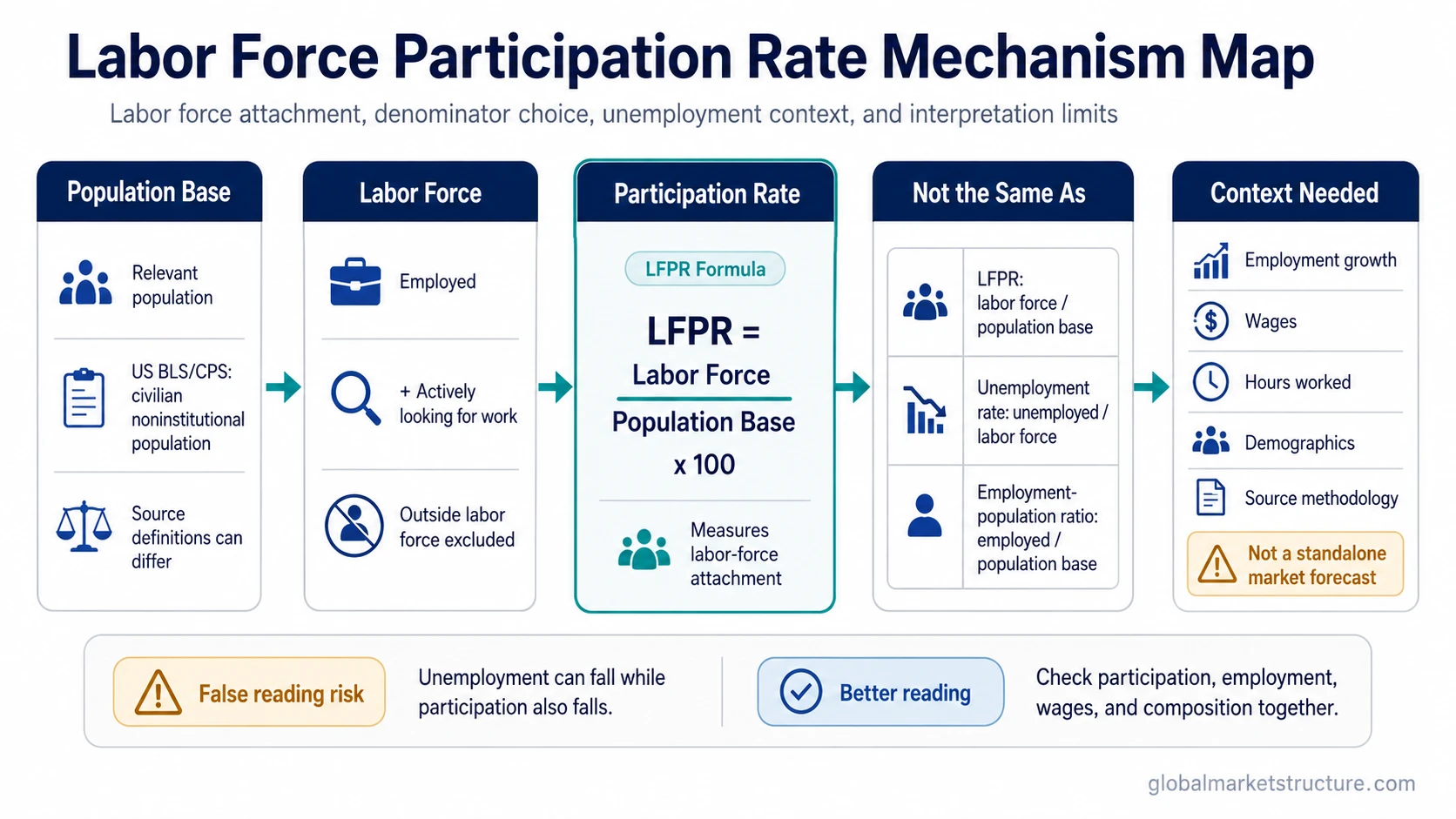
Labor Force Participation Rate vs Unemployment Rate vs Employment-Population Ratio
Labor force participation rate is often confused with the unemployment rate, but the denominators are different. Participation uses the broader population base. Unemployment uses the labor force. Employment-population ratio uses employed people against a population base.
| Indicator | Numerator | Denominator | What it helps show | Main limitation |
|---|---|---|---|---|
| Labor force participation rate | Employed plus unemployed actively looking | Relevant population base, in US BLS/CPS framing civilian noninstitutional population | Labor-force attachment and labor supply | Does not show how many people are actually employed by itself |
| Unemployment rate | Unemployed actively looking | Labor force | Joblessness among people in the labor force | Can fall if people leave the labor force |
| Employment-population ratio | Employed people | Relevant population base | Share of population actually employed | Does not show active job search among non-employed people |
Why Participation Changes Labor-Market Interpretation
Participation changes the reading of labor-market strength because it affects the size of the labor force. When participation rises, more people are working or actively looking for work. When participation falls, fewer people are counted as attached to the labor force.
This affects how unemployment, wage pressure, income, consumption demand, and policy context are interpreted. A participation increase can expand labor supply and change wage pressure. A participation decline can make labor-market slack harder to see if the unemployment rate is read alone.
Participation also interacts with real wages because wage gains, inflation, and household purchasing power can influence whether labor-market conditions translate into stronger or weaker income pressure.
False Reading: Falling Unemployment With Falling Participation
Illustrative scenario: Unemployment falls while labor force participation also falls. The headline unemployment rate may look stronger, but the participation decline can suggest that some people left or remained outside the labor force. The interpretation improves only after checking employment growth, wages, prime-age participation, and broader labor-market context.
The mistake is treating a lower unemployment rate as a complete labor-market signal. If people stop looking for work, they may no longer be counted as unemployed. That can reduce the unemployment rate even when the underlying labor-market picture is less strong than the headline suggests.
The reverse can also happen. Participation can rise because more people are entering or re-entering the labor force. That can temporarily keep unemployment elevated even when job creation is improving, because the labor force itself has expanded.
Demographic and Measurement Limitations
Participation is not a single-cause signal. It can move because of retirement, aging, school enrollment, disability status, household decisions, discouraged workers, immigration, labor-market incentives, survey definitions, and cyclical job availability.
Headline data can hide composition. Prime-age participation, age groups, gender breakdowns, and country definitions can tell a different story from the headline rate.
International comparisons need source discipline. OECD, World Bank, ILOSTAT, FRED, and BLS data may differ by age base, population definition, source method, and reference period.
These limitations do not make the indicator weak. They define how it should be used. Participation is strongest as a context measure when paired with employment growth, unemployment, wages, hours worked, demographic composition, and source methodology.
How to Use LFPR in Macro Context
Labor force participation rate can help classify labor supply, labor slack, wage pressure, household income conditions, and the policy backdrop. It is especially useful when unemployment alone gives an incomplete picture of labor-market attachment.
A rising participation rate is not automatically good or bad. It can reflect stronger labor-market confidence, financial necessity, demographic shifts, or more people looking for work. A falling participation rate is not automatically recessionary. It can reflect retirement, school enrollment, structural demographics, or cyclical discouragement.
For market interpretation, LFPR should remain one input among many. It does not forecast interest rates, equities, bonds, currencies, recession timing, or risk-asset direction by itself. The signal becomes more useful when combined with employment, wages, inflation, growth, liquidity, and policy conditions.
Current LFPR Data and Source Use
Current labor force participation values should be checked in the official data source used for the analysis. For US data, FRED and BLS are the appropriate live-data routes. For international comparisons, OECD, World Bank, and ILOSTAT definitions should be checked before comparing values.
Current values are time-sensitive, so a durable definition should not lead with an unsourced current rate. The concept remains stable, while the latest data point changes with each release and may use source-specific definitions.
FAQ
What is labor force participation rate?
Labor force participation rate is the percentage of a relevant population that is either employed or unemployed but actively looking for work. In US BLS/CPS framing, it equals (labor force / civilian noninstitutional population) x 100.
What is the labor force participation rate formula?
The US formula is (labor force / civilian noninstitutional population) x 100. The labor force includes employed people and unemployed people actively looking for work.
How is labor force participation different from unemployment rate?
Labor force participation rate uses the broader relevant population base as the denominator. Unemployment rate uses only the labor force as the denominator, so it can fall when people leave the labor force.
Is labor force participation the same as the employment-population ratio?
No. Labor force participation includes employed people and unemployed people actively looking for work. Employment-population ratio uses employed people as the numerator and a population base as the denominator.
Does labor force participation predict markets?
No. Labor force participation can improve macro context, but it is not a standalone forecast for recession, policy decisions, interest rates, equities, bonds, currencies, or risk assets.