
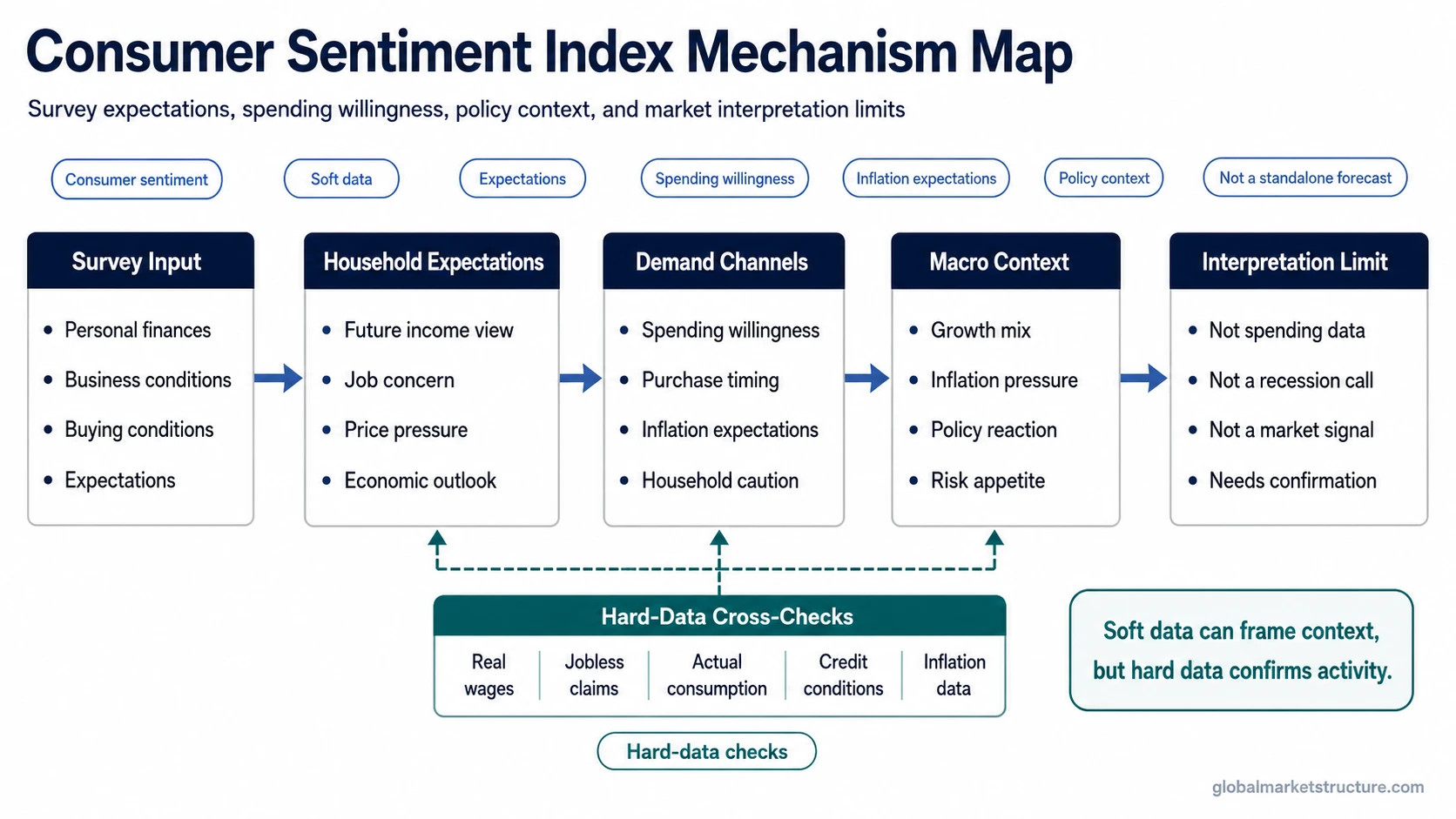
The Consumer Sentiment Index is a University of Michigan Surveys of Consumers measure of household attitudes toward personal finances, business conditions, expectations, and buying conditions. It is survey-based soft data, not spending, income, employment, or inflation data. For market interpretation, it can frame demand pressure and expectations, but it does not forecast recession, policy decisions, or asset direction by itself.
Source and category: The index belongs to the University of Michigan Surveys of Consumers and is best treated as a household-expectations indicator. It helps show how consumers feel about current and future economic conditions, while harder data is still needed to confirm what households are actually doing.
Key Points
- The Consumer Sentiment Index is a University of Michigan survey-based soft-data indicator.
- It reflects household views on finances, business conditions, expectations, and buying conditions.
- It is not the same as consumer spending, employment data, wage data, or actual inflation data.
- It can support macro interpretation, but it should not be used as a standalone market forecast.
What the Consumer Sentiment Index Measures
The Consumer Sentiment Index captures how households describe their current situation and future expectations. The University of Michigan survey framework includes views on personal finances, business conditions, buying conditions, inflation, unemployment, interest rates, and related expectations.
The result should therefore be read as reported household perception, not as a transaction record of what households have already spent.
The index is commonly discussed with two related components: Current Economic Conditions and the Index of Consumer Expectations. The first is closer to how households assess the present environment. The second is closer to how they view the future. Both are useful because sentiment can change before hard spending or labor data fully confirms a shift.
The important boundary is that the index records survey responses. It does not directly measure household income, payrolls, retail sales, credit use, or actual consumption. A sentiment reading can show pressure or confidence in household psychology, but it cannot prove how much consumers will spend.
How to Classify the Index
Consumer sentiment sits in the soft-data layer of macro analysis. Soft data is based on surveys, expectations, confidence, and stated intentions. Hard data is based on measured activity, such as employment, wages, output, prices, sales, and income.
| Question | Consumer Sentiment Index role |
|---|---|
| What does it measure? | Household attitudes about current conditions, expectations, personal finances, business conditions, and buying conditions. |
| What does it not measure? | Actual consumer spending, actual wages, payroll employment, realized inflation, market returns, or policy decisions. |
| What can it help interpret? | Spending willingness, household caution, inflation expectations, demand pressure, and growth-inflation-policy context. |
| What should be checked alongside it? | Labor conditions, real income pressure, actual consumption data, inflation expectations, credit conditions, and policy context. |
Consumer Sentiment Index vs Consumer Confidence Index
The Consumer Sentiment Index and the Consumer Confidence Index are related, but they are not the same survey. The Consumer Sentiment Index is published by the University of Michigan Surveys of Consumers. The Consumer Confidence Index is a separate Conference Board survey product.
The distinction matters because both indicators can appear in market commentary under the broad label of consumer mood. That shortcut can blur methodology, source identity, and interpretation. A drop in one survey does not automatically mean the other survey is sending the same message, and neither survey is the same as actual consumer spending.
Clean boundary: Consumer sentiment is a University of Michigan survey-based expectations input. Consumer confidence is a separate Conference Board survey. Consumer spending is realized expenditure behavior. Aggregate demand is the broader economy-wide demand concept.
How Consumer Sentiment Enters Market Interpretation
Consumer sentiment becomes more useful when it is read as part of a wider macro mix. Weak sentiment can suggest that households feel pressure from prices, income uncertainty, interest rates, or future job concerns. Strong sentiment can suggest better perceived household conditions, but it still needs confirmation from actual activity data.
For demand analysis, the index helps explain why spending willingness may soften or improve before the shift appears clearly in hard data. For inflation interpretation, survey answers matter because expectations can shape price sensitivity, wage demands, and purchase timing, but those channels remain conditional rather than mechanical.
Purchasing-power context is especially important. A weak sentiment reading carries a different meaning if Real Wages are also under pressure than if real income is improving and actual consumption remains resilient.
For markets, sentiment should remain a context input. It can influence how investors read growth risk, earnings sensitivity, risk appetite, and policy reaction, but it does not tell the market what to do next. The same sentiment reading can be interpreted differently depending on inflation, yields, credit, liquidity, labor data, and the broader regime.
Common False Reading
Weak sentiment does not automatically confirm recession. Households can report poor sentiment while spending continues, labor data remains stable, or income conditions improve. The opposite can also happen: sentiment can improve before hard data fully strengthens.
Strong sentiment does not automatically mean risk assets should rise. If stronger sentiment appears alongside sticky inflation pressure or higher rate expectations, the policy interpretation may be different from a clean growth-positive reading.
Sentiment is not a trading signal. It helps frame household expectations and macro context. It does not provide buy, sell, timing, target, or asset-direction instructions.
Why Sentiment Can Conflict With Hard Data
Survey data and measured activity often move at different speeds. Households may feel worse because prices are high, credit is expensive, or future conditions feel uncertain, while current spending remains supported by employment, savings, credit access, or wage growth.
The reverse can also occur. Sentiment may recover before hard data clearly improves if households expect inflation relief, better income conditions, or less uncertainty. That is why the index is useful as an expectations input, but risky as a standalone conclusion.
A cleaner interpretation compares the sentiment reading with labor-market evidence, purchasing-power pressure, inflation expectations, credit conditions, and actual consumption. Agreement across several areas makes the macro message stronger. Divergence means the reading should stay provisional.
Source and Data Endpoint Note
Latest official release readings belong with the University of Michigan Surveys of Consumers. FRED is useful as a primary data-series endpoint for historical lookup, metadata, and charting, but its UMCSENT series may lag the source release.
For an evergreen macro page, the stronger role is concept interpretation: what the Consumer Sentiment Index is, what it can show, what it cannot show, and how it should be checked against the rest of the labor, income, demand, and policy picture.
Related Macro Checks
Consumer sentiment should not be read in isolation. Labor-market deterioration can make weak sentiment more serious, while stable labor conditions can reduce the immediate force of a negative survey reading. A common cross-check is Initial Jobless Claims, because claims data can show whether labor stress is appearing in measured data rather than only in household attitudes.
The next layer is purchasing power. If sentiment weakens while real income pressure rises, the demand interpretation becomes more fragile. If sentiment weakens while household income and actual spending stay firm, the reading may show anxiety rather than immediate demand contraction.
The broader macro use is to compare soft expectations with hard evidence. The Consumer Sentiment Index is strongest when it helps explain a gap between how households feel and what the rest of the economic data is confirming.
FAQ
What is the Consumer Sentiment Index?
The Consumer Sentiment Index is a University of Michigan survey-based indicator of household attitudes about personal finances, business conditions, expectations, and buying conditions. It is soft data, not a direct measure of actual spending or market direction.
What does the Consumer Sentiment Index measure?
It measures survey responses about how consumers view current and expected economic conditions. Its scope includes personal finances, business conditions, buying conditions, and expectations that can affect household behavior.
Is consumer sentiment the same as consumer confidence?
No. Consumer sentiment usually refers to the University of Michigan survey, while consumer confidence usually refers to a separate Conference Board survey. They are related indicators, but they are not the same product.
Does weak consumer sentiment predict a recession?
Weak sentiment can warn that households feel pressure, but it does not confirm recession by itself. Recession interpretation requires broader evidence from labor data, income, production, credit, spending, and financial conditions.
Where should the latest Consumer Sentiment reading be checked?
Latest official release readings are better checked through the University of Michigan Surveys of Consumers. FRED can be useful for historical lookup, metadata, and charting, but the UMCSENT series may lag the source release.