
A liquidity crisis is a stress condition in which demand for cash, financing, or tradable market depth exceeds what participants can access at workable terms. Funding can become harder to obtain, market depth can weaken, collateral pressure can rise, and participants may have to sell assets to meet immediate liquidity needs.
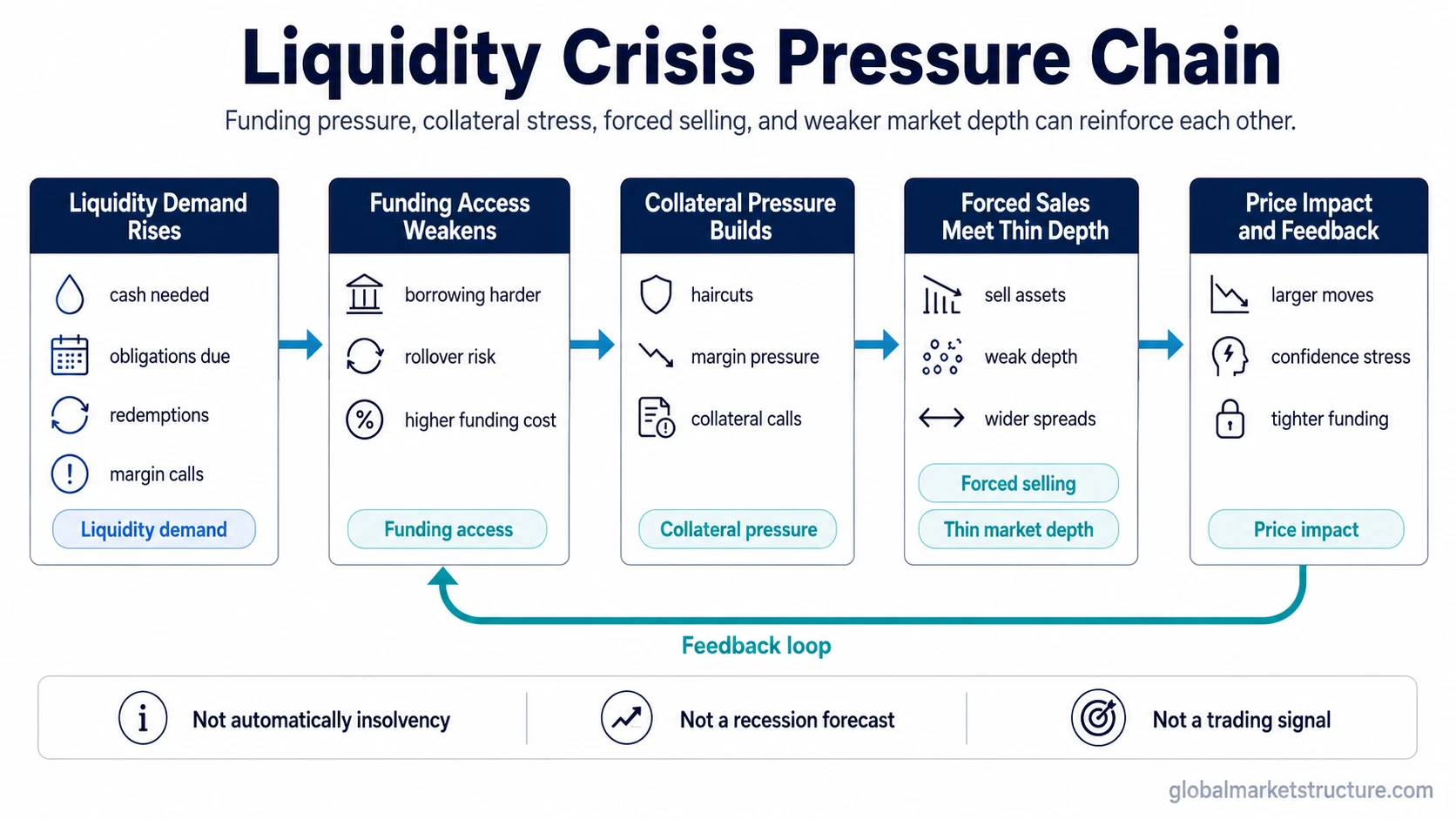
How Liquidity Stress Can Escalate
A crisis does not require every channel to fail at the same time. The stress becomes broader when difficulty obtaining liquidity begins to affect financing, collateral, asset sales, or market functioning.
Participants need cash to meet obligations, cover withdrawals, post collateral, roll financing, or reduce exposure.
Borrowing becomes harder, financing terms worsen, or collateral requirements increase.
Participants that cannot obtain enough cash through normal funding channels may have to reduce positions or sell assets.
If buyers or intermediaries reduce risk capacity, larger transactions can require greater price concessions.
Lower asset values, weaker execution conditions, or additional collateral needs can create new liquidity demand elsewhere in the system.
The Federal Reserve Bank of New York separates funding liquidity, the ability to raise cash through borrowing, from market liquidity, the cost and speed of trading an asset. It also describes a negative feedback dynamic in which weaker funding liquidity reduces the willingness to provide market liquidity, while weaker market liquidity can further impair funding. Basel liquidity guidance similarly requires institutions to consider interactions between funding and market liquidity risk. Source: Federal Reserve Bank of New York. Source: Basel Committee.
Liquidity Crisis vs Insolvency
A borrower can have assets or expected cash flows that exceed its liabilities and still be unable to meet a payment when cash is needed. Insolvency concerns whether the underlying asset and cash-flow position is sufficient to cover liabilities over time.
Cash, financing, or readily saleable assets are not available quickly enough to meet current needs.
The underlying assets or expected cash flows are insufficient relative to liabilities.
The IMF makes this distinction explicitly: a debtor may be solvent while still being unable to make a payment when due because usable liquid assets are not available at that moment. Source: International Monetary Fund.
Funding and Market Liquidity During a Crisis
Funding liquidity concerns access to cash and financing. Stress can appear through tighter borrowing terms, difficulty rolling funding, higher collateral requirements, or reduced balance-sheet capacity.
Market liquidity concerns the ability to trade without unusually large cost or price impact. Stress can appear through thinner depth, wider spreads, or larger price moves for a given amount of order flow.
A liquidity crisis can begin in either channel. The broader concern appears when impaired financing access and weaker trading conditions begin to affect one another or spread across institutions and markets.
Liquidity Risk, Liquidity Crisis, and Liquidity Spiral
| Concept | What it describes | Boundary |
|---|---|---|
| Liquidity risk | The possibility that needed liquidity may become unavailable or materially more expensive. | The risk can exist before a crisis develops. |
| Liquidity crisis | A stress state in which normal access to cash, funding, or tradable market depth becomes materially impaired relative to liquidity demand. | The crisis describes the broader condition, not one specific transmission mechanism. |
| Liquidity spiral | A reinforcing feedback mechanism involving funding pressure, asset sales, price impact, collateral stress, or weaker market liquidity. | A spiral can intensify crisis conditions, but a liquidity crisis does not require that feedback loop to be present. |
When the Liquidity Crisis Label Is Too Strong
Prices fall, volatility rises, or risk appetite weakens.
Funding access tightens, collateral pressure rises, market depth deteriorates, or participants sell because liquidity is needed.
Without evidence of impaired liquidity channels, the move is better described as a selloff or localized liquidity pressure rather than a confirmed liquidity crisis.
How to Observe Liquidity Stress
No single market measure establishes a liquidity crisis. Funding terms, collateral conditions, market depth, spreads, price impact, and liquidity-driven selling describe different parts of the stress environment.
Detailed trading-liquidity measurement belongs in How to measure market liquidity. Crisis analysis requires the measurement evidence to be combined with the funding and balance-sheet context in which the stress is occurring.
The severity and persistence of the stress depend on funding structures, collateral, balance-sheet capacity, market depth, counterparty behavior, and any private-sector or policy response. Liquidity stress can interact with solvency and economic weakness without proving either one by itself.