Policy Divergence and Currency Moves

Policy divergence and currency moves connect when markets reprice the relative policy paths between economies. A currency can strengthen or weaken as expected yield gaps, real yields, carry appeal, hedging costs, capital flows, positioning and broad dollar pressure shift. The limitation is important: a higher nominal rate does not automatically make a currency stronger.

The useful interpretation is relative, not absolute. A central bank that is expected to keep policy tighter than another may create a return advantage for its currency, but that advantage can be reduced or reversed by inflation, growth risk, safe-haven demand, policy credibility or crowded positioning.

Key Points

  • Divergent policy paths can affect currencies by changing expected relative returns between economies.
  • Real yields matter because inflation can weaken the signal from nominal interest-rate differences.
  • Carry, hedging costs and capital flows can transmit policy divergence into FX pressure, but risk appetite and positioning can override the simple reading.
  • Policy divergence is an interpretation input, not a currency forecast or trading signal.

Policy Path, Rate Gap and Currency Response

Policy-path divergence means two central banks are expected to move in different directions, or at different speeds. One may be expected to keep policy restrictive, while another may be expected to ease. That difference can influence expectations for short rates, bond yields and currency funding costs.

Monetary-policy divergence is the broader central-bank path concept. Interest-rate divergence is the yield or rate-spread layer that often carries the signal into currency markets. The currency move is the market response after investors also account for inflation, risk appetite, credibility and positioning.

Definition: Policy divergence affects currencies when differences in expected policy paths change the relative return, funding cost or risk perception attached to holding one currency instead of another.

How Policy Divergence Moves Through FX Markets

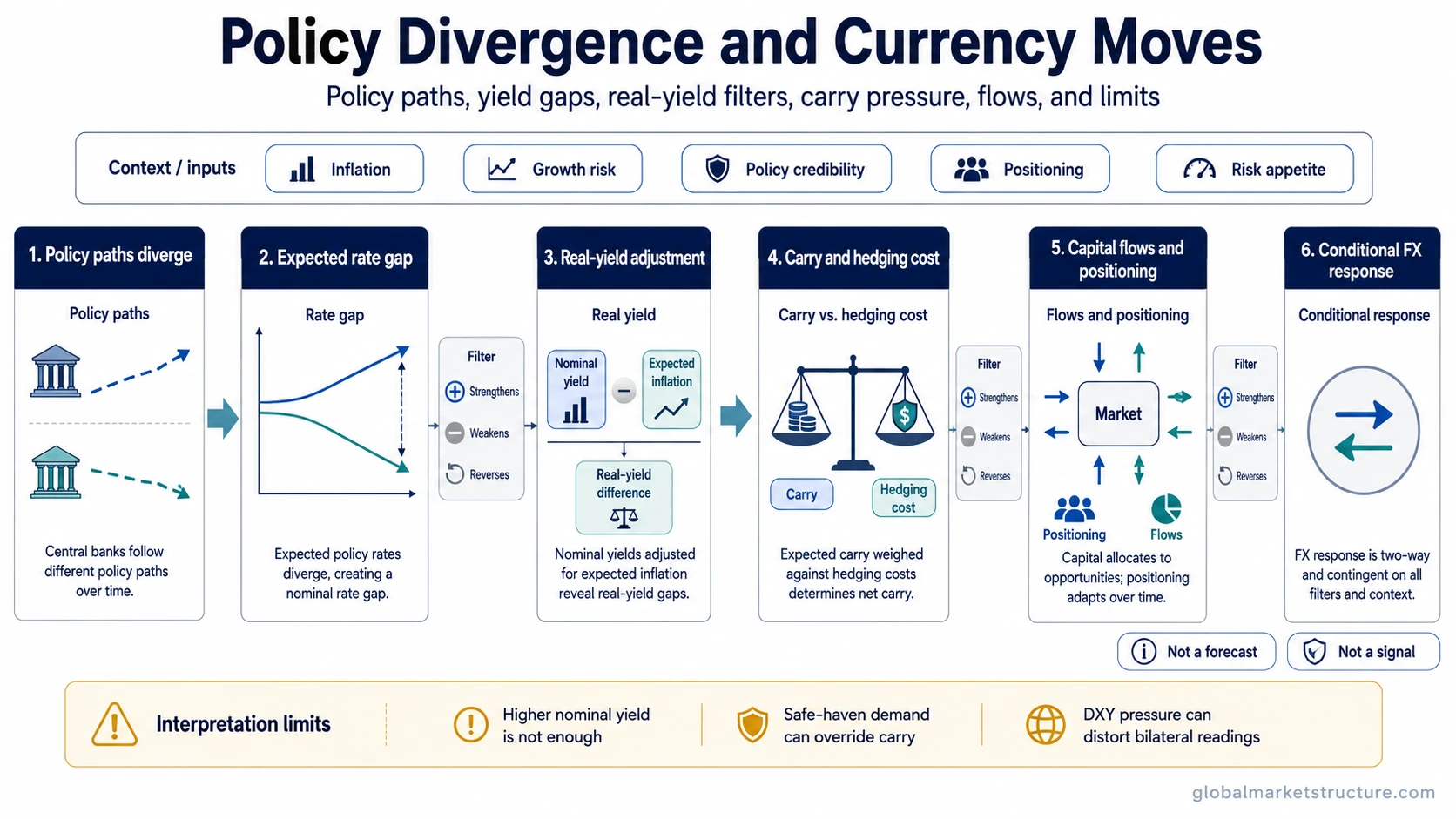
The mechanism usually begins with expected policy paths. If markets expect one central bank to remain tighter while another is expected to cut rates, expected short-rate paths separate. That separation can move front-end yields, yield spreads and forward-rate expectations.

The next layer is the real-yield adjustment. A higher nominal yield can look attractive, but inflation changes the real return. A currency with a higher nominal rate may lose support if inflation is also higher, growth risk is rising, or markets believe policy will not preserve real purchasing power.

Carry and hedging costs then translate the rate gap into portfolio behavior. Investors may prefer a currency with a stronger expected carry profile, but that preference depends on volatility, funding costs and the cost of hedging foreign exposure. A yield advantage that looks large before hedging can look smaller after hedging.

Capital flows and positioning can amplify or mute the move. If international investors shift toward the higher real-yield market, the currency may receive support. If the trade is already crowded, or if global risk appetite deteriorates, the same policy gap may produce a weaker or more volatile currency response.

Broad dollar pressure can also change the reading. When the DXY index is moving because of global dollar demand, safe-haven flows or liquidity stress, bilateral policy divergence may explain only part of the FX move.

Policy divergence currency mechanism linking central bank paths, yield gaps, real yields, carry, capital flows, positioning and risk filters.
Policy divergence can move through yield gaps, real returns, carry, hedging costs, flows and risk filters before the currency response becomes clearer.

Signal, FX Interpretation and Limitation

Signal Possible FX Interpretation Limitation
One central bank is expected to stay tighter for longer The currency may gain relative return support if markets believe the policy path is credible. The signal weakens if inflation remains high, growth risk rises or the market has already priced the divergence.
Nominal yield gap widens The higher-yielding currency may attract carry-sensitive flows. Real yields, hedging costs and volatility can reduce or reverse the apparent advantage.
Real-yield advantage improves The currency may receive stronger support than from nominal yields alone. Policy credibility, external balances and global risk appetite still matter.
Capital flows move toward the tighter-policy market Portfolio demand can support the currency if the flow is durable. Short-term positioning can unwind quickly if risk conditions change.
Safe-haven demand rises Funding and reserve currencies may strengthen even when yield logic points elsewhere. Stress conditions can overwhelm carry and rate-spread interpretation.

The Higher-Rate Currency Can Still Weaken

Common false reading: A higher policy rate or higher bond yield is not enough to conclude that a currency should strengthen. FX markets price relative returns after inflation, expected future policy, growth risk, hedging cost, liquidity demand and positioning.

A higher-rate currency can weaken when markets see the rate advantage as compensation for inflation, fiscal pressure, credibility risk or external vulnerability. It can also weaken when investors reduce risk exposure and prefer a safer or more liquid currency, even if that safer currency offers a lower yield.

The signal becomes cleaner when nominal yield advantage, real-yield advantage, policy credibility, stable risk appetite and supportive capital flows point in the same direction. The signal becomes less reliable when those inputs conflict.

What Changes the Currency Interpretation

Inflation changes the meaning of policy divergence because it determines how much of the nominal yield is preserved in real terms. A central bank may look hawkish, but if inflation is eroding the real return, the currency may not receive durable support.

Growth risk changes the interpretation because tight policy can become a burden if markets believe it will damage activity. In that case, a higher rate may reflect stress rather than strength.

Policy credibility matters because markets distinguish between a central bank that can maintain a path and one that may be forced to reverse. A credible policy gap can support a currency more than a nominal gap that markets expect to disappear.

Positioning matters because crowded trades are vulnerable to reversal. If many investors already hold the higher-yielding currency, new supportive information may have less impact, while negative surprises can trigger sharper unwinds.

Safe-haven demand can dominate the carry channel during stress. When liquidity preference rises, currency behavior may reflect balance-sheet protection and reserve demand more than rate differentials.

Simple Policy Divergence Scenario

One economy is expected to keep rates higher while another is expected to cut. At first, the higher-rate currency gains support because investors expect a wider yield gap. Later, inflation in the higher-rate economy remains stubborn, growth indicators weaken, and hedging costs rise for foreign investors. The nominal rate advantage is still visible, but the real return and risk-adjusted appeal are less attractive.

In that situation, the currency response can flatten, reverse or become more volatile. The important distinction is not whether one policy rate is higher. The stronger question is whether the full set of relative returns, inflation, credibility, flow pressure and risk conditions still supports the same interpretation.

Related Concepts That Clarify the Reading

Policy divergence is the starting point when the main issue is the difference between central-bank paths. Rate divergence becomes more relevant when the market is focused on yield spreads, curve pricing and real-yield differences. Dollar-index context becomes useful when broad dollar pressure is shaping multiple FX pairs at the same time.

Together, those concepts help separate the policy signal from the market response. A currency move can reflect policy divergence, but it can also reflect liquidity demand, positioning stress, hedging costs, external balances or global risk appetite.

FAQ

Does policy divergence always make the higher-rate currency stronger?

No. Higher nominal rates can support a currency, but inflation, real yields, growth risk, hedging costs, credibility, positioning and safe-haven demand can change the result.

What is the difference between policy divergence and interest-rate divergence?

Policy divergence refers to different expected central-bank paths. Interest-rate divergence is the rate or yield-spread expression of that difference. Currency movement is the market response after other conditions are priced.

Why can safe-haven demand override yield gaps?

During stress, investors may prioritize liquidity, funding stability and balance-sheet protection. That can support safer or more liquid currencies even when their yield advantage is smaller.