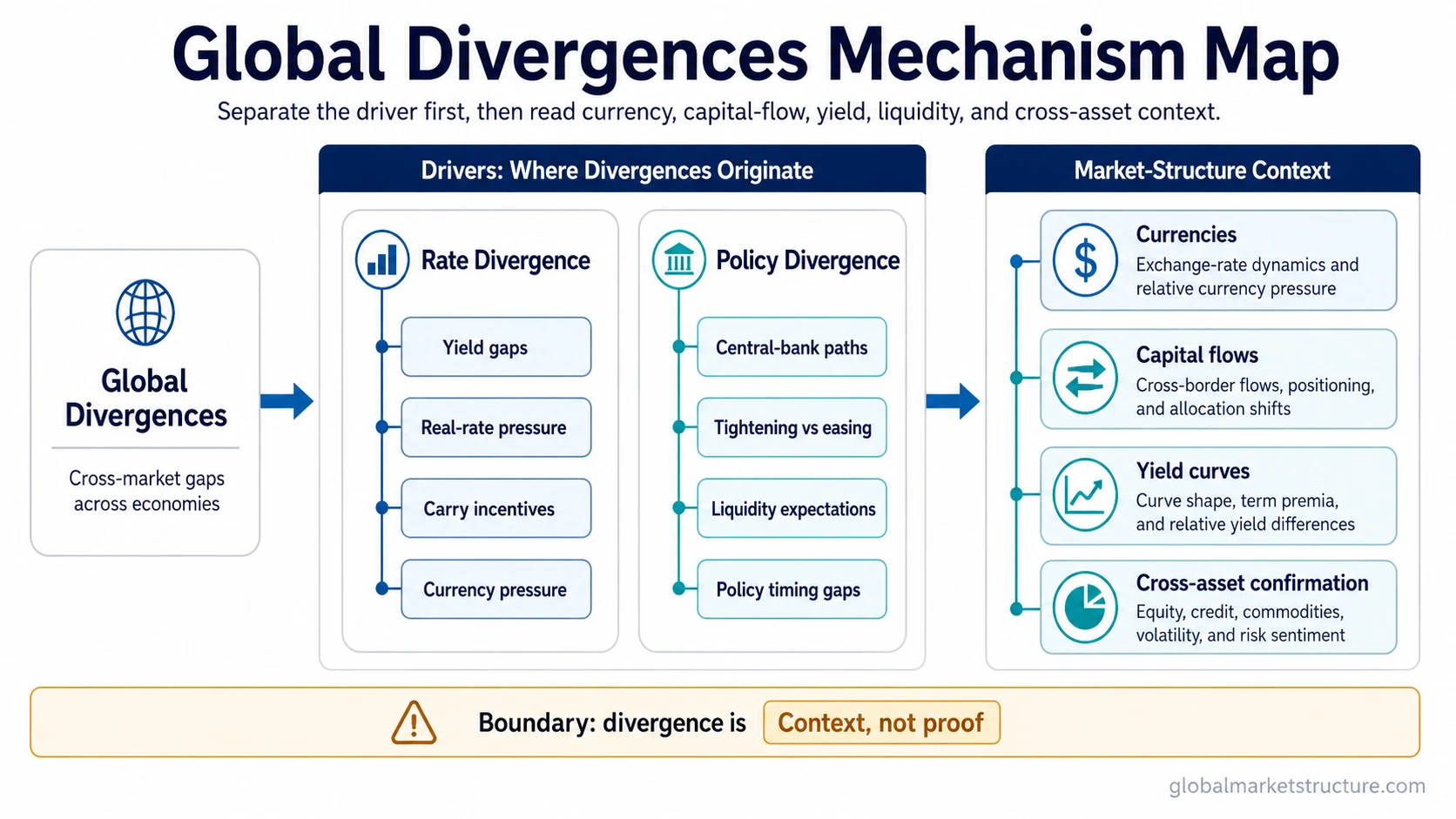
Global divergences appear when major economies stop moving through the same macro environment at the same time. Growth, inflation, policy, rates, currencies, and capital flows begin to separate across countries, so market leadership becomes less synchronized and more regional. In intermarket analysis, that shift matters because cross-asset signals often become clearer when they are read as relative gaps between economies rather than as one global trend, especially when investors are comparing regional leadership, policy direction, and allocation pressure across markets.
These divergences rarely stay contained inside one dataset or one market. A growth gap can change rate expectations. Different policy responses can widen currency moves. Currency repricing can then affect trade competitiveness, imported inflation, and financial conditions. As those adjustments build, cross-border allocation also changes, and the same divergence starts showing up across bonds, equities, currencies, and commodities.
How global divergences usually begin
The first break often appears through growth divergence. When activity, demand, inflation pressure, or earnings sensitivity stop evolving at the same speed across economies, the global cycle no longer looks uniform. Some regions start to lead, while others slow, stabilize later, or face different inflation and policy trade-offs.
That macro separation often becomes easier to observe through rate divergence. Once markets stop pricing one common path for inflation and central bank behavior, sovereign yields, discount rates, and valuation pressure begin to split across countries. That makes relative market performance more dependent on regional macro conditions than on a single global direction.
Why divergence can persist
Policy divergence helps explain why those gaps do not always close quickly. Central banks and fiscal authorities respond to different domestic pressures, so one economy may still be easing while another is tightening, or one may be absorbing a shock that another has not yet faced. When that happens, liquidity conditions, expected policy paths, and risk pricing stop moving in parallel.
Currency divergence is often the fastest market expression of that separation. Exchange rates reprice relative yields, policy credibility, growth resilience, and external balance conditions. Those moves do not simply reflect divergence after the fact. They can also deepen it by changing import prices, trade pressure, and domestic financial conditions.
How divergence moves through markets
Once economies separate across growth, rates, policy, and currencies, investors start expressing those differences through relative allocation. That is where capital rotation becomes important. Flows tend to move toward regions with stronger macro visibility, more attractive real yields, firmer currency support, or more credible policy settings, while weaker regions can lose sponsorship before the full macro slowdown is obvious in headline data.
This is why global divergence is best read as a transmission sequence rather than as a single event. Activity separates first. Rate and policy expectations adjust next. Currency markets reprice the gap. Cross-border allocation then reinforces the difference through market pricing and portfolio positioning.
How the child concepts fit together
The pages in this cluster describe different parts of the same cross-asset process rather than interchangeable labels. Growth divergence explains where macro separation starts. Rate and policy divergence show how that separation enters discounting and policy expectations. Currency divergence shows how relative pricing adjusts across borders. Capital rotation shows how investors turn the same macro gap into an allocation decision.
The divergence mapping framework brings those channels together in one structure. It helps separate a temporary regional gap from a broader change in global market leadership by organizing how growth, rates, policy, currencies, and flows interact.
Why global divergences matter in intermarket analysis
When economies diverge, broad market moves often become harder to understand through one-country analysis alone. Bond strength in one region can coexist with equity leadership somewhere else. A currency rally can reflect both local resilience and relative weakness abroad. Commodity sensitivity can also change depending on whether the dominant gap is driven by growth, inflation, policy, or capital mobility.
For that reason, divergence analysis is not just about identifying difference. It is about judging whether those differences are large enough to alter cross-asset relationships, relative performance, and the balance of global market leadership.
Where to continue
For a broader orientation, the global divergence guide introduces the theme at a wider level before the entity pages go deeper into the underlying concepts.
For a market-facing read on how these gaps appear across bonds, currencies, commodities, and equities, how to read cross-asset divergences connects the cluster to cross-asset behavior without replacing the core concepts. From there, the child pages help separate whether the main driver is growth, rates, policy, currencies, or capital rotation.