
Hard data records measured or observed economic activity, while soft data records expectations, sentiment, confidence, or survey-based perceptions. The deciding criterion is simple: ask whether the data point measures activity that has already happened or captures what people think, expect, or report.
Quick test: if the data point comes from recorded activity, transactions, production, prices, employment, or spending, it is usually hard data. If it comes from a survey, confidence reading, sentiment measure, or expectation poll, it is usually soft data.
The distinction matters because the two data types can move at different speeds. Soft data can react early to changing conditions, but it can also overstate fear or optimism. Hard data can confirm what is happening in the real economy, but it often arrives later and may be revised.
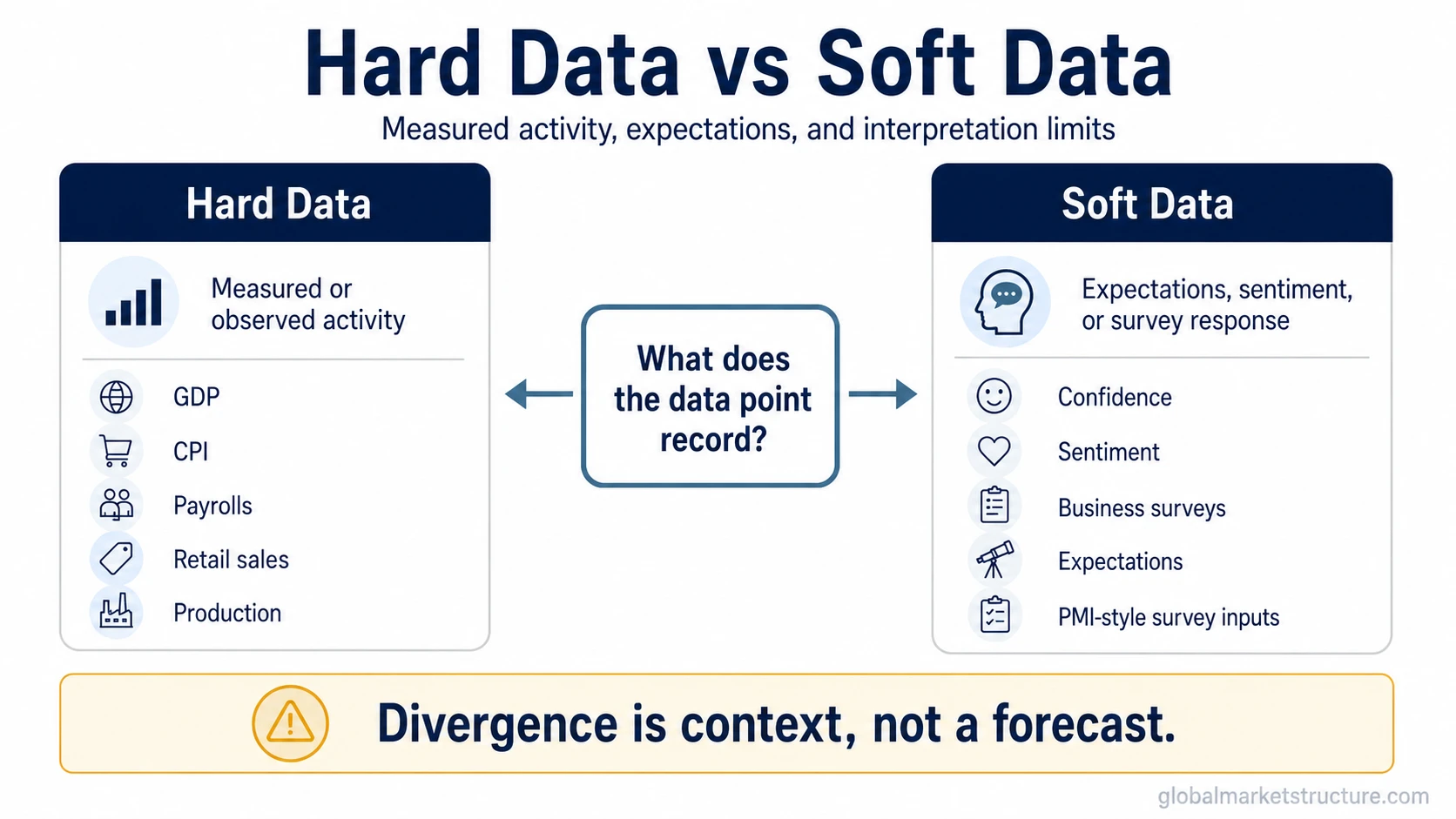
Hard Data vs Soft Data: The Main Difference
Hard data and soft data are not separated by importance. They are separated by what the data measures. Hard data measures realized activity. Soft data measures perception, expectation, or reported sentiment.
| Classification question | Hard data | Soft data |
|---|---|---|
| What does it measure? | Observed or recorded economic activity. | Expectations, confidence, sentiment, or survey responses. |
| Typical source | Measured transactions, administrative records, production data, price data, labor-market data, spending data, or official releases based on observed activity. | Household surveys, business surveys, sentiment indexes, confidence indexes, or expectation-based readings. |
| Common examples | GDP, CPI, payrolls, retail sales, industrial production, and realized spending data. | Consumer confidence, business confidence, sentiment surveys, expectations surveys, and PMI-style survey components. |
| Main strength | It is tied to activity that has already been measured or observed. | It can show how households, businesses, or market participants are perceiving conditions before all activity data is available. |
| Main limitation | It may lag changing conditions and can be revised after initial release. | It can be noisy, emotional, or inconsistent with later realized activity. |
| Interpretation risk | Treating measured data as final proof of a macro trend. | Treating sentiment or expectations as a reliable forecast. |
What Counts as Hard Data?
Hard data is economic information based on observed, recorded, or quantifiable activity. It usually describes what households, firms, prices, production, employment, or spending have already done.
Examples include GDP, payrolls, retail sales, CPI, industrial production, and other measured releases. These readings can help analysts understand actual economic conditions because they are tied to recorded activity rather than stated expectations.
Hard data is still not perfect. It can arrive after the behavior has already changed, and some releases are revised as more complete information becomes available. For that reason, hard data can be useful evidence without being final proof.
When hard data is used to describe current economic activity, it can overlap with the logic of a coincident indicator. That timing label is separate from the hard/soft distinction: hard data classifies the evidence type, while coincident classification describes timing relative to the cycle.
What Counts as Soft Data?
Soft data is economic information based on expectations, sentiment, confidence, perceptions, or survey responses. It often reflects how households, businesses, investors, or purchasing managers describe conditions rather than what has already been fully measured in activity data.
Examples include consumer confidence, business confidence, sentiment indexes, inflation expectations surveys, and many PMI-style survey readings. These can be useful because perceptions sometimes change before activity data fully captures the shift.
Soft data is also limited. A weak confidence reading does not automatically mean the economy is already contracting. A strong survey reading does not automatically mean measured activity will accelerate. Surveys can react to headlines, political views, financial conditions, or temporary anxiety before behavior changes in the hard data.
Some soft data can act as an early-warning layer, similar to how a leading indicator may point ahead of the cycle. That does not make all soft data leading data. The timing behavior depends on the specific series, its history, and the context around it.
Same Scenario, Different Meaning
A simple way to separate hard data from soft data is to look at a consumer slowdown scenario.
| Signal | Data type | What it can mean | What it does not prove by itself |
|---|---|---|---|
| Consumer confidence falls sharply. | Soft data | Households report weaker confidence or expectations. | It does not prove that spending has already fallen. |
| Retail sales weaken in later releases. | Hard data | Measured spending activity has slowed. | It does not prove the slowdown will persist. |
| Payroll growth remains firm. | Hard data | Measured labor-market activity still looks resilient. | It does not automatically invalidate weaker sentiment. |
In that scenario, the soft data shows how consumers feel or what they expect. The hard data shows whether measured behavior has changed. The useful comparison is not “which one is better,” but whether expectations and observed activity are moving together or diverging.
When Hard and Soft Data Diverge
A hard/soft data divergence happens when survey-based readings and measured activity point in different directions. For example, sentiment may weaken while payrolls and spending remain firm, or business surveys may improve before production data confirms the change.
Limitation: divergence is context, not proof. It can highlight tension between expectations and realized activity, but it does not by itself confirm recession, recovery, policy change, market direction, or asset-price outcome.
The interpretation becomes stronger only when the surrounding evidence is consistent. A sentiment decline carries more weight if spending, production, labor-market data, credit conditions, and market breadth begin to confirm the same direction. Without that confirmation, the divergence should remain a question, not a conclusion.
Hard and Soft Data Are Not the Same as Leading, Coincident, or Lagging Indicators
Hard/soft classification describes the type of evidence. Leading, coincident, and lagging classification describes timing behavior relative to the economic cycle.
A soft indicator may behave like an early signal in some settings, but soft data should not be treated as automatically leading. A hard indicator may describe current or past activity, but hard data should not be treated as automatically coincident. The same data series can also behave differently depending on release timing, revisions, and the macro environment.
The safer hierarchy is: first classify what the data measures, then ask how that series usually behaves across the cycle.
How to Classify an Economic Data Point
Use the measurement source before assigning meaning. A data point is usually hard data if it comes from realized activity, measured prices, employment, output, transactions, or spending. It is usually soft data if it comes from expectations, confidence, sentiment, or survey responses.
- Ask what is being measured: activity or perception.
- Check the source: recorded activity data, transaction data, survey data, or sentiment data.
- Separate type from timing: hard/soft is not the same as leading/coincident/lagging.
- Watch for divergence: disagreement between the two can be useful, but it is not a stand-alone forecast.
- Require confirmation: stronger macro interpretation usually needs several data channels moving together.
FAQ
Is GDP hard data or soft data?
GDP is usually treated as hard data because it estimates economic output from observed and reported source data. Its limitation is timing: GDP is released after the activity period and may be revised.
Is consumer confidence hard data or soft data?
Consumer confidence is soft data because it comes from survey-based responses about sentiment and expectations. It can be useful, but it does not prove that measured spending has already changed.
Is PMI hard data or soft data?
PMI-style data is usually treated as soft data because it is survey-based. The exact interpretation depends on the component, because some survey questions refer to reported business conditions while still being collected through survey responses.
Is soft data always a leading indicator?
No. Some soft data can move earlier than measured activity, but soft data is not automatically a reliable leading indicator. The timing behavior depends on the specific series and the surrounding evidence.
Is hard data better than soft data?
Not automatically. Hard data is tied to measured activity, but it can lag and be revised. Soft data can react earlier, but it can be noisy. The stronger interpretation comes from knowing what each data point measures and whether other evidence confirms it.