
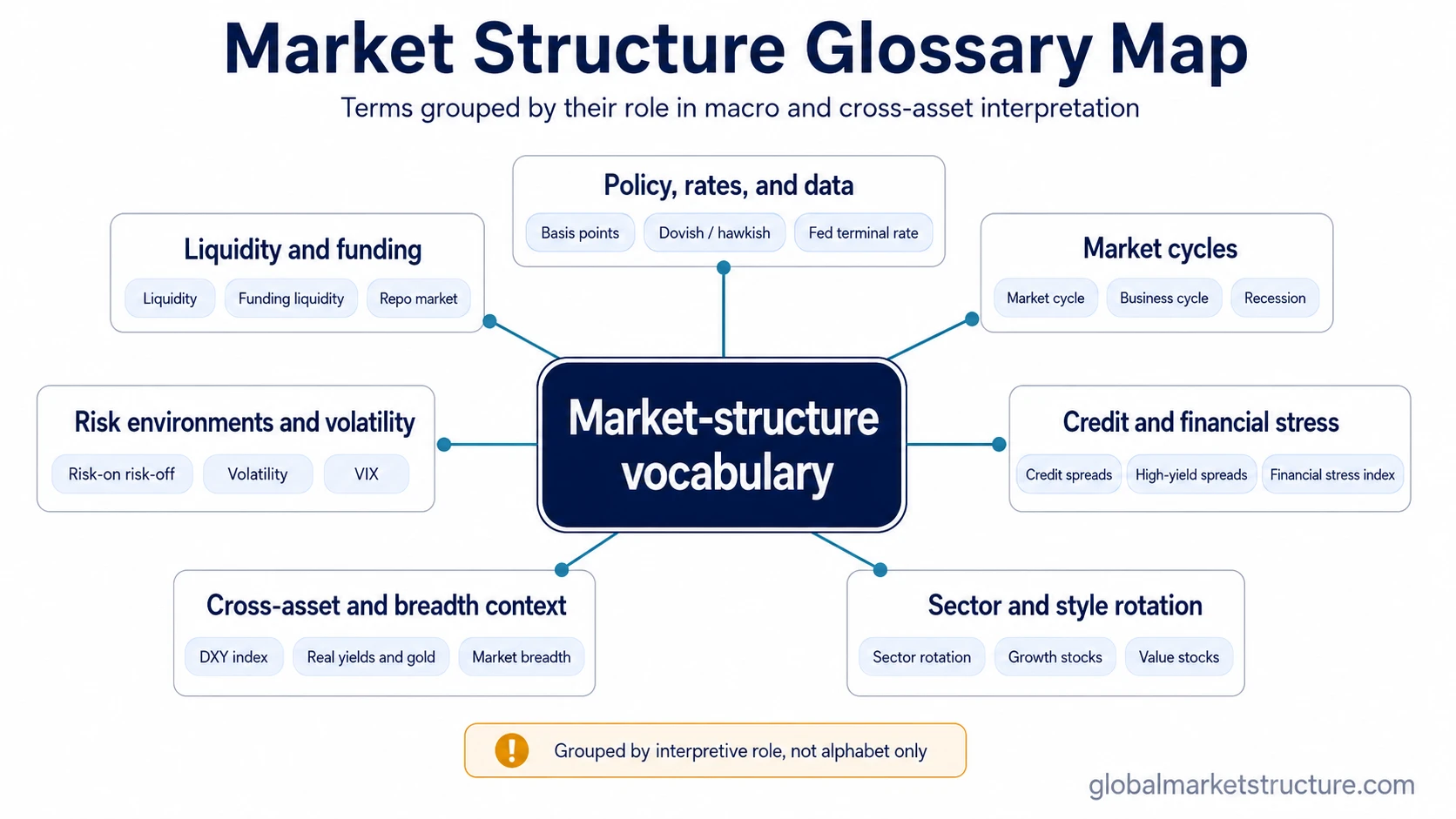
Market-structure vocabulary is easier to use when related terms are grouped by the role they play in liquidity, cycles, rates, credit, risk environments, and cross-asset confirmation. Broad terms can then lead into focused explanations of definitions, mechanisms, and interpretation limits.
Policy, rates, and data terms
Policy, rates, and data vocabulary helps separate central-bank stance, yield changes, rate-cycle language, and economic-data interpretation from broader market reaction. These terms are useful starting points for understanding how policy expectations, data releases, liquidity, duration, and risk appetite can interact.
| Term | Use it when you need to understand | Go deeper |
|---|---|---|
| Basis points | Small changes in rates, yields, spreads, or policy expectations. | Basis points |
| Dovish | Policy language that leans toward easier financial conditions, lower-rate pressure, or growth support. | Dovish |
| Hawkish | Policy language that leans toward tighter financial conditions, inflation control, or higher-rate pressure. | Hawkish |
| Dovish vs hawkish | The difference between easier-policy and tighter-policy language. | Dovish vs hawkish |
| Fed dot plot | How Federal Reserve rate projections can shape market expectations. | Fed dot plot |
| Fed tapering | How slower central-bank asset purchases can affect liquidity expectations. | Fed tapering |
| Fed terminal rate | The expected endpoint of a policy-rate hiking cycle. | Fed terminal rate |
| Neutral rate of interest | The rate concept used to discuss whether policy is restrictive, neutral, or accommodative. | Neutral rate of interest |
| Taper tantrum | A market reaction to changing expectations around central-bank asset purchases. | Taper tantrum |
| Hard data vs soft data | The difference between observed economic activity measures and survey-based expectation measures. | Hard data vs soft data |
Liquidity and funding terms
Liquidity terms describe whether capital, funding, and market depth are available enough for positions to be financed, traded, or absorbed without severe stress. They matter most when market prices move because participants are forced to adjust exposure rather than simply changing opinion.
| Term | Use it when you need to understand | Go deeper |
|---|---|---|
| Liquidity | The broad role of available money, financing, and trading capacity in market conditions. | Liquidity |
| Market liquidity | How easily assets can trade without large price impact. | Market liquidity |
| Funding liquidity | How easily participants can obtain or maintain financing. | Funding liquidity |
| Liquidity risk | The risk that financing or market depth becomes unavailable when it is needed most. | Liquidity risk |
| Liquidity crisis | A stress environment where funding pressure and market-depth problems reinforce each other. | Liquidity crisis |
| Repo market | Short-term secured funding and its role in financial-system liquidity. | Repo market |
| Reverse repo | A money-market operation that can influence reserves, cash placement, and liquidity interpretation. | Reverse repo |
Market-cycle terms
Cycle vocabulary helps classify where growth, credit, earnings, liquidity, and risk appetite may sit within a broader sequence. These terms should not be treated as timing signals by themselves, because cycle interpretation depends on confirmation across several market and macro conditions.
| Term | Use it when you need to understand | Go deeper |
|---|---|---|
| Market cycle | The broad sequence of risk appetite, expansion, contraction, and repricing across markets. | Market cycle |
| Business cycle | The economic expansion and contraction sequence behind many macro and market regimes. | Business cycle |
| Credit cycle | The expansion and tightening of credit conditions across lenders, borrowers, and markets. | Credit cycle |
| Bull market | A sustained risk-asset advance that usually needs broader context than price direction alone. | Bull market |
| Bear market | A sustained drawdown or risk-asset contraction that can reflect several different macro causes. | Bear market |
| Recession | A contraction phase in economic activity and its relationship to market-cycle interpretation. | Recession |
| Expansion | A phase of improving activity that may affect earnings, credit, and risk appetite. | Expansion |
| Contraction | A phase of weakening activity that can reshape credit, liquidity, and market leadership. | Contraction |
Risk environment and volatility terms
Risk-environment and volatility language helps distinguish market movement from the conditions surrounding that movement. A volatility reading can describe movement size, expected movement, or stress behavior, but it still needs context from liquidity, credit, positioning, and cross-asset confirmation.
| Term | Use it when you need to understand | Go deeper |
|---|---|---|
| Risk-on risk-off | How broad market behavior can shift between risk-seeking and defensive positioning. | Risk-on risk-off |
| Volatility | The size and variability of market movement, not a direction forecast by itself. | Volatility |
| Implied volatility | The option-market estimate of expected future movement. | Implied volatility |
| Realized volatility | The movement actually observed over a completed measurement window. | Realized volatility |
| Implied vs realized volatility | How expected movement compares with observed movement. | Implied vs realized volatility |
| VIX | A widely followed volatility index used as one input in stress and risk-environment interpretation. | VIX |
| Market stress | Pressure across markets that may reflect liquidity, volatility, credit, or positioning strain. | Market stress |
Credit and financial-stress terms
Credit and stress vocabulary helps connect market prices with financing conditions, default risk, and institutional risk appetite. These terms are useful when equity-market moves need to be checked against bond-market, funding-market, or spread-based evidence.
| Term | Use it when you need to understand | Go deeper |
|---|---|---|
| Credit spreads | The compensation investors demand for holding credit risk over safer benchmarks. | Credit spreads |
| Credit spreads widening | Why spread widening can signal deteriorating risk appetite or funding pressure. | Credit spreads widening |
| High-yield spreads | Lower-quality credit pricing and its relationship to risk appetite. | High-yield spreads |
| Financial stress index | Composite stress readings that can combine credit, funding, volatility, and market variables. | Financial stress index |
| Funding stress | Pressure in financing channels that can affect leverage, forced flows, and unwind dynamics. | Funding stress |
Cross-asset and intermarket terms
Cross-asset vocabulary connects moves in equities, bonds, commodities, currencies, credit, and volatility. These terms are useful when one market move needs confirmation or contradiction from another part of the macro structure.
| Term | Use it when you need to understand | Go deeper |
|---|---|---|
| DXY index | The U.S. dollar index as a pressure gauge for global liquidity and cross-asset conditions. | DXY index |
| Dollar cycle | How broad dollar phases can influence commodities, risk assets, and global liquidity. | Dollar cycle |
| Global liquidity | The broad availability of liquidity across regions, currencies, and funding channels. | Global liquidity |
| Cross-asset correlation | How relationships between asset classes change across regimes. | Cross-asset correlation |
| Real yields and gold | The relationship between inflation-adjusted yields and precious-metal behavior. | Real yields and gold |
| Dollar and commodity prices | How dollar strength or weakness can interact with commodity-market pricing. | Dollar and commodity prices |
Market breadth and leadership terms
Breadth and leadership vocabulary helps separate index-level performance from participation underneath the surface. These terms are useful when market direction looks strong or weak, but confirmation depends on how widely the move is shared across sectors, styles, and constituents.
| Term | Use it when you need to understand | Go deeper |
|---|---|---|
| Market breadth | How widely a market move is supported across individual securities or groups. | Market breadth |
| Market breadth indicators | Measures used to observe participation, divergence, and internal market strength. | Market breadth indicators |
| Market leadership | Which sectors, styles, or assets are driving performance across a cycle or regime. | Market leadership |
| Sector rotation | How leadership shifts across sectors as cycles, rates, liquidity, or risk appetite change. | Sector rotation |
| Growth stocks | How long-duration equity leadership can interact with rates, liquidity, and risk appetite. | Growth stocks |
| Value stocks | How valuation-sensitive or cyclical leadership can behave across different cycle phases. | Value stocks |
Choosing the right concept path
Start with the concept family, then move into the focused explanation for the term itself. Compact route descriptions stay brief so definitions, mechanisms, limitations, and related concepts remain in the dedicated explanations where they belong.
Some market terms can sit in more than one group. Volatility can be a risk-environment term, a stress input, or an options-market concept depending on context. Stronger interpretation usually comes from the surrounding evidence, not from the label alone.