Hawkish describes a monetary-policy stance or communication tone that puts more weight on controlling inflation and is usually associated with tighter-policy or higher-rate expectations. Markets often read hawkish language through the expected path of interest rates and financial conditions, but the label is not a policy promise, not today’s rate, not the neutral rate, and not a standalone market signal.
Key Points
- Hawkish is a policy-tone term, not proof that a rate hike has already happened.
- It usually signals stronger concern about inflation or price stability.
- Markets may translate hawkish language into a higher expected rate path or tighter financial-conditions reading.
- The market reaction depends on prior pricing, yields, liquidity, credit, the dollar, positioning, and risk appetite.
What Hawkish Means in Monetary Policy
Definition: In monetary policy, hawkish means a central bank, policymaker, or policy statement sounds more focused on controlling inflation than on supporting growth, employment, or easier financial conditions. A hawkish tone often suggests less tolerance for inflation risk and a greater willingness to keep policy restrictive if needed.
That does not mean a central bank has already raised rates. It also does not mean every hawkish statement leads to the same market reaction. The useful meaning is the bias: hawkish language points toward tighter-policy interpretation, especially when it changes how investors think about future rates.
Hawkish is most often used in the context of monetary policy, central-bank statements, speeches, inflation reports, and market commentary around the expected path of policy rates.
How Hawkish Language Affects Rate Expectations
Markets do not only react to today’s policy rate. They also react to what policy language implies about the future path of rates.
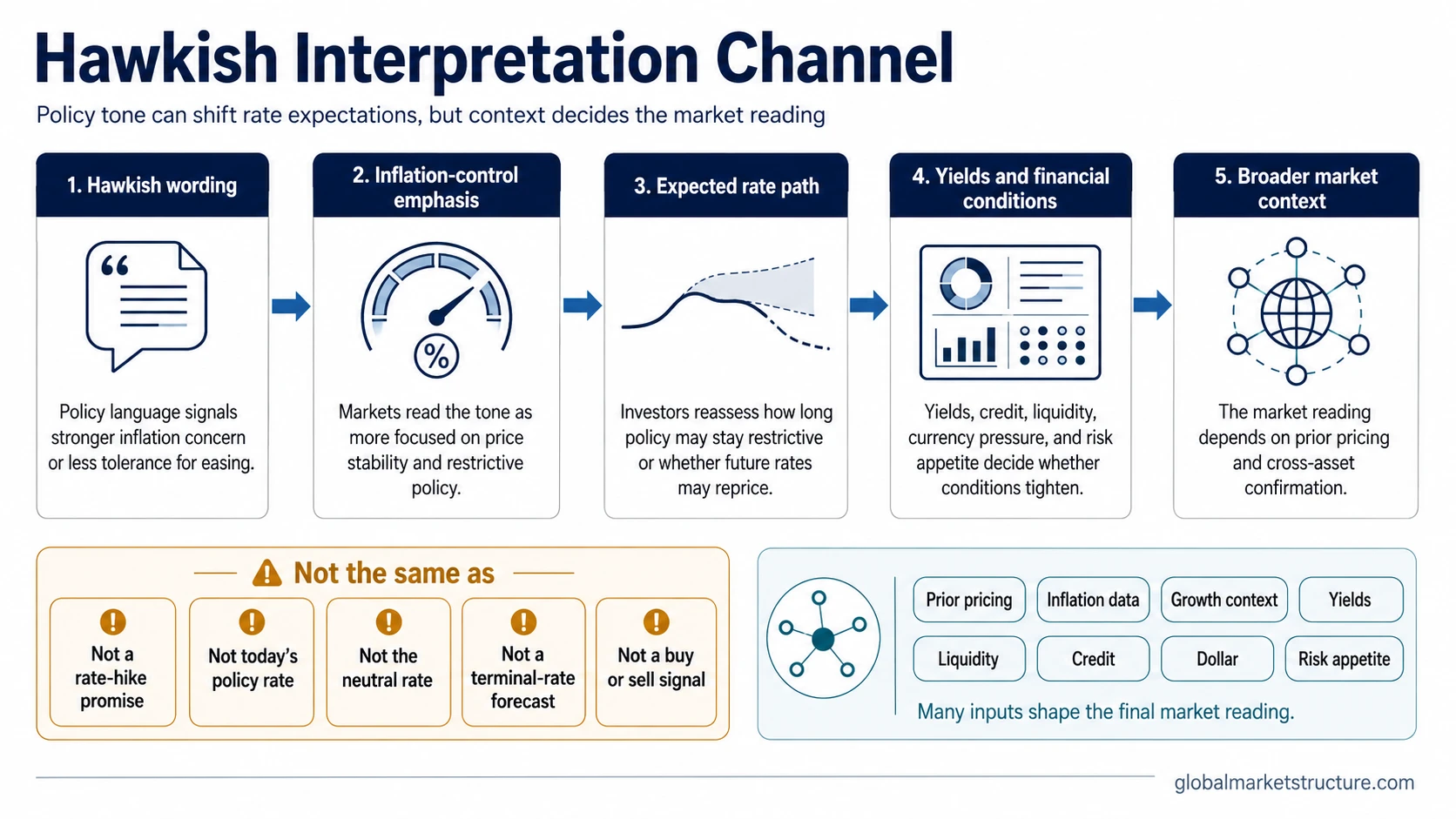
A simple expectation channel:
- Policy wording or bias
- Stronger inflation-control emphasis
- Expected rate-path repricing
- Yields and financial-conditions interpretation
- Broader market reading only with context
For example, a central bank can leave rates unchanged while still sounding hawkish if it stresses inflation risk, warns that easing is premature, or signals that restrictive policy may need to last longer. In that case, the market may focus less on the current decision and more on whether the expected path of future rates has shifted.
The same words can have different effects depending on whether markets were already positioned for them. A hawkish message can matter more when it surprises investors, pushes yields higher, or tightens financial conditions. It can matter less when the message was already priced, contradicted by incoming data, or not confirmed by other markets.
Hawkish Wording, Policy Action, and Market Interpretation
| Concept | What it means | What it does not prove |
|---|---|---|
| Hawkish tone | Language or policy bias that places more emphasis on inflation control and restrictive policy conditions. | It does not prove a rate hike has happened or must happen next. |
| Rate hike | An actual policy decision that raises the policy rate. | It does not automatically explain the full future rate path or market reaction. |
| Expected rate path | Market expectations for where policy rates may go over future meetings. | It is not the same as today’s policy rate or a central-bank promise. |
| Financial conditions | The broader mix of yields, credit, liquidity, equity conditions, currency pressure, and funding environment. | It does not always tighten just because policymakers sound hawkish. |
| Market reaction | The way assets respond after policy language, data, and positioning are processed together. | It is not determined by the word “hawkish” alone. |
| Quantitative tightening | A balance-sheet policy process that reduces central-bank asset holdings or liquidity support. | It is not the same thing as hawkish tone, even though both can be associated with tighter policy conditions. |
What Hawkish Does Not Mean
A hawkish policy reading is often misused when it is treated as a complete forecast. The term is useful, but only when its boundaries are clear.
Hawkish does not mean rates will definitely rise. A central bank can sound hawkish while keeping rates unchanged, waiting for more data, or trying to manage expectations through communication.
Hawkish does not mean stocks must fall. Equity reaction depends on whether the message changes discount-rate expectations, growth expectations, liquidity conditions, and risk appetite.
Hawkish does not mean the dollar must rise. Currency reaction depends on relative policy expectations, positioning, global risk appetite, and whether other central banks are moving in the same or opposite direction.
Hawkish is not the same as the neutral rate. The neutral rate is an estimate of the interest rate that is neither stimulative nor restrictive. Hawkish is a stance or tone around policy bias.
Hawkish is not the same as the terminal rate. The terminal rate is the expected peak or endpoint of a rate-hiking cycle. Hawkish language can influence terminal-rate expectations, but the two terms are not identical.
Hawkish is not the same as quantitative tightening. Quantitative tightening is a balance-sheet action. Hawkish is broader policy-tone language.
Hawkish is not a buy or sell signal. It is one input into market interpretation, not a complete trading framework.
A Simple Hawkish Policy Scenario
A central bank statement says inflation remains too high and policymakers need more evidence before considering easier policy. The policy rate is unchanged, but the wording sounds less willing to ease.
Markets may respond by raising expectations for how long policy stays restrictive. Yields can move higher if the message is a surprise and rate-path expectations reprice. Financial conditions may tighten if credit, liquidity, currency pressure, and risk appetite confirm the shift.
The reaction can also be muted. If investors already expected tough inflation language, the statement may not change the expected rate path much. Hawkish wording can shift probabilities, but it does not remove uncertainty or decide the market reaction by itself.
Hawkish vs Dovish
Hawkish and dovish describe opposite policy-tone directions.
Hawkish language puts more emphasis on inflation control, restrictive policy, and higher-for-longer rate expectations. Dovish language puts more emphasis on easing pressure, supporting growth, or reducing policy restraint when conditions allow.
The contrast is useful, but the label alone is not enough. A full market reading still needs the expected rate path, inflation data, growth context, yields, liquidity, credit, the dollar, and risk appetite.
Dovish vs hawkish separates the two policy stances directly.
Related Monetary Policy Concepts
Hawkish sits near several rate and liquidity concepts, but each one has a different job.
- Dovish: the opposite policy-tone direction, usually associated with easier-policy interpretation.
- Dovish vs hawkish: the direct comparison between the two policy stances.
- Neutral rate of interest: the estimated policy rate that is neither stimulative nor restrictive.
- Fed terminal rate: the expected peak or endpoint of a policy-rate cycle.
- Quantitative tightening: a balance-sheet tightening process, not simply hawkish wording.