
Dovish means a monetary-policy stance or communication style that leans toward easier policy, lower-rate expectations, slower tightening, or more accommodation. In markets, dovish language can affect expectations about rates and liquidity, but it does not by itself guarantee rate cuts, easier financial conditions, or a specific asset-price direction.
The useful point is the expectation channel. A dovish reading tells investors how policy language may be interpreted, not what the central bank will definitely do next and not how every asset must respond.
What dovish means
Dovish is a policy-stance term. It is usually used when a central bank, policymaker, or market commentator appears more open to easier monetary policy, a lower expected rate path, slower tightening, or more supportive conditions.
The term does not always mean that policy is already easy. It can describe a speech, statement, forecast, voting pattern, or policy bias that markets interpret as less restrictive than expected.
| Term | Policy meaning | Market interpretation limit |
|---|---|---|
| Dovish | Leans toward easier policy, slower tightening, or lower-rate expectations | Does not guarantee rate cuts or rising risk assets |
| Neutral | Does not clearly lean easier or tighter | Still depends on data, inflation, growth, and policy reaction |
| Hawkish | Leans toward tighter policy, higher-rate expectations, or inflation restraint | Does not guarantee falling markets or immediate tightening |
How dovish language affects rate expectations
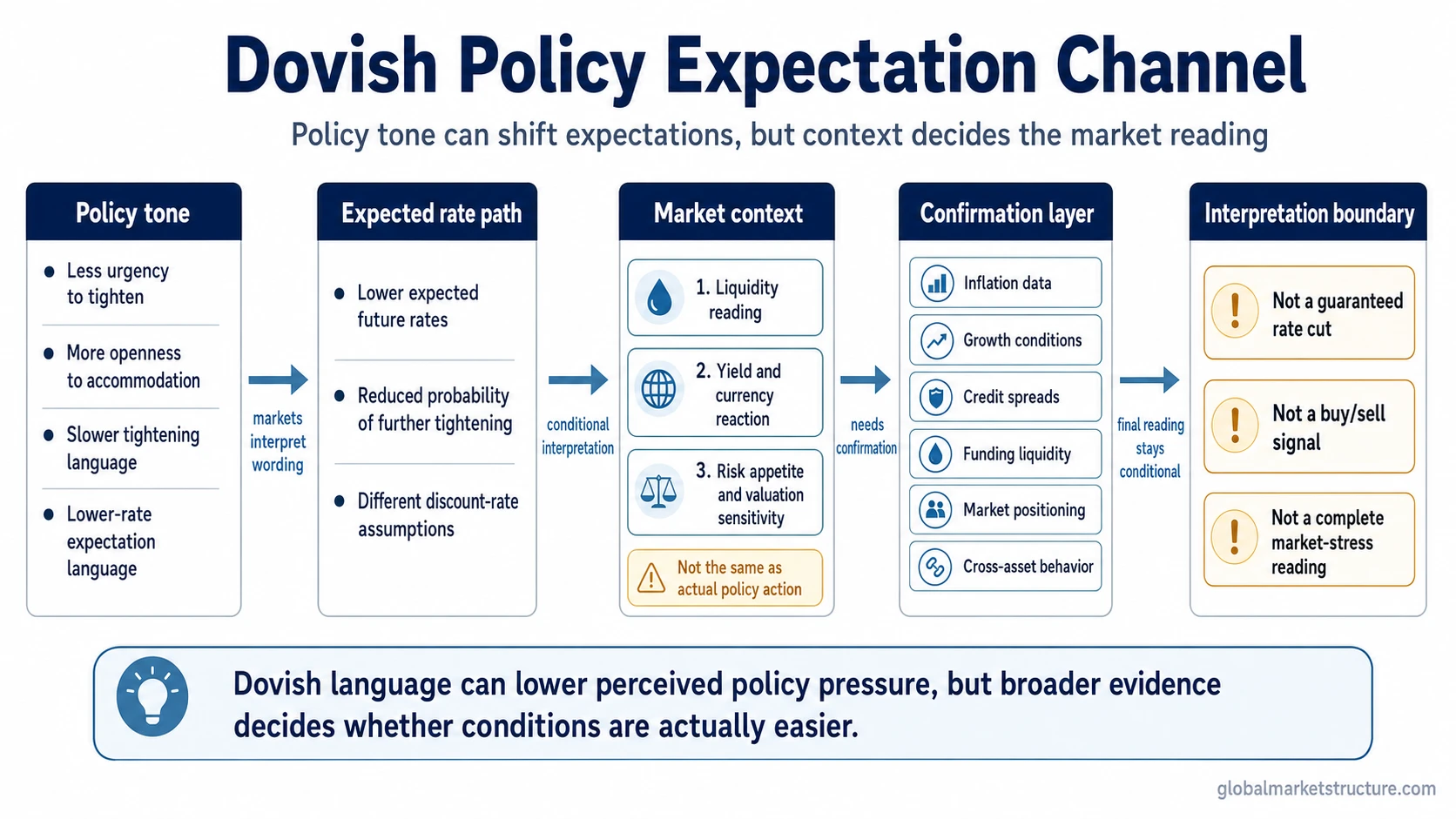
Dovish language matters because markets often adjust to expected policy paths before every policy decision is finalized. If communication sounds less restrictive, investors may lower their expected path for future rates or reduce the probability assigned to additional tightening.
This is where forward guidance becomes important. Central-bank language can influence expectations even when the current policy rate has not changed.
| Step | What changes | Why the reading remains conditional |
|---|---|---|
| Policy wording | Statements sound less focused on tightening or more open to accommodation | Language can shift again if data changes |
| Expected rate path | Markets may price a lower or less restrictive path | Expectations are not the same as actual decisions |
| Liquidity interpretation | Investors may read the environment as less restrictive | Funding, credit, inflation, and risk appetite can still offset the signal |
| Market response | Assets may react through yields, currencies, valuation, or risk appetite | No single direction is guaranteed |
Why dovish does not guarantee a market outcome
A dovish reading is not a trading signal. It does not automatically mean interest rates will fall, stocks will rise, credit conditions will improve, or liquidity will become easy in realized terms.
Actual market interpretation depends on the reason for the dovish shift. A softer policy tone can be read differently if it reflects falling inflation, weakening growth, financial stress, or a central bank trying to manage expectations. The same word can therefore carry different market meaning in different regimes.
A safer interpretation is that dovish language can lower perceived policy pressure, but the final reading still needs context from inflation data, growth conditions, credit spreads, liquidity, market positioning, and cross-asset confirmation.
Dovish vs hawkish
Dovish generally means leaning easier, while hawkish generally means leaning tighter. The difference is about policy bias, not a guaranteed asset-price direction.
A dovish tone may suggest less pressure from future tightening. A hawkish tone may suggest more concern about inflation or the need for restrictive policy. In both cases, the market impact depends on whether the message changes expectations and whether broader conditions confirm the reading.
Simple example of a dovish reading
If a central bank signals less urgency to raise rates, investors may read that as dovish because the expected rate path could move lower. That can affect bond yields, currency expectations, liquidity interpretation, and risk appetite, but it remains a conditional reading rather than a guarantee that markets will rise.
The practical mistake is treating the word as the conclusion. The better reading is to ask what changed in expectations, why the tone shifted, and whether the rest of the market structure confirms easier conditions.
Related concepts
Dovish sits inside the broader language of monetary policy and central-bank communication. The most relevant next concepts are monetary policy for the wider policy framework and forward guidance for the way central-bank communication shapes expectations.
For interpretation, keep the term narrow: dovish describes a policy bias or communication tone. It should not replace a full analysis of inflation, growth, liquidity, credit conditions, or cross-asset behavior.