
A leading indicator is an early-moving measure used to identify possible changes in market-cycle or economic conditions before those changes are confirmed by current or lagging data. It can warn that conditions are shifting, but it does not prove that a cycle turn, recession, policy shift, or market move will happen.
Definition: A leading indicator is evidence that tends to move before the broader condition it is used to monitor. In market-cycle analysis, it helps analysts watch for early changes in momentum, credit conditions, expectations, orders, breadth, or risk appetite before the change is confirmed elsewhere.
- Leading indicators are early-warning inputs, not confirmation by themselves.
- Their value depends on context, persistence, and agreement with other evidence.
- A single leading signal can be early, noisy, or wrong.
- Interpretation improves when early evidence is checked against current-state and breadth-based measures.
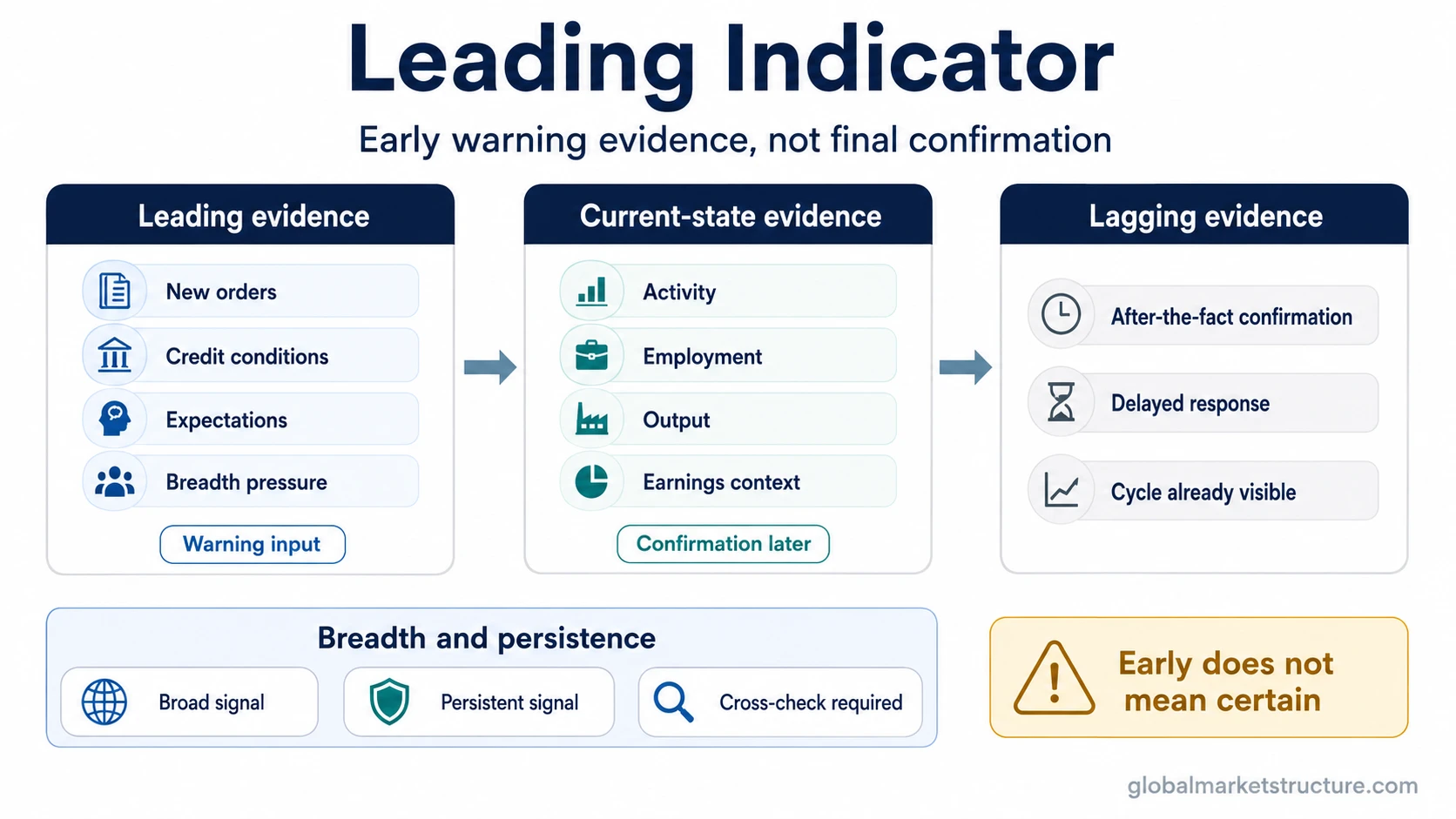
What a leading indicator shows
A leading indicator can show that pressure or improvement is forming before the main economic or market-cycle data has fully changed. It is useful because some inputs adjust before headline conditions are obvious.
Examples can include changes in new orders, credit conditions, expectations, yield-curve behavior, market breadth, or other upstream measures. The exact indicator depends on the cycle question being asked. The important point is not that every leading indicator has the same meaning, but that each one is watched because it may move before broader confirmation appears.
Whether an indicator is leading also depends on the condition being compared. A measure can move ahead of one economic process without necessarily leading every other variable or market outcome. The timing relationship therefore needs to be defined against a specific target rather than treated as a permanent property of the indicator.
That early movement is also the main weakness. A leading indicator can warn that the environment is changing, but it cannot prove that the change will continue. Early evidence needs follow-through, broader confirmation, and a clear separation between signal, noise, and interpretation.
How leading indicators work in market cycles
In many market-cycle frameworks, the sequence often starts with upstream conditions. Credit may tighten, expectations may weaken, orders may slow, or market participation may narrow before the most visible data changes.
The leading measure moves first. Current-state data may still look stable for a while because employment, output, earnings, or broad activity measures often adjust with a delay. A coincident indicator is used for that current-state evidence, while a leading indicator is used to watch for possible change before that current-state evidence has fully turned.
Confirmation may or may not arrive. This is why leading indicators are better treated as warning inputs than as forecasts. Confidence improves when several independent measures point in the same direction and the signal persists rather than reversing quickly.
What a leading indicator cannot prove
A leading indicator is not a forecast by itself. It is not a recession call, a policy prediction, a buy signal, a sell signal, or proof that a market move must follow. It is one input in a broader interpretation process.
The common mistake is treating an early signal as if it already confirmed the final outcome. A weakening leading measure may show that risk is rising, but it does not confirm that the economy has entered contraction. An improving leading measure may show that pressure is easing, but it does not confirm that a durable recovery has started.
False signals can appear because expectations change, data is revised, market pricing overshoots, survey readings move faster than measured activity, or one narrow indicator reacts to a temporary shock. The signal becomes more useful when it aligns with broader evidence instead of standing alone.
Leading, coincident, lagging, and diffusion evidence
Leading indicators are easiest to understand when they are separated from neighboring evidence types. A leading indicator points to possible change before confirmation. A coincident measure describes the current state. A lagging measure confirms what has already happened after the cycle has moved further along.
A diffusion index adds another layer by showing breadth across components. Breadth matters because a signal is usually more convincing when weakness or improvement spreads across many components rather than depending on one isolated data point.
Comparing leading and lagging indicators helps distinguish early-warning evidence from later confirmation, especially when indicators at different points in the timing sequence are moving in different directions.
What strengthens or weakens the reading
A leading indicator becomes more useful when it is persistent, broad, and supported by other evidence. It becomes weaker when it is isolated, short-lived, or contradicted by current-state data.
| What it can show | What it cannot prove | What strengthens the reading | What weakens the reading |
|---|---|---|---|
| Early pressure or improvement before confirmed cycle data changes. | That a recession, recovery, policy shift, or market move must happen. | Several independent indicators move in the same direction. | Only one narrow indicator moves while other evidence stays stable. |
| Possible change in expectations, credit conditions, orders, breadth, or risk appetite. | That the final outcome is already confirmed. | The signal persists across more than one reading or observation period. | The signal reverses quickly or looks like a one-off data shock. |
| A warning that the current cycle state may be changing beneath the surface. | That timing can be known precisely. | Soft evidence is supported by measured activity, pricing, or broader market behavior. | Survey or expectations data moves without support from harder evidence. |
| A reason to look more closely at confirmation signals. | That the indicator should be used as a standalone decision rule. | The evidence type is clear in the interpretation. | Different evidence types are treated as if they all measure the same thing. |
Practical scenario
Suppose new orders weaken while current employment data still looks stable. The early weakness may warn that economic momentum is softening before the current-state data confirms it. That does not prove a cycle turn by itself. The reading becomes more meaningful if credit conditions also tighten, breadth weakens, and the signal persists instead of reversing quickly.
This scenario shows why leading indicators are useful but limited. They help identify where to look next. They do not remove uncertainty, and they do not replace confirmation from broader market-cycle evidence.
Related concepts
Coincident indicators describe current conditions, while lagging indicators confirm developments after they are already visible in the data. Diffusion measures help judge whether a signal is broad or narrow. The distinction between hard data and soft data helps separate measured activity from surveys, expectations, or sentiment-led evidence.
Together, these concepts prevent one common error: treating early movement as final confirmation. A leading indicator is most useful when it improves the question being asked, not when it is forced to provide certainty that the evidence cannot support.