
A lagging indicator confirms a condition after the underlying shift has already begun or occurred. In market-cycle analysis, it helps confirm that economic, labor, inflation, or market conditions have changed, but it is not designed to forecast the next turning point.
The timing distinction is the core idea: a leading indicator is watched for earlier warning evidence, a coincident indicator describes current or very recent conditions, and a lagging indicator confirms after the change is already visible in measured data.
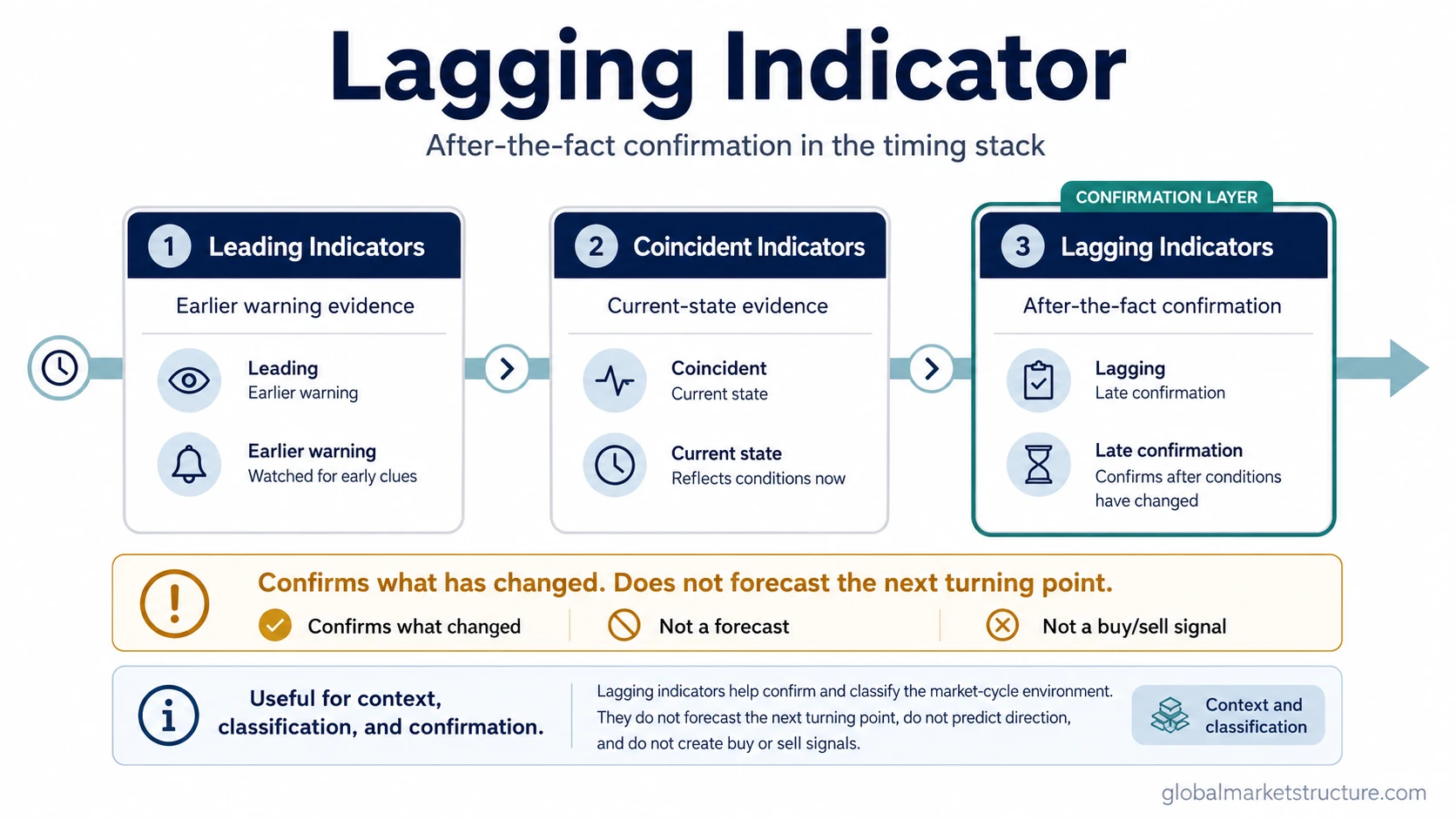
What a lagging indicator confirms
A lagging indicator is backward-looking by design. It does not usually move first. It becomes useful after activity, behavior, or measured conditions have already shifted enough to appear in reported data or confirmed market evidence.
In a market-cycle context, the value is confirmation. A lagging indicator can help classify whether an earlier warning signal has become visible in broader conditions, whether a phase has already matured, or whether a regime change has moved beyond early speculation.
That confirmation still has to be read in context. A lagging indicator can support an interpretation, but it does not prove that the next phase is already known, and it does not create a standalone market-timing signal.
Lagging indicator in the timing stack
Indicators are often easier to interpret when they are separated by timing role rather than treated as one group. The same economic or market environment can contain earlier warning evidence, current-state evidence, and late confirmation at the same time.
| Indicator type | Timing role | What it helps answer | Main limitation |
|---|---|---|---|
| Leading indicator | Earlier warning evidence | What may be changing before the shift is fully visible? | Can give false warnings or weaken before the cycle actually turns. |
| Coincident indicator | Current-state evidence | What is happening now or very recently? | May describe the present without giving much early warning. |
| Lagging indicator | After-the-fact confirmation | What has already changed enough to be confirmed? | Can arrive after markets or earlier indicators have already reacted. |
Comparing leading vs lagging indicators makes the timing contrast explicit: leading evidence is used for earlier warning, while lagging evidence is used for confirmation after the underlying shift is already visible.
Why late confirmation can still be useful
Late confirmation is not the same as useless confirmation. A lagging indicator can reduce the risk of treating every early warning as a completed regime shift. It can also help separate temporary noise from a change that has already reached measured conditions.
In market-cycle work, that matters because early evidence can be unstable. Breadth may weaken and then recover. Sentiment may deteriorate without a durable macro shift. A lagging indicator can help confirm whether earlier signals have moved into harder, slower-changing evidence.
The strongest interpretation usually comes from sequence. Earlier warning evidence, current-state evidence, and lagging confirmation all answer different questions. When they point in the same direction, the cycle reading becomes more coherent. When they conflict, the interpretation should stay conditional.
Examples in macro and market-cycle context
Lagging indicators often appear in areas that are measured after behavior has already changed. Labor-market data, inflation readings, and output measures can all be discussed as lagging evidence when they are used to confirm conditions that have already developed.
For example, a weakening cycle may first appear through softer forward-looking data, weaker market breadth, or tighter credit conditions. Later, slower-moving reported data may confirm that the slowdown has become visible in broader activity. The lagging evidence does not create the first warning, but it can confirm that the earlier warning was not only market noise.
Classification depends on the question being asked, what data is being measured, and whether the indicator is being used for early warning, current-state context, or after-the-fact confirmation.
Common false reading
Mistake: Treating a lagging indicator as either useless because it arrives late or decisive because it confirms a change.
Better interpretation: A lagging indicator is useful for confirmation, classification, and context. It should not be used as a standalone forecast, a market-direction call, or a buy/sell signal.
Limits of lagging indicators
- They often confirm after the underlying shift is already underway.
- They can lag market prices, credit conditions, or earlier warning evidence.
- They can make a cycle shift look clearer only after uncertainty has already mattered.
- They can be misleading when used without leading, coincident, liquidity, credit, breadth, or regime context.
- They do not forecast the next turning point by themselves.
Practical scenario
A common market-cycle scenario is that risk appetite weakens before slower economic data fully reflects the change. Market breadth may narrow, credit conditions may become less supportive, and investors may become more selective while headline activity still looks stable.
Later, lagging evidence may confirm that the earlier deterioration has reached broader measured conditions. At that point, the lagging indicator helps classify the environment, but it does not prove that the next market move is predictable. The useful question becomes how late confirmation fits with current-state evidence and earlier warning signals.
How lagging indicators fit with other evidence
A lagging indicator is strongest when it is interpreted as one layer in a timing stack. Earlier warning evidence can raise the question. Coincident evidence can describe the current state. Lagging evidence can confirm whether the change has already appeared in slower-moving data.
Confirmation can also be broader than one data point. A diffusion index can help show whether participation is broad or narrow across a group, which adds a different confirmation lens from a single lagging measure.
The practical boundary is simple: lagging indicators help confirm what has already changed. They become weaker when they are asked to do the job of early warning, market prediction, or trade timing.