
Turning Points and Signals organizes the market-cycle indicators used to read whether conditions may be shifting, confirming, or already reflected in the data.
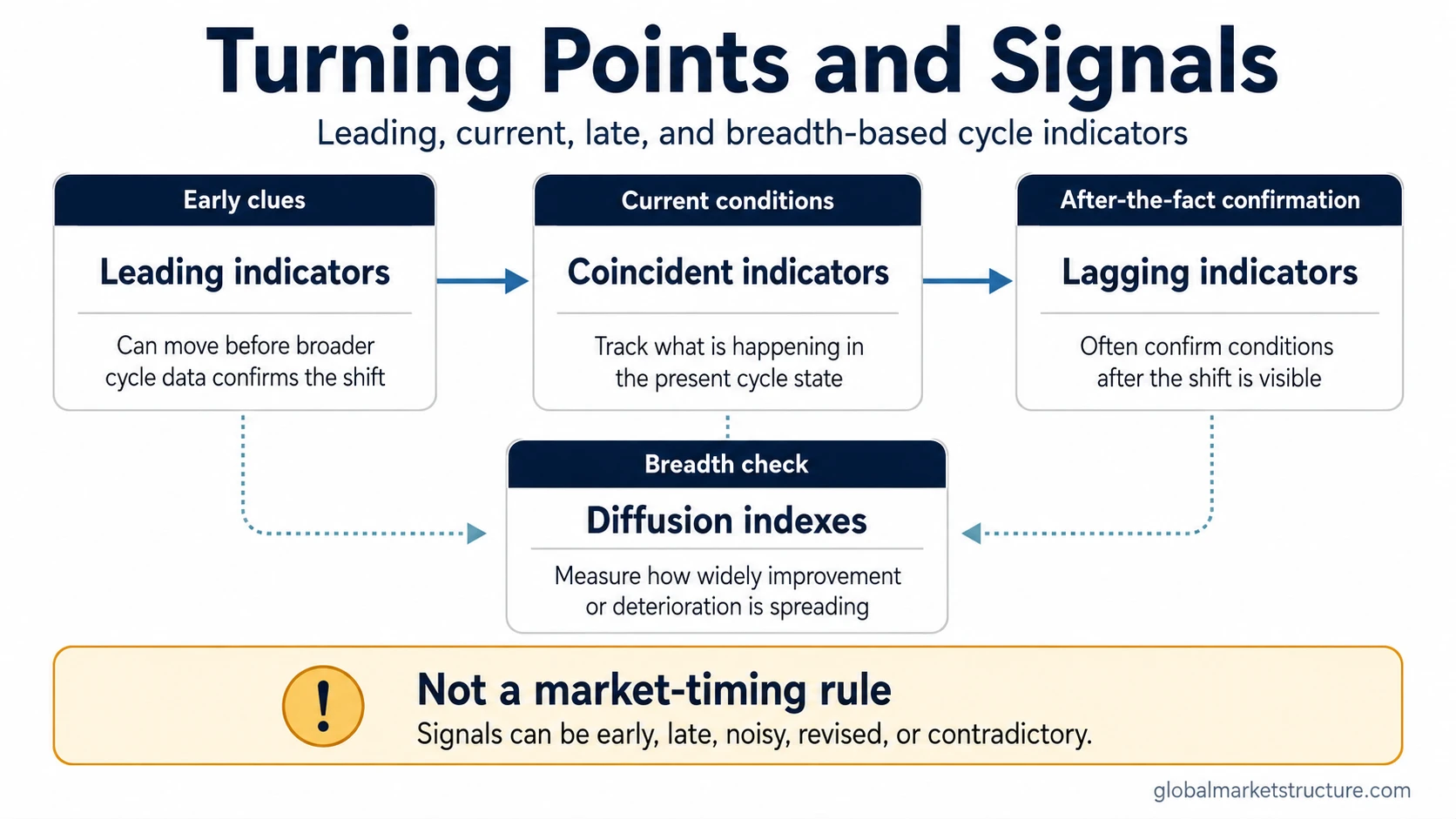
The core distinction is timing role: leading indicators can move before a broader cycle change, coincident indicators describe current conditions, lagging indicators confirm after the fact, and diffusion indexes measure how broad a shift has become.
Cycle signals are most useful when their timing role is clear. A signal can appear early, arrive late, reverse after revision, or conflict with other evidence. The safer starting point is to identify the signal family before assigning meaning to one data point.
Choose the Right Cycle Indicator
| Reader question | Concept to read | Why it fits |
|---|---|---|
| What can move before the broader cycle changes? | leading indicators | They cover signals that may shift before the full cycle is visible in broad activity data. |
| What confirms the current state of the cycle? | coincident indicators | They describe measures that tend to move with current economic or market conditions. |
| What reacts after the cycle has already changed? | lagging indicators | They often confirm conditions after earlier signals or market behavior have already shifted. |
| How broad is the improvement or deterioration? | diffusion indexes | They measure breadth across multiple components instead of relying on one isolated indicator. |
| How do early and late signals differ? | leading vs lagging indicators | They separate forward-looking clues from after-the-fact confirmation. |
How to Read the Signal Timing
Early signals are useful because they can reveal a possible shift before the cycle is obvious. Their weakness is uncertainty. A leading indicator may turn before the rest of the data follows, but it can also send a premature or false warning.
Current-condition signals help anchor the interpretation in what is already happening. Coincident indicators are usually less forward-looking, but they can reduce the risk of relying only on early clues that have not yet spread into broader activity.
Late signals are not useless. Lagging indicators can confirm that a shift has become visible in slower-moving data. Their limitation is timing: by the time they improve or deteriorate, markets may already be focused on the next phase.
Signal Breadth Matters
A single indicator can move for idiosyncratic reasons. Breadth helps show whether the change is isolated or spreading across a wider set of components. Diffusion indexes are useful in this role because they focus on participation, not just the level of one measure.
When early signals, current-condition measures, late confirmations, and breadth measures point in different directions, the disagreement is part of the evidence. Mixed signals usually call for more context, not a stronger claim.
Limits of Turning Point Signals
Limitation: Market-cycle indicators can be early, late, noisy, revised, or contradictory. They can frame conditions and improve interpretation, but they should not be treated as prediction tools, buy or sell signals, or fixed rules for timing market tops and bottoms.
The safer use is comparative: identify whether the evidence is early, current, late, or breadth-based, then compare it with the matching indicator category before drawing a stronger cycle interpretation.