
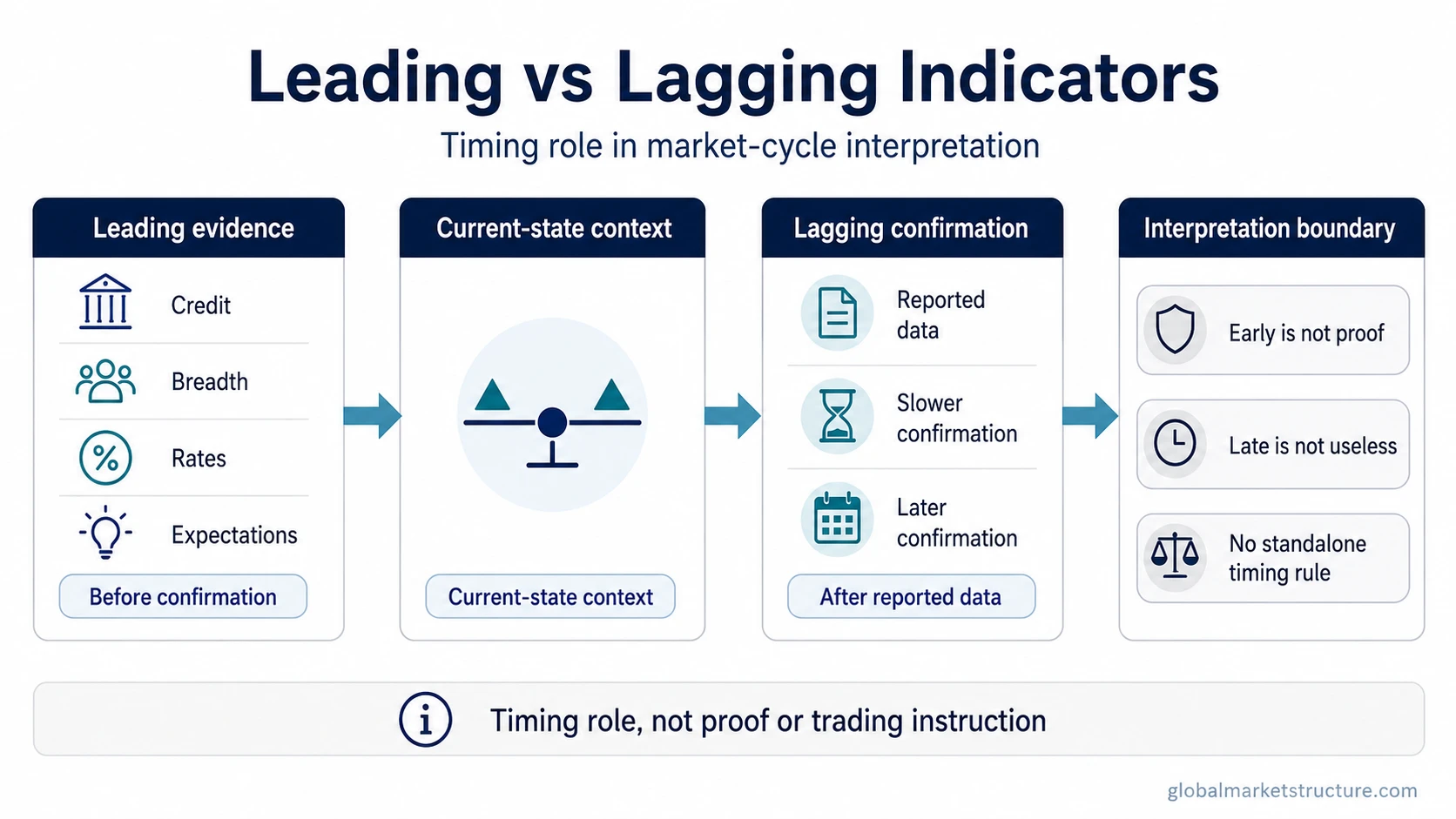
Leading indicators come earlier in the interpretation sequence because they can warn before confirmation appears. Lagging indicators come later because they confirm after slower or reported data has already shifted. The difference is timing role, not quality. Leading evidence can be early and wrong; lagging evidence can arrive late and still help confirm whether a market-cycle shift is real.
Key Points
- Leading indicators act as early-warning evidence before the full shift is confirmed.
- Lagging indicators confirm after a change is already visible in slower or reported data.
- The distinction is about timing, not whether one type is always better.
- Both types are more useful when macro regime, credit, breadth, liquidity, DXY, rates, and policy-expectation context are checked together.
How to Tell Whether an Indicator Is Leading or Lagging
An indicator is leading when it tends to move before the broader condition becomes obvious in confirmed data. In market-cycle work, that can mean a measure that begins to deteriorate before reported activity weakens, or one that improves before the recovery is clear in slower data. A leading indicator gives earlier information, but early information is not final proof.
An indicator is lagging when it mainly confirms a change after the underlying shift has already become visible. That can make it late for early turning-point recognition, but confirmation still matters because it reduces the risk of overreacting to weak or temporary early signals. A lagging indicator can confirm whether earlier evidence was part of a broader shift.
The practical classification test is timing. If the evidence usually appears before the shift is confirmed, it is leading. If it appears after the shift is already visible in slower data, it is lagging.
Leading vs Lagging Indicators Comparison
| Criteria | Leading indicators | Lagging indicators |
|---|---|---|
| Timing role | Appear earlier in the interpretation sequence. | Appear after the shift is already more visible. |
| Evidence type | Early-warning or forward-looking evidence. | Confirmation from slower, reported, or already-adjusted data. |
| Main strength | Can help identify a possible turning point before consensus confirmation. | Can help confirm whether an earlier signal was part of a real shift. |
| Main weakness | Can give false warnings, especially when read outside context. | Can arrive after markets have already started discounting the change. |
| Market-cycle use | Useful for monitoring early changes in risk appetite, credit conditions, breadth, liquidity, or policy expectations. | Useful for checking whether later macro, earnings, labor, or activity data confirms the broader cycle direction. |
| Common false reading | Treating an early warning as a proven forecast. | Treating later confirmation as irrelevant because it is not early. |
Same Market Scenario, Different Interpretation
Illustrative scenario: Credit conditions begin to tighten, market breadth weakens, and policy-expectation proxies start shifting before slower activity data clearly changes. Those early signals can act as leading evidence. They warn that the market-cycle backdrop may be changing, but they do not prove the final outcome by themselves.
Later, slower activity data, labor-market evidence, or broader confirmation measures begin to reflect the same deterioration. Those later signals are lagging evidence. They may arrive after markets have already adjusted, but they help confirm that the earlier warning was not only temporary noise.
The two readings describe different points in the same interpretation sequence. Leading evidence helps identify what may be developing. Lagging evidence helps confirm what has already developed.
Where Coincident Indicators Fit
Coincident indicators sit between the two roles. They describe current-state conditions rather than early warnings or late confirmation. In a market-cycle framework, they can help show whether the current environment is expanding, slowing, stressed, or stabilizing. The core distinction remains early warning versus later confirmation.
Common Mistakes and Limitations
Leading does not mean correct. A leading signal can move early because conditions are starting to shift, but it can also move because of temporary stress, positioning, sentiment, or a narrow market disturbance.
Lagging does not mean useless. A lagging signal can be late for early timing, but it can still confirm whether earlier evidence was part of a broader market-cycle transition.
One indicator is rarely enough. The interpretation becomes stronger when different types of evidence point in the same direction. For example, a leading signal carries more weight when credit, breadth, liquidity, rates, DXY, and risk appetite are not sending conflicting messages.
Indicators are not market signals by themselves. The leading-versus-lagging distinction classifies evidence by timing role. It does not create a buy signal, sell signal, recession call, policy forecast, or guaranteed timing rule.
How Both Types Work Together
A market-cycle reading is usually stronger when early warning and later confirmation are separated. Leading indicators help identify what might be changing before the shift is fully visible. Lagging indicators help confirm whether the suspected shift has become durable enough to show up in slower data.
The mistake is forcing both roles to do the same job. Early-warning evidence should not be judged as if it already contains confirmation. Later-confirmation evidence should not be dismissed simply because it is not early. The useful sequence is early warning, current-state context, later confirmation, then continued monitoring for contradiction or persistence.
FAQ
Are leading indicators better than lagging indicators?
No. Leading indicators are earlier, not automatically better. They can warn before confirmation, but they can also give false readings. Lagging indicators are later, but they can confirm whether an earlier warning became a real shift.
Why are lagging indicators useful if they arrive late?
Lagging indicators are useful because confirmation has value. They can show whether earlier signals were supported by slower or reported data, even if markets already began adjusting before that confirmation appeared.
Is leading versus lagging a market-timing signal?
No. Leading versus lagging is a classification of evidence by timing role. It does not create a buy signal, sell signal, recession forecast, recovery call, or policy prediction by itself.