Investor Sentiment Indicators

Investor sentiment indicators show how optimistic, pessimistic, fearful, greedy, crowded, or risk-seeking market participants appear to be. Their useful role is contextual: they help explain mood, positioning pressure, and market vulnerability, but they do not forecast direction, time reversals, identify bottoms, or replace evidence from flows, liquidity, breadth, and cross-asset behavior.

Key Points

  • Investor sentiment indicators measure mood and risk appetite proxies, not future market direction.
  • The same reading can mean different things depending on persistence, positioning, liquidity, and market breadth.
  • Extreme sentiment is better treated as a vulnerability condition than as a timing tool.
  • Sentiment evidence becomes more useful when it aligns with flows, positioning pressure, and related market behavior.

What Investor Sentiment Indicators Measure

Investor sentiment indicators are tools that try to capture how investors feel, behave, or appear positioned toward risk assets. Some are based on surveys. Others come from options activity, volatility gauges, fund flows, market breadth, or composite fear-and-greed dashboards.

This page is not a live indicator dashboard. It explains how to classify sentiment readings and interpret them inside broader market structure instead of treating the latest value as a standalone signal.

The important distinction is that sentiment is not the same as confirmed exposure. A survey may show what investors say. Options activity may show how traders are hedging or speculating. Fund-flow data may show where capital is moving. A composite index may combine several inputs into one reading. These are useful clues, but each clue has a different weakness.

For broader context, investor sentiment sits inside the larger concept of market sentiment. Market sentiment describes the wider tone of risk appetite across markets, while individual indicators provide narrower evidence about one part of that tone.

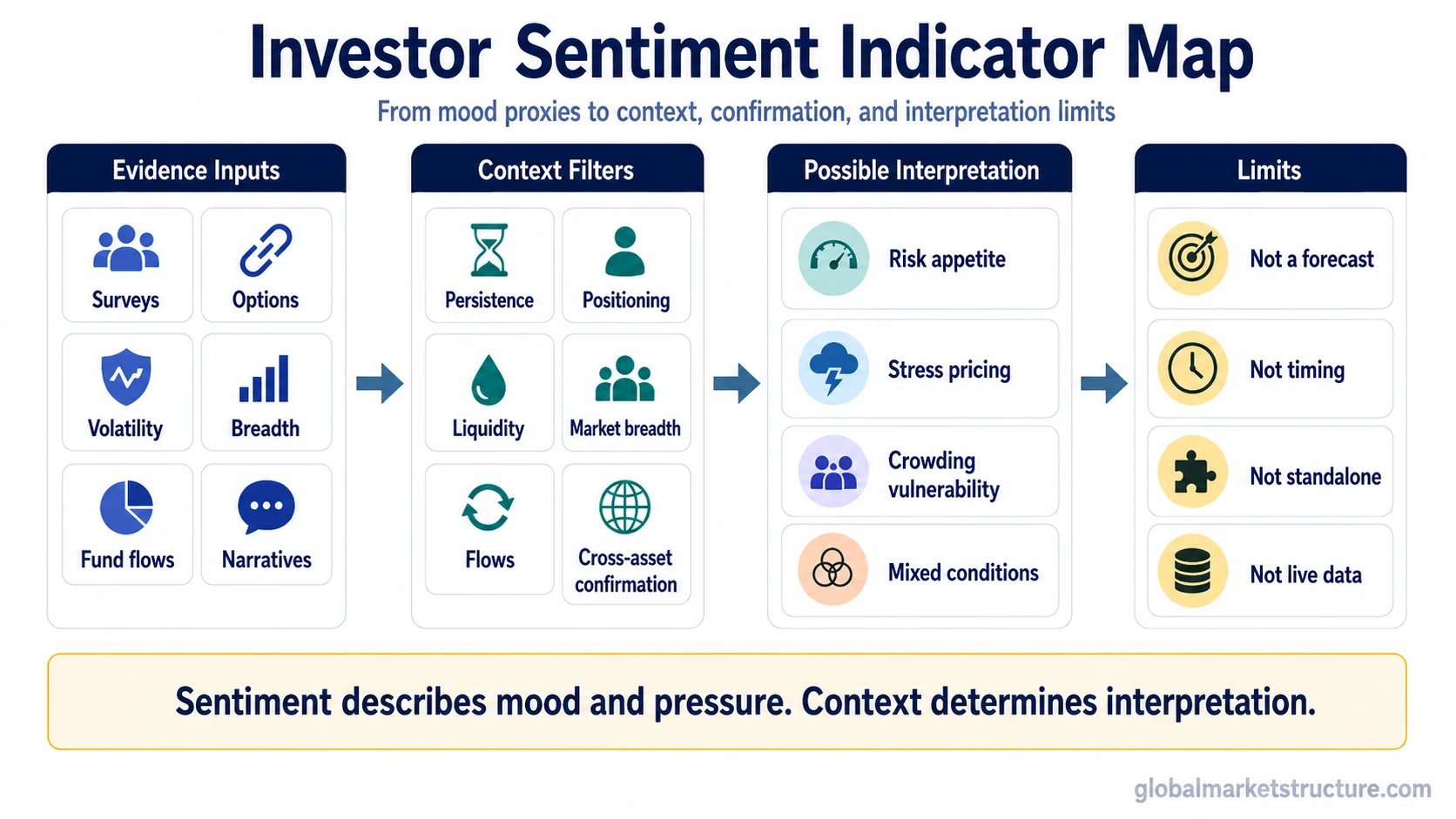
Investor sentiment indicator map showing evidence inputs, context filters, possible interpretations, and limits.
Investor sentiment indicators are most useful when mood, positioning pressure, liquidity, flows, breadth, and cross-asset confirmation are interpreted together.

Investor Sentiment Indicator Families

Sentiment indicators are easiest to interpret when they are grouped by what they actually observe. A survey, an options ratio, a volatility gauge, and a fund-flow measure should not be read as if they are the same type of evidence.

Indicator family What it tries to show How to use it carefully
Survey indicators How investors report feeling about future market conditions. Useful for mood extremes, but reported opinions can change quickly and may not match actual exposure.
Options sentiment How market participants are using puts and calls for hedging, speculation, or protection. Useful as a risk-appetite clue, but options activity can reflect hedging demand rather than outright directional conviction.
Volatility and fear gauges How much stress, uncertainty, or demand for protection appears in market pricing. Useful when volatility aligns with liquidity stress, widening spreads, weaker breadth, or defensive flows.
Breadth and participation proxies Whether risk appetite is broad across many stocks or concentrated in a narrow group of leaders. Useful for confirmation because strong index performance with weak participation can signal fragile sentiment.
Fund-flow and positioning context Where capital appears to be moving and whether exposure is becoming concentrated. Useful for identifying persistence, crowding, and potential liquidity sensitivity.
Media and social sentiment How market narratives, headlines, or retail discussion appear to be tilted. Use cautiously because narrative intensity can be noisy, late, or disconnected from actual capital flows.

How To Interpret Investor Sentiment Indicators

The practical question is not whether a sentiment indicator is bullish or bearish by itself. The better question is what the reading says about market vulnerability, crowding, risk appetite, and confirmation from other evidence.

Condition Possible interpretation Main limitation
Sentiment is very optimistic, but breadth is broad and liquidity remains supportive. Risk appetite may be strong and widely supported. Optimism alone does not prove the market is near a top.
Sentiment is very optimistic while leadership narrows and flows concentrate in a small group of assets. Crowding risk may be increasing because exposure is becoming less diversified. Crowding can persist for longer than expected if liquidity and momentum remain supportive.
Sentiment is very pessimistic while selling pressure is persistent and liquidity is weak. Fear may reflect real stress rather than an immediate contrarian opportunity. Extreme pessimism does not automatically mark a durable bottom.
Sentiment improves while flows, breadth, and credit conditions also stabilize. The improvement may reflect a broader shift in risk appetite. Confirmation still depends on whether the improvement persists beyond a short relief move.
Sentiment readings conflict across surveys, options, volatility, and flows. The market may be in a mixed or transitional risk environment. Conflicting evidence should reduce confidence, not force a single conclusion.

Common Mistake: Treating Sentiment Extremes As Timing Signals

A common mistake is assuming that extreme optimism must mean a reversal is near, or that extreme pessimism must mean a bottom is forming. That reading is too mechanical. Sentiment extremes can identify vulnerability, but vulnerability is not the same as timing.

A stronger interpretation asks whether the sentiment reading is persistent, whether positioning is crowded, whether liquidity is tightening, whether breadth is weakening, and whether cross-market evidence is confirming the same message. Without that surrounding evidence, a sentiment extreme is only one input.

Failure-Mode Example

A practical scenario is a market where survey sentiment turns very bearish after a sharp decline. The tempting read is to treat that pessimism as contrarian and assume that downside risk is exhausted.

That read is incomplete if fund flows remain negative, volatility stays elevated, market breadth keeps deteriorating, and credit-sensitive areas do not stabilize. In that case, pessimism may reflect ongoing stress rather than capitulation. The stronger case would require evidence that selling pressure is losing force, liquidity is improving, participation is broadening, or risk appetite is returning across more than one market segment.

The failed case is when the sentiment reading is extreme, but the broader structure does not improve. The lesson is that sentiment can describe the emotional state of the market without proving that the market has finished repricing risk.

Investor Sentiment Indicators vs Market Sentiment vs Positioning

Investor sentiment indicators, market sentiment, and positioning are related, but they are not interchangeable.

Concept What it means Why the distinction matters
Investor sentiment indicators Specific measures that reflect mood, fear, greed, hedging behavior, or risk appetite proxies. They are evidence inputs, not complete market explanations.
Market sentiment The broader tone of risk appetite across investors, assets, narratives, and market behavior. It is the wider condition that individual indicators help interpret.
Positioning How investors are actually exposed through holdings, leverage, flows, or derivatives. It can matter more than stated opinion because forced exposure changes can affect liquidity.
Current dashboard readings Live or recent values from data providers, indexes, or composite gauges. They show a reading at a point in time, but they do not explain the full market structure by themselves.

Related Indicators and Where They Fit

The Fear and Greed Index belongs in the composite-gauge category because it combines several market inputs into a single sentiment-style reading. That can be useful for quick context, but the reading still needs interpretation against liquidity, breadth, flows, and positioning.

The put-call ratio belongs in the options-sentiment category. It can help show demand for calls versus puts, but the same ratio can reflect hedging, speculation, or changing volatility conditions. The surrounding context determines whether the reading is meaningful.

Final Limitation

No single investor sentiment indicator can reliably explain the whole market environment. A survey can show reported mood. An options measure can show hedging or speculation. A volatility gauge can show stress pricing. A flow measure can show capital movement. None of these alone proves what the market will do next.

The strongest use of sentiment indicators is conditional. They help when they are placed inside a broader evidence stack that includes persistence, positioning pressure, capital flows, liquidity, breadth, and cross-asset confirmation. They become weaker when they are used as standalone forecasts or as shortcuts for timing.

FAQ

Are investor sentiment indicators predictive?

Investor sentiment indicators are not reliable standalone prediction tools. They can show mood, fear, greed, crowding, or risk appetite, but interpretation depends on confirmation from flows, positioning, liquidity, breadth, and related market evidence.

Which investor sentiment indicator is best?

No single sentiment indicator is best in every environment. Surveys, options data, volatility gauges, fund flows, and breadth proxies each measure different evidence. The useful approach is to compare several types of evidence rather than ranking one as universally superior.

Do extreme sentiment readings mean a market reversal is near?

Extreme readings can show vulnerability or crowding, but they do not time reversals by themselves. A reversal case needs stronger evidence, such as changing flows, stabilizing liquidity, broader participation, or a shift in related market behavior.