
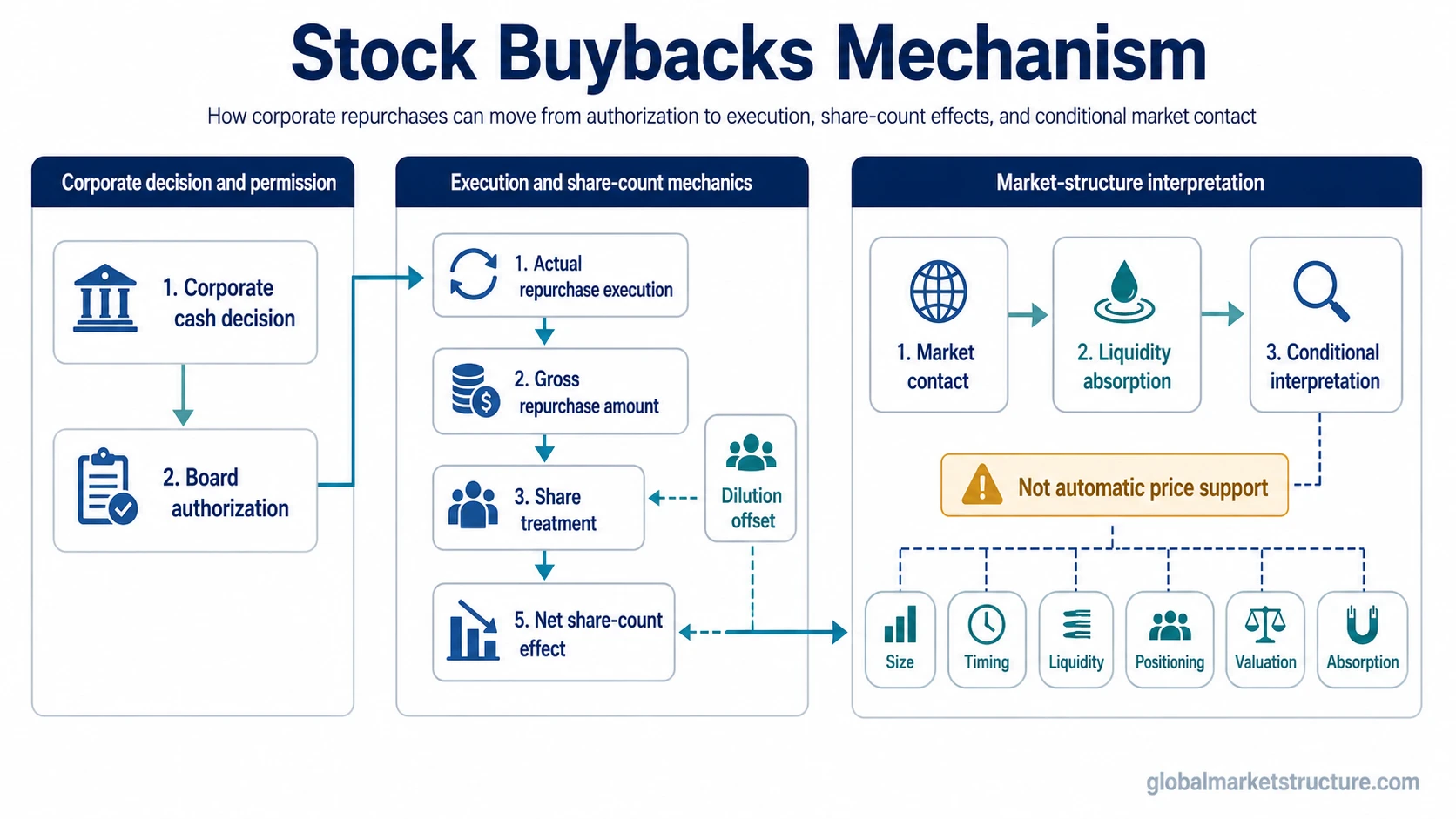
A stock buyback is a company repurchasing its own shares. The market effect depends on actual execution. Buybacks can reduce share count, support EPS, and add demand when real purchases occur, while dilution, liquidity, timing, and absorption can weaken those effects.
In simple terms: a buyback authorization gives a company capacity to repurchase shares. The company may use all, part, or none of that capacity, and purchases can be spread across time.
A large authorization therefore says little about immediate market demand by itself. Actual purchases, execution pace, and the liquidity available to absorb them determine the flow that reaches the market.
What Stock Buybacks Actually Mean
A stock buyback, or share repurchase, happens when a company purchases its own shares. If those shares are retired or otherwise reduce the effective share count, the transaction can affect shares outstanding and per-share metrics.
Buyback analysis becomes clearer when the board authorization, the purchases actually executed, and the eventual change in share count are treated separately.
| Layer | What it means | What it does not prove |
|---|---|---|
| Authorization | The company is allowed to repurchase shares up to a stated amount or limit. | That the full amount will be executed. |
| Execution | The company actually buys shares in the market or through another repurchase method. | That the market impact must be large. |
| Net share-count effect | Repurchases exceed offsetting issuance or dilution. | That every buyback automatically reduces the effective share count. |
Authorization vs Actual Buyback Execution
Market contact begins when purchases are actually executed.
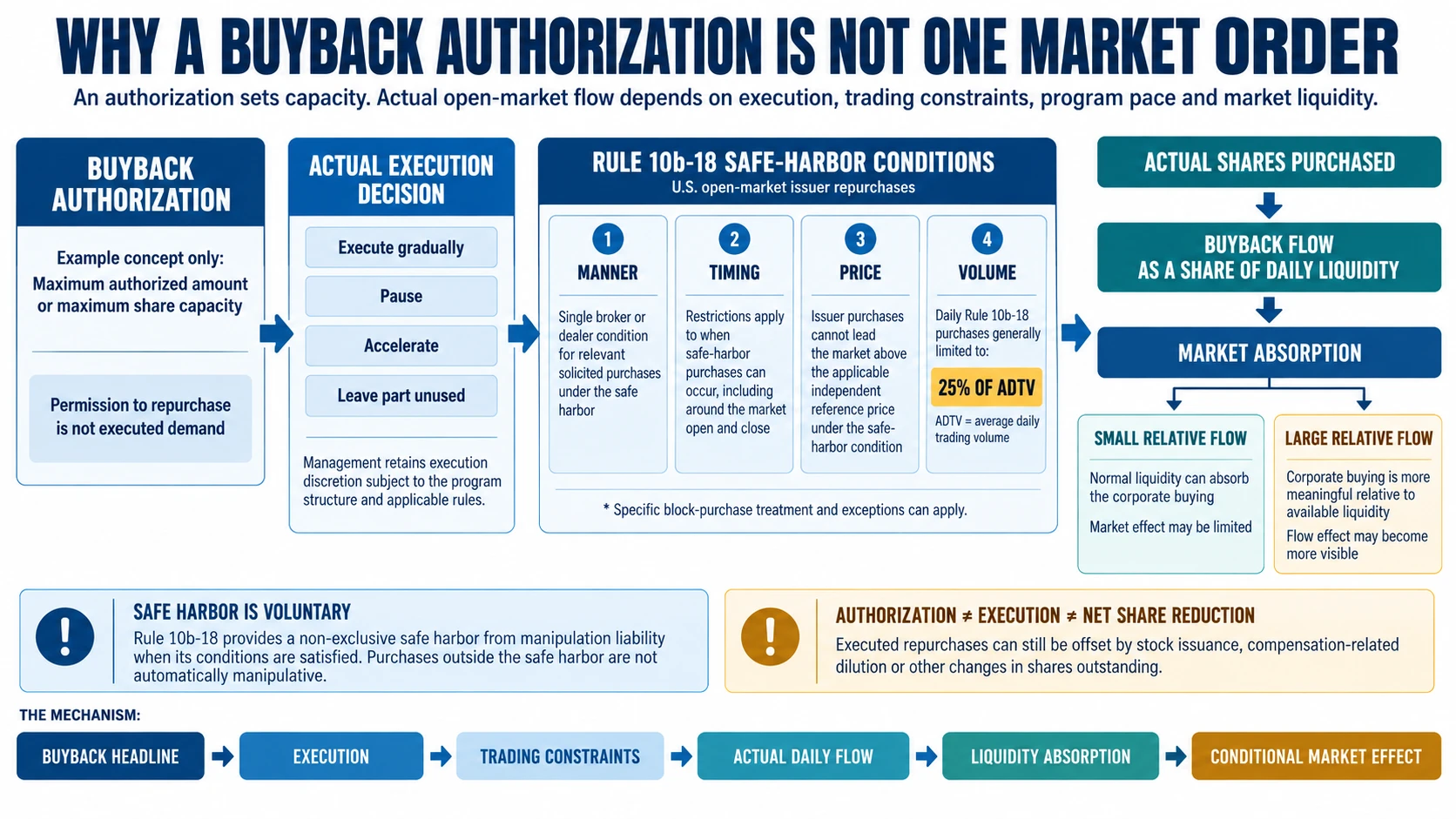
Companies can use only part of an authorization, spread purchases over time, pause the program, or leave part of it unused. A large headline authorization can therefore produce a much smaller real flow effect.
Why a Buyback Authorization Is Not One Market Order
Open-market repurchases are generally executed over time. Their pace can depend on market conditions, internal decisions, blackout periods, and the rules or program structures governing execution.
Companies are not required to use that safe harbor, and purchases outside it are not automatically improper. Its conditions are still useful for understanding why issuer repurchases conducted within the framework tend to be constrained rather than unlimited.
| Execution constraint | What it affects | Why it matters for flow interpretation |
|---|---|---|
| Manner | How purchases are routed within the safe-harbor framework. | Execution follows defined conditions. |
| Timing | When qualifying purchases can occur. | Timing conditions affect when issuer demand can reach the market. |
| Price | The price conditions for qualifying purchases. | The safe harbor does not provide unlimited price discretion. |
| Volume | The daily purchase size under the safe-harbor condition, generally linked to ADTV. | A large total program can translate into a much smaller daily flow. |
The authorization can then be translated into a more useful market-structure sequence: actual execution, daily or periodic repurchase flow, and that flow relative to normal trading liquidity. This shows whether corporate buying is likely to be a small background source of demand or a more visible part of market absorption.
Gross Repurchases vs Net Share Reduction
Gross repurchases do not always translate into an equal reduction in shares outstanding. A company can repurchase shares while issuing others through stock compensation, acquisitions, convertibles, or other capital actions.
Net share-count change therefore gives a different piece of information from gross repurchase spending. Heavy repurchase activity can coexist with only a small decline in diluted shares outstanding when issuance offsets much of the buying.
| Measure | What it shows | Main limitation |
|---|---|---|
| Authorization amount | Repurchase capacity approved by the company. | Does not establish actual execution. |
| Gross repurchases | How many shares or how much capital was used to buy shares back. | Does not include offsetting issuance. |
| Net share reduction | The share-count change after repurchases and offsetting issuance are considered. | Does not establish a lasting valuation benefit by itself. |
Do Stock Buybacks Always Increase EPS?
EPS can rise mechanically when net income remains unchanged and the effective share count falls. The size of that effect depends on how much the share count actually declines and what happens to earnings during the same period.
Weaker earnings can offset the denominator benefit. Stock-based compensation or other issuance can also leave the share count higher than gross repurchase figures suggest.
When Buybacks Matter More for Market Flow
The same dollar amount can have different market effects depending on execution pace and available liquidity.
| Condition | Stronger flow relevance | Weaker flow relevance |
|---|---|---|
| Program size vs liquidity | The repurchase flow is meaningful relative to normal trading volume. | The flow is small relative to available liquidity. |
| Execution pace | Repurchases are active and persistent. | Repurchases are slow, intermittent, or largely unused. |
| Dilution | Repurchases produce visible net share reduction. | Issuance offsets much of the repurchase activity. |
| Market positioning | Corporate demand represents a larger share of available liquidity. | Other buying and selling flows dominate the market. |
| Earnings backdrop | Stable or improving earnings preserve more of the mechanical per-share effect. | Falling earnings can offset the benefit of a lower share count. |
Buybacks are therefore one component of the flow backdrop. Their relevance increases when executed buying is large enough to matter relative to the liquidity available at the time.
Why Companies Use Stock Buybacks
Companies can use repurchases to return excess cash, adjust capital structure, offset dilution, support per-share metrics, or allocate capital when management prefers repurchasing shares to other available uses of cash.
The economic result depends on the circumstances. Balance-sheet capacity, reinvestment needs, valuation, financing, and the price paid for the shares all affect the eventual outcome.
Stock Buybacks vs Dividends
Buybacks and dividends return capital through different mechanisms. A dividend transfers cash directly to shareholders. A buyback uses corporate cash to purchase shares and can reduce the share count when repurchases exceed offsetting issuance.
| Feature | Stock buybacks | Dividends |
|---|---|---|
| Capital-return form | Company repurchases its own shares. | Company distributes cash directly to shareholders. |
| Flexibility | Programs can be adjusted, paused, or executed opportunistically. | Regular dividends can create a stronger expectation of continuity. |
| Per-share effect | Can reduce shares outstanding if repurchases exceed dilution. | Does not directly reduce share count. |
| Market-flow relevance | Can create direct issuer demand when shares are actually repurchased. | Primarily distributes cash rather than creating issuer share purchases. |
| Main interpretation risk | Confusing authorization with execution or gross spending with net reduction. | Assuming a dividend policy will remain unchanged. |
The relative value of either method depends on the business, valuation, balance sheet, reinvestment opportunities, tax context, and how the capital-return policy is funded.
Why Buybacks Are Not Automatically Bullish
Executed repurchases can add demand and reduce share count, but neither effect determines the market outcome on its own. Buying can be small relative to liquidity, dilution can offset the share-count effect, and earnings or valuation can move against the mechanical benefit.
Funding also changes the interpretation. Repurchases funded from excess cash have a different balance-sheet effect from programs that require additional borrowing.
Market absorption matters as well. Strong selling can absorb corporate demand without producing a clear price response, while the same repurchase pace may become more visible when available liquidity is thinner.
Simple Stock Buyback Example
A company authorizes a large repurchase program and executes only part of it over several quarters. During the same period, it issues new shares through stock-based compensation. Gross repurchases are substantial, while the net decline in shares outstanding is smaller because part of the buying offsets dilution.
The market-flow effect also depends on how those purchases compare with normal liquidity. Separating the authorization, executed repurchases, net share-count change, and actual trading flow produces a more precise reading than the headline amount alone.
How Buybacks Fit Market-Structure Interpretation
Executed repurchases can become a source of equity demand. Their relevance depends on how much is purchased, how consistently the program is executed, and how large that flow is relative to market liquidity.
Persistent repurchases can absorb part of the available supply during execution. Over time, they can also reduce shares outstanding when new issuance does not offset the purchases.
Small, delayed, or heavily offset repurchases carry less market-structure weight. In those cases, the program remains relevant to capital allocation without becoming a dominant flow.
Buyback yield compares repurchases with market value, which makes repurchase intensity easier to compare across companies and periods.
Related Flow Mechanisms
Corporate buybacks begin with an issuer capital-allocation decision.
Index rebalancing begins with benchmark changes that can require tracking portfolios to adjust exposures.
Volatility targeting adjusts exposure through rules tied to realized or expected volatility.
These mechanisms can all affect market structure, but their triggers and execution paths are different.
Common Misreads
| Misread | Why it fails | Better reading |
|---|---|---|
| Authorization means the buying is already happening | An authorization sets repurchase capacity. The company can execute gradually, pause, or leave part of the program unused. | Track actual repurchases and execution pace. |
| Gross buybacks equal net share reduction | Stock compensation and other issuance can replace some of the shares being repurchased. | Compare gross repurchases with the change in diluted shares outstanding. |
| Higher EPS means the business improved | A lower share count can raise EPS even when operating performance is unchanged. | Separate the share-count effect from revenue, margins, and total earnings. |
| A large buyback guarantees price support | Issuer demand can be small relative to market liquidity or overwhelmed by larger selling flows. | Compare executed repurchases with available liquidity and competing flows. |
| The same buyback size has the same market effect | Liquidity, execution pace, positioning, and selling pressure can change how easily the market absorbs the buying. | Judge the flow relative to the conditions in which it is executed. |
How to Use the Concept Safely
For market-structure analysis, buybacks are most useful when authorization, actual execution, dilution, and liquidity are evaluated separately. This keeps the analysis tied to the flow that actually reaches the market.
Limitation: buybacks do not guarantee higher prices, establish undervaluation, or override earnings, positioning, liquidity, and broader market conditions.
FAQ
What is a stock buyback?
A stock buyback is a company repurchasing its own shares. It can reduce shares outstanding if the repurchased shares are retired and if new issuance or dilution does not offset the effect.
Is a buyback authorization the same as an actual buyback?
No. A buyback authorization gives the company permission to repurchase shares, but actual execution depends on whether the company buys shares, how much it buys, and when the purchases occur.
Why is a large buyback authorization not one large market order?
Because real repurchases are usually executed over time rather than all at once. Execution pace, trading rules, timing, price conditions, and market liquidity all affect how much of the authorization becomes actual daily market flow.
Do stock buybacks always increase EPS?
No. EPS can rise if net income is unchanged and the share count falls, but the effect depends on actual net share-count reduction. New issuance, stock compensation, or weaker earnings can offset the mechanical benefit.
Are stock buybacks automatically bullish?
No. Buybacks can add demand or reduce share count under the right conditions, but market impact depends on execution, size, timing, valuation, dilution, liquidity, positioning, and absorption.