Margin Requirement

Margin requirement means the minimum equity or collateral threshold needed to support financed exposure. In market-structure interpretation, the important issue is not account setup, but how that threshold can become pressure when prices fall, requirements tighten, collateral support shrinks, or a maintenance breach pushes exposure toward a margin call.

Definition: A margin requirement is the minimum equity, collateral, or margin buffer required to maintain financed exposure. It acts as a threshold between supported exposure and potential pressure from shortfalls, tighter rules, or forced reduction.

Because leverage increases exposure sensitivity, the same requirement can feel stable in calm conditions and restrictive when volatility rises, collateral values fall, or liquidity becomes thinner.

Key Points

  • A margin requirement is a threshold, not the same thing as a margin call.
  • Initial margin applies when financed exposure is opened; maintenance margin applies while it remains open.
  • Tighter requirements matter more when leveraged exposure, falling collateral values, and weak liquidity interact.
  • A margin requirement is not a standalone market forecast.

Margin Requirement Meaning

A margin requirement sets the amount of equity or collateral needed to support borrowed or financed market exposure. When the available equity buffer is comfortably above the required level, the requirement may only define capacity. When the buffer narrows, the same rule can become a constraint point.

The market-structure value comes from the relationship between the requirement and the surrounding conditions. A stable requirement with ample collateral is different from a rising requirement during falling prices, wider volatility, and weaker liquidity. The threshold matters because it can change how much exposure participants are able to carry.

Threshold, not prediction: A margin requirement can help identify where leverage becomes more fragile, but it does not predict direction by itself.

Margin Requirement, Initial Margin, Maintenance Margin, and Margin Call

The main distinction is between the threshold itself and what happens after the threshold is breached. Initial and maintenance requirements describe different points in the life of financed exposure. A margin call describes a response to a shortfall.

Concept What it means Market-structure relevance
Margin requirement The equity or collateral threshold required to support financed exposure. Defines how much buffer exists before pressure can appear.
Initial margin The threshold required when exposure is opened. Shapes how much financed exposure can be created at the start.
Maintenance margin The ongoing threshold required after exposure is open. Becomes important when losses or requirement changes reduce the buffer.
Margin call A demand or corrective event after equity falls below a required threshold. Can start the path toward exposure reduction if the shortfall is not resolved.
Margin debt An aggregate measure of borrowing secured by securities. Shows borrowed exposure at a system level, not the threshold on one position or account.

Why Margin Requirement Acts Like a Threshold

A threshold matters because the same exposure can move from supported to stressed without the underlying position changing size. The change can come from falling asset values, tighter requirements, higher volatility, weaker liquidity, concentration limits, or broker and house rules that are stricter than minimum regulatory rules.

Broker or house requirements can be stricter than regulatory minimums, so the market-structure reading should focus on how the required buffer changes under stress rather than treating one provider rule as a universal signal.

The useful question is not only whether a requirement exists. The useful question is whether financed exposure still has enough support after price movement, volatility, and liquidity conditions change.

Stable threshold: Exposure remains supported when collateral values are steady and the required buffer is comfortably maintained.

Constraint point: Exposure becomes more fragile when the required buffer rises or collateral value falls close to the maintenance boundary.

Breach pathway: A shortfall can lead to a margin call, forced reduction, or liquidation pressure if the account cannot restore the required buffer.

How Margin Requirements Become Leverage Pressure

Margin requirements become market-structure pressure when they interact with exposure that is already sensitive to price movement. The pressure chain is usually conditional, not automatic.

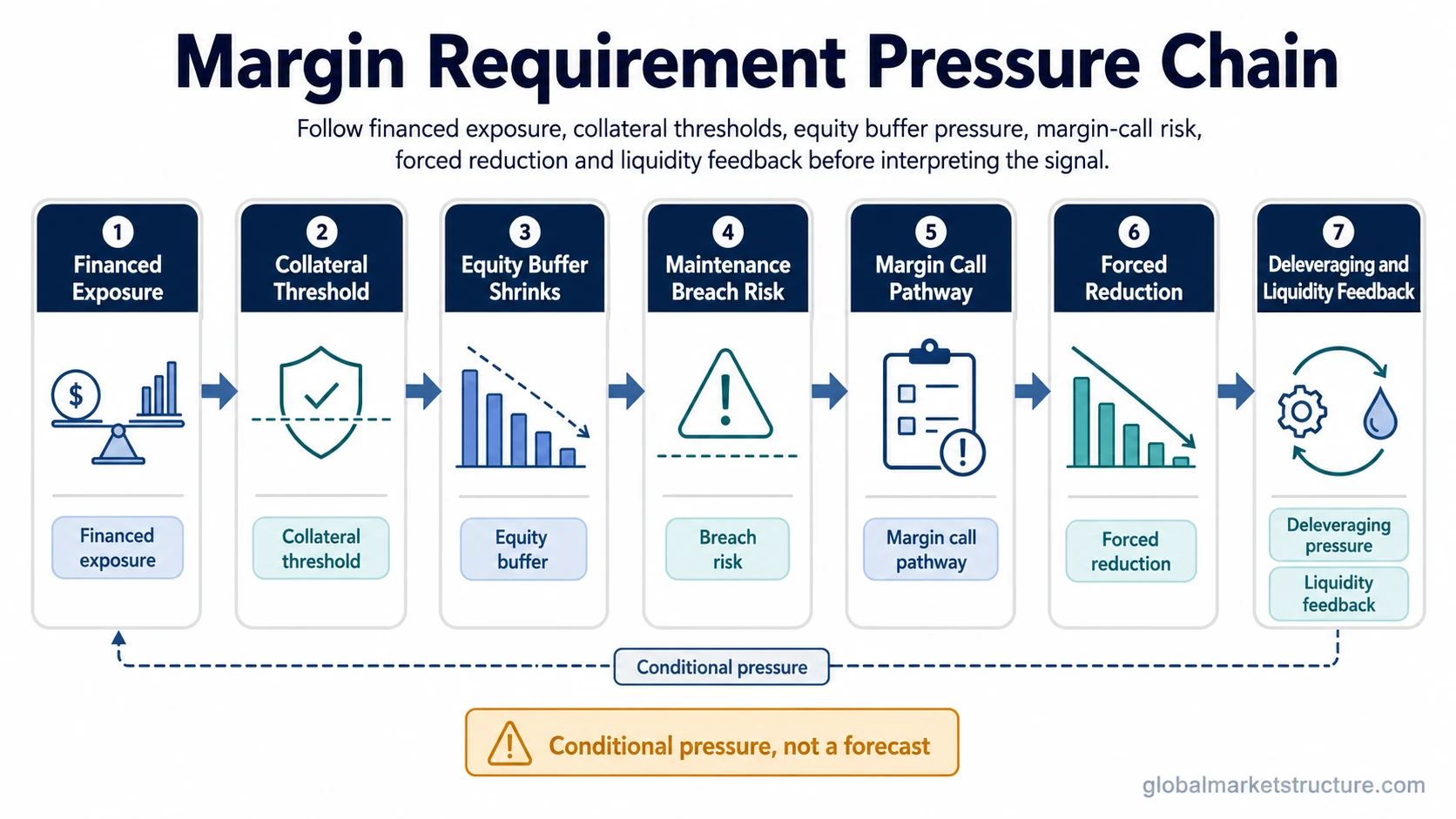
Pressure chain: financed exposure → collateral threshold → shrinking equity buffer → maintenance breach risk → margin call pathway → forced reduction → deleveraging pressure → liquidity feedback.

The chain becomes more important when many participants face similar exposure constraints at the same time. If liquidity is thin, forced reductions may have larger price impact. If volatility is rising, requirements may tighten while collateral values are already falling. That combination can create a feedback loop between collateral pressure and market liquidity.

Margin requirement pressure chain showing financed exposure, collateral threshold, equity buffer pressure, margin call pathway, forced reduction, deleveraging pressure, and liquidity feedback.
Margin requirement acts as a collateral threshold, not a standalone forecast. It matters most when leverage, falling collateral values, tighter requirements, and liquidity pressure interact.

What Changes the Interpretation

A margin requirement has different meaning depending on the condition around it. The same numerical threshold can be routine in one environment and restrictive in another.

Condition Possible implication Limitation
Stable requirement Financed exposure may remain well supported if collateral buffer is ample. Stability does not remove price risk or funding risk.
Rising requirement Available risk capacity may shrink even if exposure size is unchanged. A tighter threshold does not prove broad market stress by itself.
Price decline near maintenance threshold The account or position may become more sensitive to further losses. The outcome depends on collateral, liquidity, and the ability to restore the buffer.
Requirement breach The breach can start a corrective process that may involve adding collateral or reducing exposure. Not every breach creates broad forced selling pressure.
100% requirement Borrowing capacity for that exposure may be limited or removed. It does not automatically mean liquidation is imminent or that the market direction is known.
Broker or house tightening Participants may need more equity to carry the same exposure. Provider-specific rules should not be generalized across all markets or brokers.
Weak liquidity Forced reductions may have larger price impact if many participants reduce exposure together. Liquidity stress must be confirmed through broader market conditions, not inferred from one requirement alone.

Common Mistakes

Mistake 1: Treating margin requirement as the same thing as margin call. A requirement is the threshold. A margin call is a response after the required buffer is not met.

Mistake 2: Treating margin requirement as the same thing as margin debt. Margin debt measures borrowing at an aggregate level. A margin requirement defines the buffer needed to support financed exposure.

Mistake 3: Treating tighter requirements as a standalone forecast. Requirements may reduce capacity, but direction depends on exposure, liquidity, volatility, positioning, and how participants respond.

Mistake 4: Treating provider rules as broad market signals. Broker or house rules may reflect risk controls for specific products, accounts, or conditions, not a universal market message.

Margin Requirement Scenario in Volatile Conditions

Prices decline while volatility rises, and requirements tighten on exposures that were previously easy to finance. The collateral buffer shrinks from both sides: asset values fall, while the required equity threshold becomes harder to maintain.

If leveraged exposure is small and liquidity remains deep, the effect may stay contained. If exposure is crowded, collateral support is thin, and liquidity weakens, the same requirement can become a pressure point. Participants may reduce exposure to restore the buffer, and those reductions can add to deleveraging pressure.

The scenario remains illustrative. It does not describe a specific market event, broker rule, or current stress condition.

Related Concepts

Margin requirement sits between financed exposure and forced reduction risk. The related concepts separate the chain into clearer parts: exposure sensitivity, threshold breach, corrective demand, and potential liquidation pressure.

Related concept How it fits the pressure chain
Exposure sensitivity Leverage explains why a small equity buffer can make a position more sensitive to price movement and requirement changes.
Breach pathway Margin call explains the demand or corrective process that can follow when the required buffer is not maintained.
Forced-flow risk Forced liquidation and deleveraging become relevant only after the threshold problem starts affecting actual exposure reduction.

FAQ

What is a margin requirement in simple terms?

A margin requirement is the minimum equity or collateral needed to support financed exposure. It defines the buffer required before the exposure becomes under-supported.

Is a margin requirement the same as a margin call?

No. A margin requirement is the threshold. A margin call is a response that can occur after equity falls below the required threshold.

What is the difference between initial margin and maintenance margin?

Initial margin applies when financed exposure is opened. Maintenance margin applies while the exposure remains open and becomes important when losses or tighter requirements reduce the buffer.

Does a higher margin requirement predict market direction?

No. A higher requirement can reduce borrowing capacity or increase pressure on leveraged exposure, but market direction depends on positioning, liquidity, volatility, collateral values, and participant behavior.