
A reverse carry trade, as used here, describes a deterioration or reversal in the economics that supported an existing carry position. The change can come from a narrower rate differential, higher funding costs, a stronger funding currency, or a less favorable volatility and liquidity backdrop. The phrase describes the incentive state before it says anything about actual position flows.
The original carry trade can remain open even after its expected advantage weakens. Actual reduction or closure of existing positions belongs to the carry trade unwind stage.
The funding, rate, FX, or risk conditions supporting the original carry become less favorable or begin to favor the opposite allocation.
Existing positions are actually reduced, hedged, closed, or forced lower as participants respond to changing economics or risk constraints.
How Carry Incentives Reverse
A carry position starts with an expected advantage between a lower-cost funding side and a higher-yielding exposure. That advantage can shrink even before the original rate gap disappears. Exchange-rate movement, hedging costs, financing terms, volatility, and liquidity can all change the economics of maintaining the position.
Those arrows describe a possible transmission path rather than a deterministic sequence. A rate repricing can weaken carry without forcing exits, and a funding currency can strengthen for reasons unrelated to carry positioning.
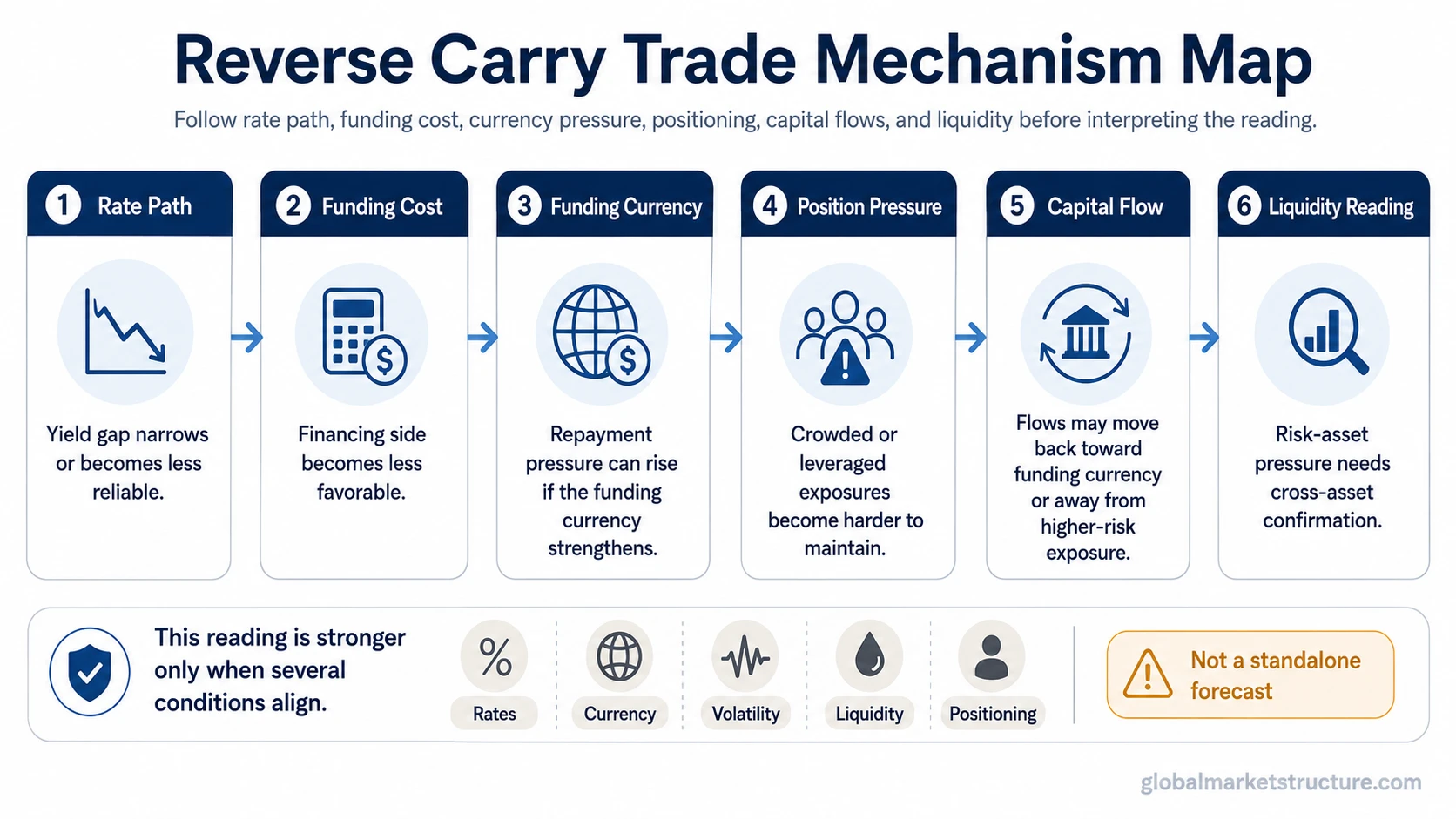
What Changes the Economics
| Channel | Observed change | Possible effect on carry | What still needs confirmation |
|---|---|---|---|
| Rate differential | The yield advantage narrows or expected policy paths converge. | The compensation for holding the funded exposure declines. | Whether the remaining spread is still attractive after FX and financing costs. |
| Funding cost | Borrowing, rollover, or hedging becomes more expensive. | The net economics deteriorate even if headline yields have not moved much. | The actual financing structure and how long the higher cost persists. |
| Funding currency | The currency used to fund the position strengthens. | Unhedged or partly hedged carry exposure can face a larger FX loss. | Whether the move is connected to carry positioning rather than another macro driver. |
| Volatility and positioning | Price variability rises while similar carry positions are crowded or leveraged. | Risk limits and mark-to-market losses can make the position harder to maintain. | Evidence that positions are actually being reduced rather than merely repriced. |
| Liquidity | Market depth weakens as participants need to adjust exposure. | Normal resizing can produce larger price moves and stronger feedback. | Whether the pressure remains local or spreads across connected markets. |
BIS Bulletin 124 finds that large short positions in funding currencies can amplify the exchange-rate response to policy tightening through the unwinding of leveraged carry positions. BIS Bulletin 90 documents a separate episode in which deleveraging and margin increases amplified volatility during a carry-trade unwind. These findings support the mechanics above without making every rate or currency reversal evidence of an unwind.
Reverse Carry Trade vs Reverse Cash-and-Carry
The similar names refer to different structures. Reverse carry, in the sense used on this page, concerns the economics of an existing carry setup. Reverse cash-and-carry is a defined cash-futures arbitrage structure.
- Focuses on funding, yield differentials, FX movement, and holding conditions.
- Can appear before any position is actually closed.
- Does not require a specific spot-versus-futures pair.
- Shorts the cash asset and goes long the related futures contract.
- Targets a futures contract trading cheaply relative to the cash asset after carry economics.
- Belongs to spot-futures pricing and arbitrage mechanics.
CME Group describes reverse cash-and-carry as selling the security in the cash market while going long the futures contract. For the broader family of spread relationships between linked instruments, see Basis trade.
Where Currency Carry Fits
Currency carry trade provides the baseline FX structure: funding in a lower-yielding currency and holding higher-yielding currency exposure. Yen-funded examples appear frequently because the yen has often served as a funding currency, but the reverse-carry idea is broader than a yen-specific episode.
A stronger funding currency can weaken the economics of an unhedged carry position. The interpretation becomes more credible when the rate differential, funding conditions, positioning, volatility, and target exposures all move in a consistent direction.
When Incentive Reversal Becomes Market Pressure
The expected carry becomes less attractive because rates, FX, financing, or volatility move against the original setup.
Participants hedge more, reduce leverage, rotate exposure, or begin closing positions.
Margin, collateral, liquidity, or financing constraints make reductions less discretionary and increase cross-market transmission risk.
If financing access, collateral terms, or market depth become the dominant problem, the analysis has moved into broader funding stress rather than a simple change in carry incentives.
Participants can accept lower carry, hedge the currency exposure, or reduce positions gradually. A stronger market-stress interpretation needs evidence of actual position reduction, leverage pressure, weaker liquidity, or cross-asset transmission.
FAQ
Is a reverse carry trade the same as a carry trade unwind?
No. Reverse carry trade on this page describes a deterioration or reversal in the incentives behind a carry structure. A carry trade unwind is the actual reduction, hedging, or closure of existing carry positions.
Is reverse carry trade the same as reverse cash-and-carry arbitrage?
No. Reverse cash-and-carry arbitrage shorts the cash asset and goes long the related futures contract to exploit a spot-futures pricing relationship. Reverse carry trade here refers to changing funding, rate, FX, and capital-flow incentives.
Does a reverse carry trade predict a market crash?
No. Deteriorating carry economics can contribute to market pressure, but direction and severity depend on actual positioning, leverage, liquidity, financing conditions, and whether position reductions spread across markets.