
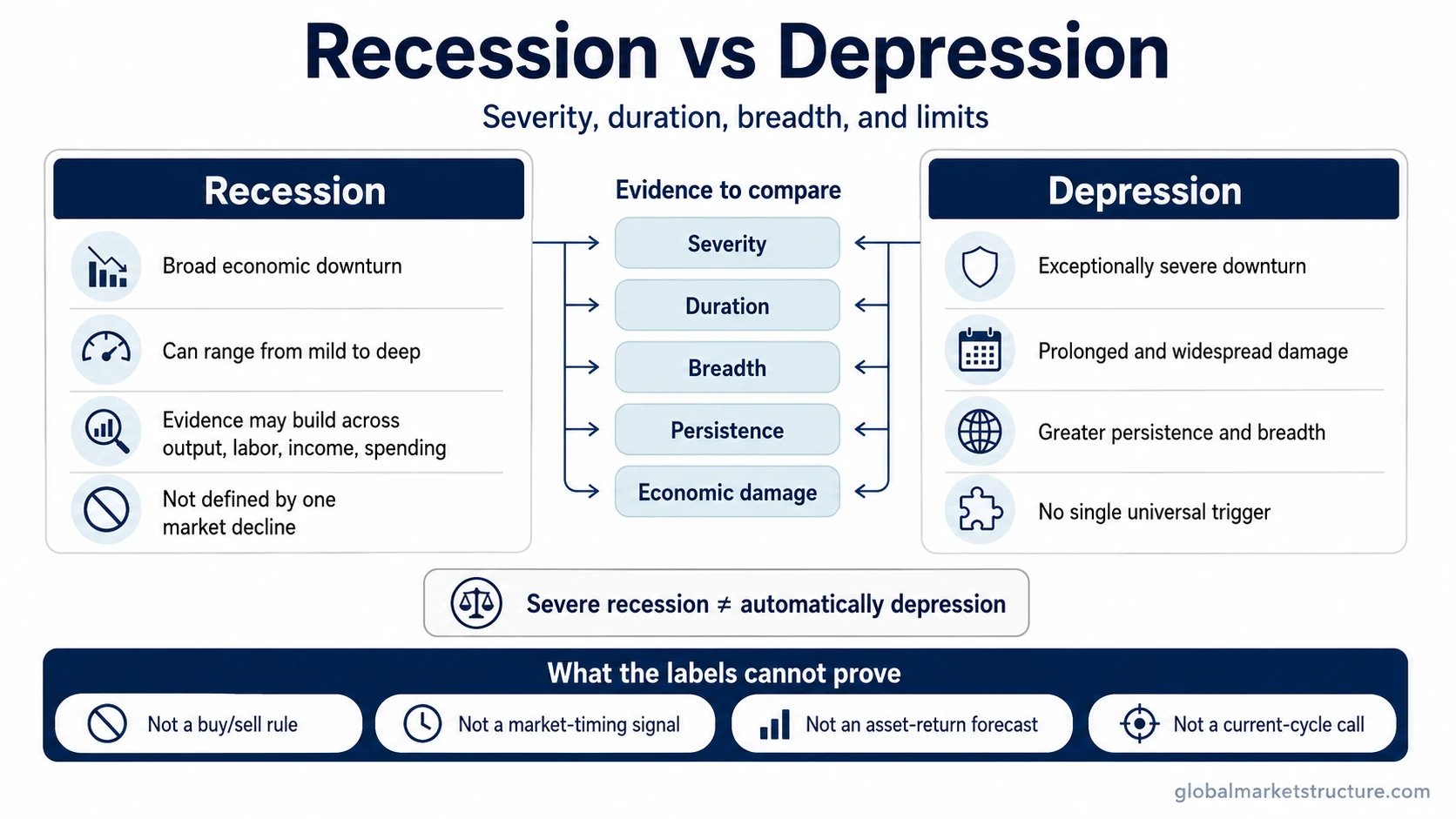
A recession is a broad decline in economic activity across an economy, while a depression is a much more severe, prolonged, and widespread downturn. The difference is not just a stock-market drop or one weak GDP reading. It is a classification judgment based on depth, duration, breadth, and persistence, and neither label is a buy/sell signal or asset-return forecast.
Key points:
- A recession describes a broad economic downturn, not every market decline or single weak data point.
- An economic depression is a rarer and stronger classification for an unusually severe, prolonged, and widespread contraction.
- Depression does not have one universal official trigger that applies across every country, institution, and historical case.
- Economic labels classify conditions after evidence accumulates. They do not time market tops, bottoms, or future returns.
Recession vs Depression: Core Differences
| Criteria | Recession | Depression | Why the distinction matters |
|---|---|---|---|
| Basic meaning | A broad economic downturn. | An exceptionally severe broad downturn. | The terms classify different degrees of economic stress. |
| Severity | Can range from mild to deep. | Requires unusually large economic damage. | A severe recession is not automatically a depression. |
| Duration | Usually shorter than a depression. | Usually prolonged and harder to reverse. | Time matters because brief shocks can look extreme before evidence settles. |
| Breadth | Affects broad activity, such as output, income, employment, and spending. | Affects the economy more deeply and widely across households, firms, and credit conditions. | A narrow sector slump is not enough by itself. |
| Persistence | Evidence must last beyond a very brief disruption. | Weakness remains entrenched across the economy. | Persistence separates a temporary shock from a deeper economic breakdown. |
| Evidence used | Broad economic indicators, not only GDP. | Severity, duration, breadth, and historical context. | Single-metric definitions can create false certainty. |
| Formality / threshold | Some countries and institutions use formal dating methods or technical rules. | No single universal official threshold defines every depression. | The depression label requires caution because the boundary is less standardized. |
| Market-signal limitation | Does not automatically identify market direction. | Does not automatically identify market direction. | Economic classification is not a trading rule. |
What Makes a Downturn Recessionary?
A recession is not simply a bad week for markets, a decline in one asset class, or a weak reading in one report. The useful classification test is whether economic activity has weakened broadly enough to affect the real economy rather than only sentiment or prices.
Common evidence includes output, employment, income, production, sales, and spending. A two-quarter GDP decline is a familiar shortcut in many discussions, but it is not the full definition used in every official or institutional setting.
The practical boundary is breadth. If weakness is narrow, brief, or limited to financial markets, recession language can become premature. If weakness spreads across multiple parts of the economy and persists, the recession label becomes more defensible.
What Makes a Downturn Depression-Level?
Depression is a stronger classification. It is usually reserved for downturns that are not only broad, but also unusually deep, long-lasting, and damaging across the economy. The term points to exceptional severity rather than a routine cyclical contraction.
The boundary cannot be reduced to one universal number. A downturn does not become a depression only because GDP falls for a set number of quarters, unemployment rises, or markets crash. Those signals may be part of the evidence, but the classification depends on the combined scale, breadth, and persistence of the damage.
That is why “depression” should not be used as a casual synonym for a painful recession. A recession can be serious without crossing into depression-level classification.
Severe Recession vs Depression Boundary
A severe recession can include deep contraction, falling employment, weaker income, tighter credit, and pressure across many industries. Depression language requires a higher bar: exceptional depth, long duration, broad damage, and persistent weakness that goes beyond a normal cyclical downturn.
| Situation | More accurate label | Reason |
|---|---|---|
| Broad economic weakness that is painful but not historically extreme | Recession | The downturn is broad, but the depression threshold is not automatically met. |
| Deep, prolonged, economy-wide contraction with persistent damage | Possible depression classification | The evidence may justify stronger language if severity, duration, breadth, and persistence align. |
| Large stock-market decline without broad economic contraction | Neither label by itself | Market prices alone do not define recession or depression. |
The boundary is easiest to misread when a recession is painful but still cyclical. A severe recession can produce major stress without becoming a depression if the damage does not remain exceptionally deep, prolonged, and entrenched. Depression language should be reserved for a higher classification threshold, not used as a synonym for “bad downturn.”
Recession vs Depression Example in Context
Imagine output weakens, hiring slows, household income falls, and consumer spending contracts across several parts of the economy. If the weakness is broad and persistent enough, recession classification may be reasonable.
The same scenario should not automatically be called a depression. Depression language would require stronger evidence that the contraction is exceptionally severe, prolonged, widespread, and difficult to reverse. The same starting conditions can lead to different labels depending on how deep and persistent the damage becomes.
This is an illustrative scenario, not a current-cycle call or historical claim.
Common Mistakes When Comparing Recession and Depression
- Using GDP alone: Two quarters of negative GDP can be a useful shortcut in some contexts, but recession classification is broader than one simplified rule.
- Calling every bad recession a depression: Depression is a stronger and rarer label that requires exceptional severity and persistence.
- Treating a market crash as proof: A stock-market crash can occur with or without recessionary economic conditions.
- Using the labels as trading signals: Recession and depression describe economic conditions, not buy/sell rules.
- Assuming one universal depression threshold: Depression classification does not rely on one globally accepted official trigger.
What Recession and Depression Labels Cannot Prove
Recession and depression labels classify economic conditions. They do not prove where stock indices should trade next, when a market top or bottom has formed, whether future returns will be positive or negative, or what action any investor should take.
The labels also do not identify the current state of the economy by themselves. Classification depends on evidence, timing, revisions, and institutional judgment. A downturn can be serious without becoming a depression, and a market decline can be severe without proving that the real economy has entered either category.
Related Cycle Concepts
For the recession side of the comparison, the deeper issue is how broad economic decline is defined, dated, and separated from short-lived weakness.
For the depression side, the deeper issue is why exceptional severity, duration, breadth, and persistence create a stronger downturn label.
FAQ
Is a depression just a severe recession?
A depression is often described as a much more severe and prolonged downturn than a recession, but the distinction should not stop at “worse recession.” Depression language also depends on breadth, persistence, and the scale of economic damage.
Is two quarters of GDP decline enough to define a recession?
Two quarters of GDP decline is a common simplified rule, but recession classification can involve broader evidence, including employment, income, output, sales, and spending. The shortcut can miss how official or institutional dating methods evaluate the whole economy.
Does a stock-market crash mean there is a recession or depression?
No. A stock-market crash can reflect expectations, valuation changes, liquidity stress, or risk repricing. Recession and depression labels require evidence from the broader economy, not market prices alone.
Is there an official depression threshold?
There is no single universal official threshold that defines every depression. The label usually depends on exceptional severity, long duration, wide economic damage, and historical context.