
An economic depression is generally used to describe a severe, prolonged downturn that damages the broader economy more deeply than an ordinary recession.
In market-cycle analysis, the term describes depression-level economic deterioration. It does not by itself signal market bottoms, asset returns, policy timing, or recovery timing.
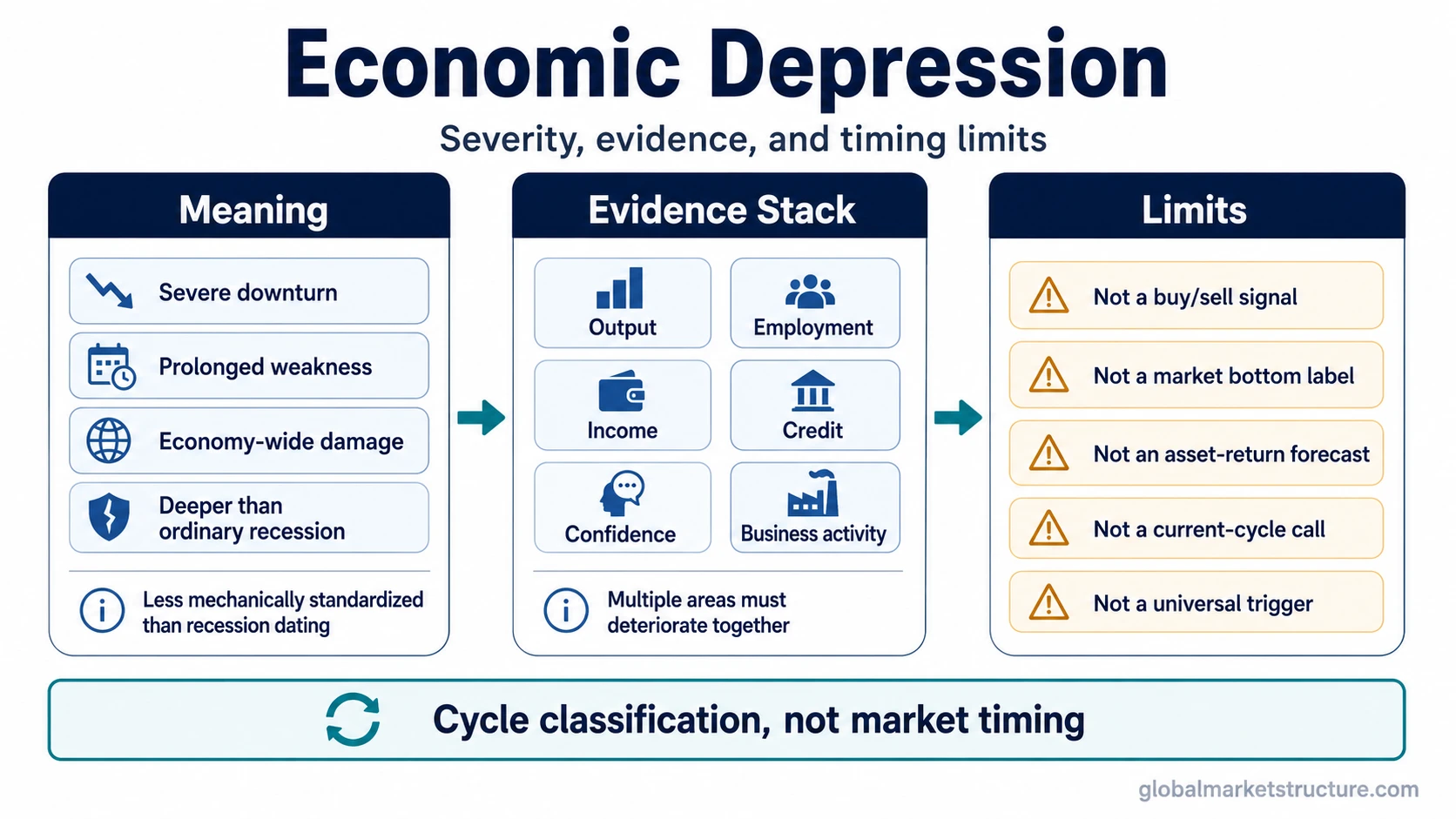
Economic depression means: a severe and prolonged contraction across the broader economy, usually involving more damage than a normal recession.
Economic depression does not mean: a mechanical trading signal, a guaranteed market decline, a confirmed market bottom, a current-cycle declaration, or a fixed official threshold that applies in every country and every period.
What is an economic depression?
An economic depression is a classification label for extreme economic weakness. The term is usually used when a downturn is unusually deep, persistent, and widespread enough to damage production, employment, income, credit creation, business activity, and confidence at the same time.
In the United States, recession dating can follow formal NBER business-cycle procedures, while depression is usually used more interpretively to describe unusually severe contraction. That distinction matters because a depression label should not be treated as a precise trigger, date stamp, or universal official declaration.
For Global Market Structure, the useful role of the term is cycle classification. It helps describe the difference between ordinary contraction and deep cycle deterioration, while keeping separate the questions of market pricing, policy response, and eventual recovery.
Economic depression vs recession
In the United States, recession is the more formally dated business-cycle category. An economic depression is generally discussed as a more severe, and often longer-lasting, downturn, but it does not have one standard trigger that works like a universal threshold.
The difference is not only time. Severity, breadth, labor-market damage, credit stress, financial instability, income weakness, and the depth of lost output all affect whether a downturn begins to look depression-like. A downturn can be serious without being labeled a depression, and a depression label should not replace a careful recession vs depression comparison.
What can support a depression-level classification?
No single indicator proves an economic depression by itself. The classification becomes more plausible when multiple areas of the economy deteriorate together and remain weak for an extended period.
These are not official depression criteria. They are evidence areas that can help interpret whether weakness is unusually deep, broad, and persistent.
| Evidence area | What it can indicate | What it cannot prove alone |
|---|---|---|
| Output and real activity | Deep contraction in production, services, investment, or commerce | A universal depression threshold |
| Employment | Broad labor-market damage and weaker household income | The exact length of the downturn |
| Income and consumption | Pressure on demand, spending, and household stability | Whether asset prices have bottomed |
| Credit conditions | Tighter lending, defaults, deleveraging, or impaired financing | The timing of policy response |
| Business failures | Stress moving from demand weakness into solvency and survival risk | The future path of equity markets |
| Financial stress | Rising strain across banks, funding markets, spreads, or liquidity | That the downturn will follow one historical template |
| Confidence and investment | Reduced willingness to hire, lend, spend, or expand | When recovery begins |
| Price pressure or deflation | Weak demand, debt pressure, or falling nominal activity where relevant | That every depression must look the same |
How an economic depression can reinforce itself
Depression-level weakness often becomes dangerous because different parts of the economy can weaken each other. Falling output can reduce income and employment. Lower income can reduce consumption. Weaker demand can pressure business revenue. Business stress can reduce hiring, investment, and credit quality.
Credit conditions can then make the downturn more difficult to stabilize. If lenders pull back, firms and households may face tighter financing just as cash flow is weakening. That can increase defaults, reduce investment, damage confidence, and deepen the contraction.
The key point is feedback. A depression is not only a bad economic number. It is a severe cycle environment where output, labor, income, credit, confidence, and financial stress can become mutually reinforcing.
Illustrative scenario
A broad economy may begin with falling production and weaker new orders. If firms respond by cutting investment and slowing hiring, household income and consumption can weaken. If credit conditions tighten at the same time, stressed firms may struggle to refinance or survive. The downturn becomes more depression-like when these forces spread across the economy and persist, but the label still does not forecast stock-market direction or recovery timing.
Market-cycle role
In market-cycle language, economic depression belongs near the severe end of contraction analysis. It is a way to describe deep cycle deterioration, not a separate asset-pricing model.
That distinction prevents a common mistake. A weak economy and a weak market can appear together, but they are not the same label. A secular bear market describes a long-term market regime, while economic depression describes severe economy-wide weakness. A bull market can describe rising asset prices, but it does not by itself define the condition of the real economy.
The cycle label helps organize macro evidence. It should not be used to infer that equities must keep falling, that a bottom is near, or that a recovery path is already visible.
What an economic depression label cannot prove
An economic depression label has strict limits. It can describe severe economic deterioration, but it does not create a direct market or policy conclusion.
- It does not create a buy signal or sell signal.
- It does not identify a stock-market bottom.
- It does not prove that asset prices will keep falling.
- It does not forecast the timing or size of policy response.
- It does not prove when recovery will begin.
- It does not declare current economic conditions without current, dated evidence.
- It does not replace recession dating or a full recession/depression comparison.
Why the Great Depression is often mentioned
The Great Depression is commonly cited because it represents an extreme example of prolonged economic weakness. That historical association can help explain why the word depression carries more severity than recession.
Historical context should remain separate from the definition. The general concept of economic depression is not the same as a history of the Great Depression, and not every severe downturn follows the same path, policy response, financial structure, or recovery sequence.
Common mistakes
Treating depression as a fixed official threshold: The term should not be reduced to one universal GDP decline, unemployment number, or duration rule unless a specific source and jurisdiction define it that way.
Treating depression as a recession synonym: A depression is usually discussed as more severe and prolonged, with broader economic damage.
Treating depression as a market signal: Economic classification and asset-price timing are different problems.
Turning the topic into Great Depression history: The historical example matters, but the core concept is broader than one episode.
FAQ
What is an economic depression?
An economic depression is a severe, prolonged, economy-wide downturn. It is generally treated as deeper and longer-lasting than a recession and can involve broad weakness in output, employment, income, credit, confidence, and business activity.
How is an economic depression different from a recession?
In the United States, recession is the more formally dated business-cycle category. A depression is generally discussed as a more severe, and often longer-lasting, downturn, but the term is less mechanically standardized than recession dating.
Is there an official definition of economic depression?
There is no single standard depression definition that should be treated as a universal trigger across all countries and periods. Specific institutions may define recessions or historical episodes differently, so the source and context matter.
Does an economic depression mean stocks will keep falling?
No. Economic depression describes severe economy-wide weakness. It does not forecast asset returns, identify a market bottom, or create a buy or sell signal.
Why is the Great Depression often used as an example?
The Great Depression is often mentioned because it is a commonly cited historical reference point for extreme and prolonged economic weakness. It should be treated as historical context, not as the full definition of economic depression.