
Cost-push inflation and demand-pull inflation both describe rising prices, but they point to different pressure sources. Cost-push inflation begins when production costs or supply constraints lift prices even if demand is not strong. Demand-pull inflation begins when spending demand exceeds available supply. For market interpretation, the useful distinction is not the label alone, but what it says about growth, margins, policy reaction, and persistence.
Inflation can come from more than one pressure channel at the same time. That is why the cost-push versus demand-pull split works best as a diagnostic framework, not as a complete market forecast.
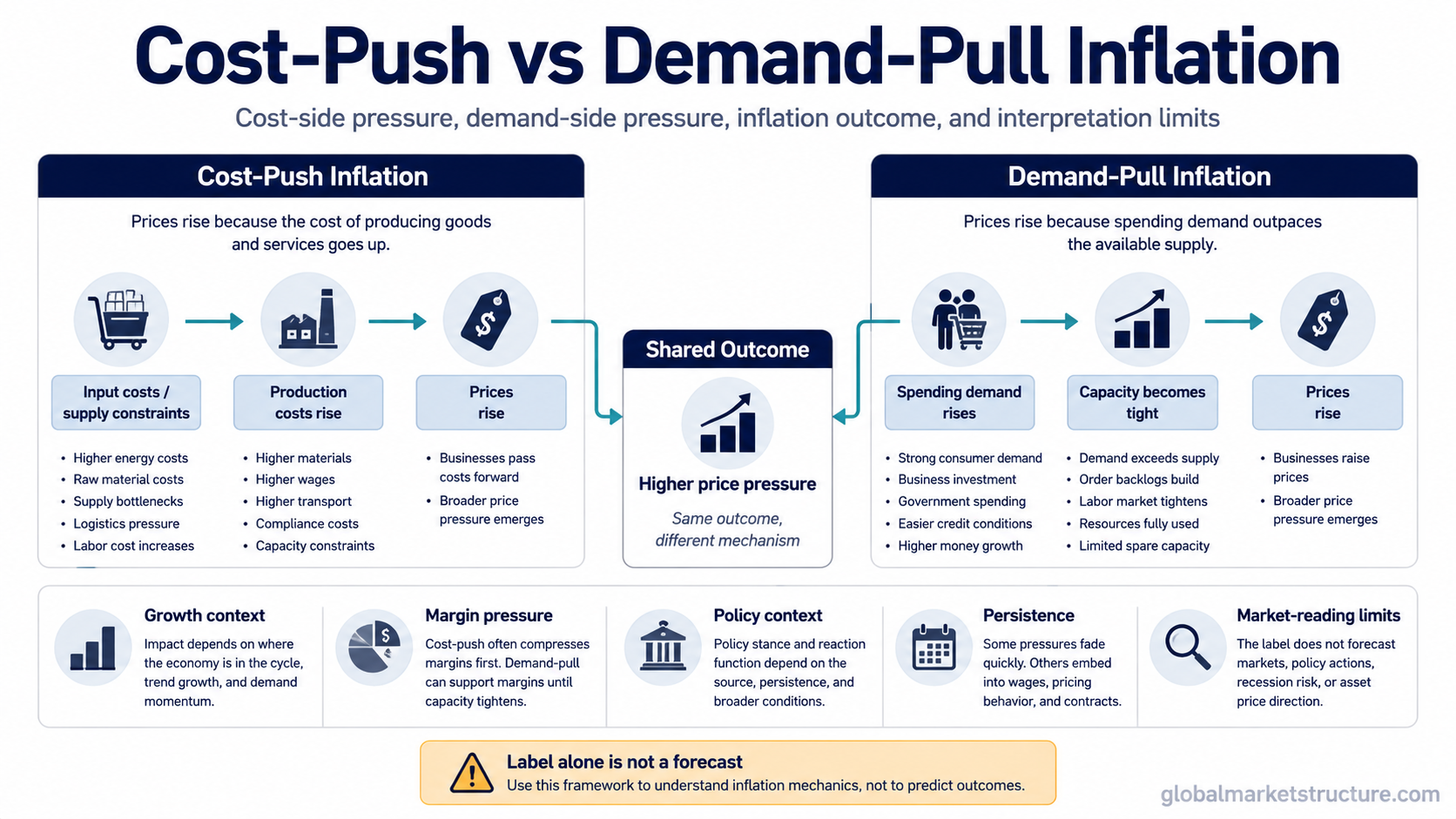
Cost-Push vs Demand-Pull Inflation: Key Differences
| Comparison point | Cost-push inflation | Demand-pull inflation |
|---|---|---|
| Main pressure source | Costs rise on the supply side. | Spending demand rises faster than available supply. |
| Typical trigger | Higher input costs, production bottlenecks, logistics pressure, energy costs, labor costs, or supply disruption. | Strong household, business, government, or credit-driven demand that stretches productive capacity. |
| Supply and demand condition | Supply becomes more expensive or harder to provide. | Demand becomes too strong relative to what the economy can produce. |
| Growth context | Can appear even when real activity is slowing or uneven. | Often appears when demand is firm, capacity is tight, or spending is broad enough to lift prices. |
| Margin context | Can pressure company margins if firms cannot pass higher costs to customers. | Can support pricing power while demand remains resilient, but only if volume and affordability hold up. |
| Policy context | Harder to read because tighter policy may reduce demand but may not directly fix the supply constraint. | More directly linked to demand management, although real-world policy effects still depend on timing and transmission. |
| Market-reading limit | The label does not automatically imply recession, stagflation, or asset direction. | The label does not automatically imply healthy growth, easy policy, or asset direction. |
What Cost-Push Inflation Means
Cost-push inflation is price pressure that starts from the cost of producing or supplying goods and services. If energy, labor, raw materials, shipping, financing, or production constraints become more expensive, producers may raise prices to protect margins or offset higher operating costs.
The important macro point is that cost-push pressure can appear even when end demand is not especially strong. Prices can rise because supply has become more constrained, not because consumers or businesses are aggressively increasing spending.
This is where the concept connects to a supply shock. A supply shock can be one cause of cost-side inflation pressure, but the two terms are not exact synonyms. The shock describes the disruption or impulse. Cost-push inflation describes the resulting price-pressure classification.
What Demand-Pull Inflation Means
Demand-pull inflation is price pressure that starts from demand exceeding available supply. It can appear when households, businesses, governments, or credit conditions create more spending than the economy can absorb at stable prices.
The key difference is that demand-pull pressure is not mainly about the producer’s cost base. It is about demand pulling prices higher because capacity, inventories, labor, housing, services, or other supply channels cannot respond fast enough.
This is related to a demand shock, but again the terms are not identical. A demand shock describes a change in demand conditions. Demand-pull inflation describes the inflationary pressure that can result when that demand runs ahead of available supply.
Same Price Increase, Different Mechanism
Two economies can both report higher prices, but the underlying mechanism can be different.
In one scenario, fuel and transport costs rise, manufacturers face higher input expenses, and retailers raise prices even though customer demand is only stable. That is closer to cost-push inflation because the pressure begins on the cost and supply side.
In another scenario, households and businesses increase spending quickly, inventories tighten, service providers run near capacity, and sellers raise prices because demand is exceeding what can be supplied. That is closer to demand-pull inflation because the pressure begins on the demand side.
The same price outcome can therefore carry different macro information. One version points more toward cost pressure and margin stress. The other points more toward demand strength and capacity pressure.
Can Cost-Push and Demand-Pull Inflation Happen Together?
Yes. Real inflation episodes can contain both mechanisms. A supply constraint can raise input costs while strong demand allows firms to pass those costs through. A demand boom can also expose supply bottlenecks that were not visible when activity was weaker.
The overlap matters because a single label can hide the full pressure mix. If costs are rising and demand is still strong, inflation may be more persistent than a one-channel explanation suggests. If costs are rising but demand is weakening, the same inflation rate may carry a different growth and margin message.
Boundary case: If prices rise after a production disruption, the initial pressure is cost-side. If those price increases persist because buyers keep accepting higher prices and demand remains resilient, the inflation mix may become partly demand-supported. The classification can shift as conditions change.
Why the Difference Matters for Policy and Market Context
The cost-push versus demand-pull distinction matters because the same inflation rate can imply different macro conditions. Demand-pull inflation often says more about spending strength, capacity pressure, and the risk that demand needs to cool. Cost-push inflation often says more about supply constraints, margin pressure, and the risk that inflation stays uncomfortable even when growth is not strong.
For policy interpretation, the distinction should be handled carefully. A central bank can influence demand through rates, credit conditions, and expectations, but it may not directly repair an energy shock, logistics disruption, or production bottleneck. That does not make policy irrelevant. It means the inflation source changes how the policy problem is framed.
For market context, the label is useful only when combined with other signals. Cost-push pressure can affect margins, real income, and growth sensitivity. Demand-pull pressure can affect expectations, capacity usage, and policy tightening risk. Neither label alone tells investors what asset prices should do.
What the Labels Do Not Tell You
Cost-push and demand-pull are classification tools, not complete forecasts. They do not tell you how long inflation will last, whether policy will tighten or ease, whether growth will break, or which asset class will outperform.
They also do not prove that one inflation type is always worse than the other. Cost-push pressure can be temporary or persistent. Demand-pull pressure can reflect healthy activity or an overheating cycle. The interpretation depends on persistence, expectations, wages, margins, credit conditions, policy reaction, and whether supply can adjust.
The practical mistake is treating the label as the conclusion. The better use is to ask what kind of pressure is driving prices and what that pressure implies for the broader growth, margin, and policy mix.
Related Concepts
Inflation is the broader concept of rising price levels and price dynamics. A supply shock describes a disruption to production, inputs, or availability that can create cost-side pressure. A demand shock describes a change in spending, credit, or aggregate demand conditions that can create demand-side pressure.
| Concept | Best use |
|---|---|
| Inflation | Broad concept of rising price levels and inflation dynamics. |
| Supply shock | Disruption or impulse that can create cost-side pressure. |
| Demand shock | Change in spending, credit, or aggregate demand conditions that can create demand-side pressure. |
FAQ
What is the main difference between cost-push and demand-pull inflation?
Cost-push inflation starts from rising production costs or supply constraints. Demand-pull inflation starts from spending demand exceeding available supply. Both raise prices, but the pressure source is different.
Can cost-push and demand-pull inflation happen at the same time?
Yes. Prices can rise because costs increase while demand remains strong enough for firms to pass those costs through. In that case, inflation may contain both cost-side and demand-side pressure.
Is cost-push inflation always worse than demand-pull inflation?
No. The impact depends on persistence, growth, margins, wages, expectations, policy reaction, and whether supply can adjust. The label alone does not prove which environment is worse.
Does the distinction predict markets?
No. The distinction helps interpret the source of inflation pressure, but it does not forecast asset direction. Market interpretation still depends on policy, liquidity, earnings, credit, positioning, and broader risk conditions.
Are cost-push inflation and supply shocks the same thing?
No. A supply shock can cause cost-push inflation, but it is not the same term. The shock describes the disruption. Cost-push inflation describes the price-pressure classification that may result.