
A financial cycle is a medium-term macro-financial boom-bust process in which credit, asset values, risk appetite, and financing constraints reinforce each other. It is related to the business cycle and financial conditions, but it is not the same thing as either one.
Financial cycle definition: the financial cycle describes how easier credit, rising asset values, stronger collateral, and greater risk appetite can reinforce a financial upswing, and how tighter financing, weaker collateral, and lower risk appetite can reinforce a downswing.
Key Points About the Financial Cycle
- The financial cycle is shaped by credit, asset values, risk appetite, leverage, and financing constraints.
- It often moves on a longer horizon than the business cycle, although the two can interact.
- Credit growth, property prices, lending standards, leverage, and credit spreads are common ways to observe parts of the cycle.
- It is related to financial conditions, but financial conditions describe the broader current environment, not the full boom-bust process.
- It is not a recession forecast, an equity-direction signal, or a market-timing tool.
Financial Cycle Definition
The financial cycle belongs to macro-finance. It focuses on how balance sheets, borrowing capacity, asset values, and risk appetite can feed back into each other over time.
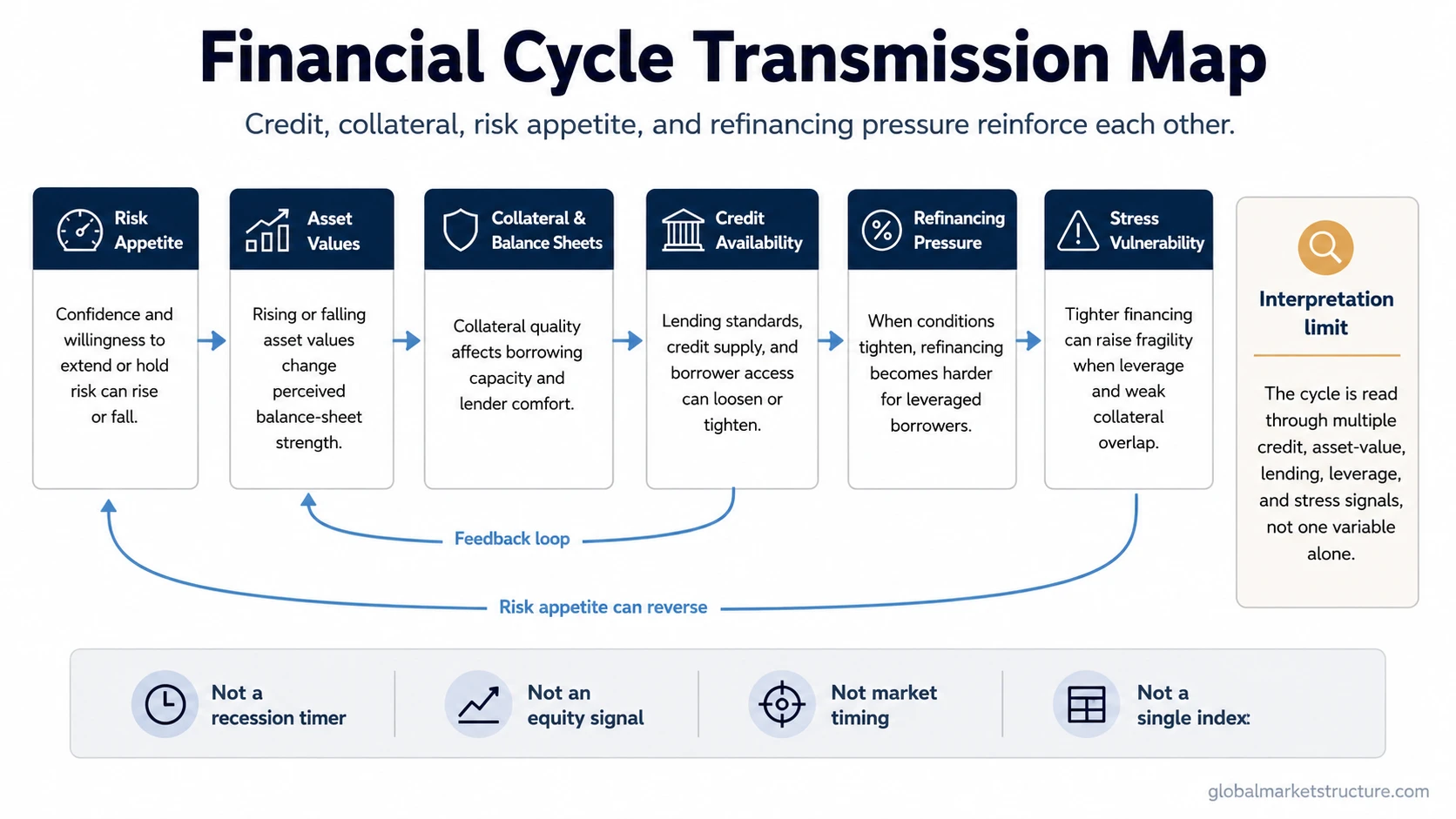
During an upswing, rising asset values can improve collateral values and make borrowers look safer. Lenders may become more willing to extend credit, borrowers may become more confident, and leverage can increase. During a downswing, the same feedback loop can work in reverse as collateral weakens, financing becomes harder, and risk appetite falls.
The useful distinction is that the financial cycle is not simply “the economy is expanding” or “markets are rising.” It describes the credit and balance-sheet process that can amplify economic and market conditions.
Financial Cycle vs Nearby Concepts
The term is often confused with business cycles, credit cycles, financial conditions, financial conditions indexes, and global liquidity cycles. The boundaries matter because each concept answers a different question.
| Concept | What it describes | Common observable | What it is not |
|---|---|---|---|
| Financial cycle | A macro-financial boom-bust process driven by credit, asset values, leverage, risk appetite, and financing constraints. | Credit growth, property prices, leverage, lending standards, credit spreads, and funding conditions. | Not a single index, not a recession timer, and not an equity-market signal. |
| Business cycle | The expansion and contraction of real economic activity. | Output, employment, income, production, and consumption measures. | Not primarily a balance-sheet and credit-feedback process. |
| Credit cycle | The expansion and contraction of borrowing, lending, credit quality, and credit availability. | Loan growth, defaults, spreads, lending standards, and credit issuance. | Not the full financial cycle when asset values, collateral, and risk appetite are also central. |
| Financial conditions | The broader market environment created by rates, credit, liquidity, the dollar, lending, and risk appetite. | Yields, credit spreads, equity conditions, funding pressure, market liquidity, and lending signals. | Not necessarily the full medium-term boom-bust cycle. |
| Financial conditions index | A measurement construct that combines selected financial variables into an index. | Composite index readings from a specific provider or model. | Not the financial cycle itself, because methodology and inputs vary by index. |
| Global liquidity cycle | A broader cross-border liquidity and funding environment shaped by policy, dollar liquidity, capital flows, and global risk appetite. | Dollar funding conditions, capital flows, global risk appetite, policy liquidity, and cross-asset liquidity signals. | Not identical to a domestic financial cycle centered on local credit, balance sheets, and property values. |
How the Financial Cycle Works
The financial cycle is easiest to understand as a feedback sequence rather than a single indicator.
| Step | Transmission channel | What can happen |
|---|---|---|
| 1 | Risk appetite and asset values | Stronger confidence can support higher asset values, while higher asset values can make risk feel easier to hold. |
| 2 | Collateral and balance sheets | Rising collateral values can improve borrowing capacity and make balance sheets appear stronger. |
| 3 | Credit availability | Lenders may ease credit standards or increase credit supply when perceived risk is falling. |
| 4 | Lending and refinancing pressure | When the cycle turns, weaker collateral and tighter lending can make refinancing harder. |
| 5 | Financial conditions and stress | Tighter financing can feed into broader conditions and may raise stress vulnerability, especially when leverage is high. |
The sequence is conditional. It can strengthen, weaken, pause, or vary across countries and markets. The financial cycle is a framework for reading the interaction, not a mechanical rule.
Domestic and Global Financial Cycles
A domestic financial cycle usually focuses on local credit, property prices, leverage, balance sheets, banking conditions, and borrower behavior. Housing and property markets are often important because they can affect collateral values, bank balance sheets, and household or corporate borrowing capacity.
A global financial cycle adds a cross-border layer. Capital flows, global risk appetite, dollar funding conditions, and policy expectations can influence financing conditions across markets. This global layer can affect domestic conditions, but it should not be treated as the whole financial cycle.
The distinction matters because a country can face domestic credit vulnerability while global liquidity is still supportive, or global funding pressure while domestic indicators have not fully turned. The stronger reading comes from comparing both layers instead of collapsing them into one label.
What Can Be Observed
The financial cycle should not be inferred from one variable alone. It is usually inferred from a group of credit, asset, lending, leverage, and stress signals.
| Observable channel | What it can show | Interpretation limit |
|---|---|---|
| Credit growth | Whether borrowing is expanding or slowing. | Strong credit growth can be healthy or risky depending on balance-sheet quality and asset valuations. |
| Property or housing prices | Whether collateral values are strengthening or weakening. | Property signals vary by country, dataset, and financing structure. |
| Lending standards | Whether lenders are becoming easier or more restrictive. | Survey-based measures can lag or differ across borrower segments. |
| Credit spreads | Whether markets are demanding more or less compensation for credit risk. | Spreads can move for liquidity, risk appetite, default expectations, or technical market reasons. |
| Leverage | Whether balance sheets are becoming more sensitive to asset-price or income shocks. | Leverage levels need context around income, cash flow, collateral quality, and refinancing needs. |
| Funding conditions | Whether borrowers and intermediaries can obtain financing smoothly. | Funding pressure can appear before it is visible in broad economic data. |
| Financial stress signals | Whether strain is becoming visible across markets or institutions. | A financial stress index can summarize stress symptoms, but it does not explain the entire cycle buildup. |
What the Financial Cycle Does Not Tell You
The financial cycle is useful for understanding vulnerability and transmission, but it should not be read as a direct forecast.
- Not a recession forecast: a financial-cycle downturn can raise vulnerability, but it does not automatically time a recession.
- Not an equity-direction signal: credit and balance-sheet pressure can affect risk appetite, but they do not determine a single market path.
- Not market timing: the cycle can move slowly and may diverge from asset prices for long periods.
- Not a financial conditions index: an index is a measurement tool, while the financial cycle is the broader process being interpreted.
- Not a crisis guarantee: credit booms can increase fragility, but every boom does not automatically end in systemic stress.
Illustrative Financial Cycle Scenario
Consider a generic economy where asset values rise for several years while lending becomes easier. Higher collateral values make borrowers appear safer, banks become more willing to extend credit, and investors become more comfortable with risk. The upswing reinforces itself because stronger asset prices improve borrowing capacity, and easier credit can support more asset demand.
The same mechanism can reverse. If asset values weaken, collateral quality may deteriorate. Lenders may tighten standards, refinancing may become harder, and borrowers with higher leverage may reduce activity. Risk appetite can fall at the same time financing becomes less available.
This scenario is illustrative, not a historical case. The point is the feedback loop: asset values, credit availability, balance sheets, and risk appetite can amplify each other in both directions.
Related Financial Conditions Concepts
The financial cycle connects naturally to two adjacent concepts. Financial conditions describe the broader environment created by rates, credit, liquidity, lending, the dollar, and risk appetite. Financial stress focuses on visible strain once parts of that environment begin to break down.
- Financial conditions help classify whether the broad market environment is becoming easier or tighter.
- Financial stress index readings help summarize whether stress symptoms are appearing across financial markets or institutions.
FAQ
Is the financial cycle the same as the business cycle?
No. The business cycle focuses on real economic expansion and contraction. The financial cycle focuses on credit, asset values, leverage, risk appetite, collateral, and financing constraints. They can interact, but they are not the same concept.
Is the financial cycle the same as financial conditions?
No. Financial conditions describe the broader current environment across rates, credit, liquidity, lending, and risk appetite. The financial cycle describes a medium-term boom-bust process that can shape and be shaped by those conditions.
Does the financial cycle predict recessions?
No. A financial-cycle downturn can raise vulnerability and may coincide with economic weakness, but it is not a recession timer. Recession analysis requires separate economic, credit, labor-market, policy, and financial evidence.
Is a financial conditions index the financial cycle?
No. A financial conditions index is a measurement construct that combines selected variables. The financial cycle is the broader macro-financial process involving credit, asset values, risk appetite, balance sheets, and financing constraints.