
QE can affect asset prices by lowering yields, changing the available supply of safe assets, encouraging portfolio rebalancing, easing liquidity expectations, and signaling a more accommodative policy stance. The effect is conditional, not automatic. Growth expectations, inflation, real yields, earnings risk, credit stress, and the strength of the balance-sheet impulse can all change the market response.
Quantitative easing is a central-bank asset-purchase policy. Its asset-price effect usually comes through transmission channels rather than through direct buying of stocks, credit, crypto, or other risk assets.
Key Points
- QE can put downward pressure on long-term yields and discount-rate expectations.
- Asset purchases can reduce the private-sector supply of safe duration assets, which may encourage portfolio rebalancing.
- Liquidity expectations and risk premiums can improve when policy support reduces funding stress.
- Policy signaling can affect expectations for future rates, but it can also signal economic stress.
- QE is a liquidity and policy-transmission input, not a forecast or a market signal by itself.
The Basic Transmission Sequence
The core sequence is simple: a central bank buys assets, the supply of those assets available to private investors changes, yields and liquidity expectations may adjust, investors may rebalance portfolios, and asset prices may become more sensitive to lower discount rates or lower perceived liquidity risk.
Each step is conditional. A purchase program can ease one part of the market structure while another part of the environment, such as weaker growth expectations or wider credit spreads, offsets the support.
Mechanism in one line: Central-bank purchases can change yields, asset supply, liquidity expectations, and policy signals, but asset prices still depend on the surrounding macro and risk environment.
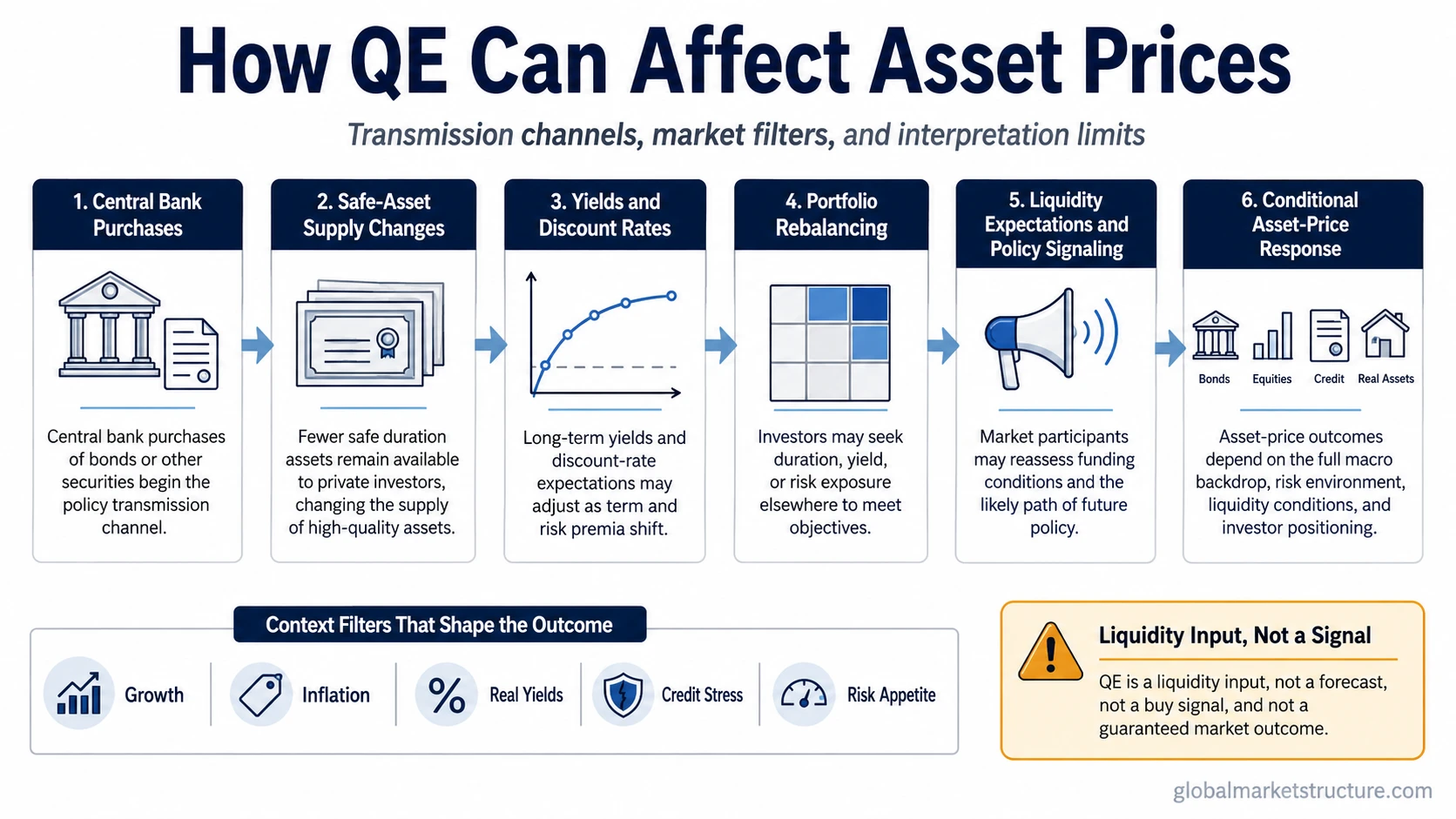
QE Asset-Price Transmission Channels
The main channels are easier to evaluate when the mechanism, possible implication, and limitation are separated. QE can affect conditions that matter for prices, but it does not remove the need to read inflation, real yields, growth, credit, and risk appetite together.
| Channel | What QE changes | Possible asset-price implication | Limitation |
|---|---|---|---|
| Discount-rate channel | Long-term yields and discount-rate expectations | Duration-sensitive assets may reprice higher when yields fall | Higher inflation, rising real yields, or earnings risk can offset the effect |
| Portfolio-rebalancing channel | Supply of safe duration assets and investor allocation incentives | Investors may move toward riskier or longer-duration assets | Rebalancing can weaken if risk aversion dominates |
| Liquidity-premium channel | Perceived liquidity abundance and funding stress | Risk premiums may compress when liquidity stress eases | Credit stress or crisis interpretation can dominate |
| Signaling channel | Expectations for policy stance and future rates | Easier-policy expectations may support valuations | If QE signals severe economic stress, the signal can be bearish or mixed |
| Balance-sheet impulse | Direction and pace of asset purchases | An expanding impulse can support easier financial conditions | Slowing or reversing impulse can weaken support even if the balance sheet remains large |
Why Lower Yields Can Affect Valuations
The discount-rate channel matters because asset prices reflect expected future cash flows discounted back to the present. When long-term yields fall, the discount rate applied to future cash flows can decline, which may support higher valuations for assets with longer-duration cash-flow profiles.
This effect is not uniform. Long-duration equities, growth-sensitive assets, credit, real assets, and currencies can react differently because each market also prices inflation risk, earnings expectations, default risk, external funding conditions, and risk premiums.
Limitation: Lower nominal yields do not automatically mean easier valuation conditions. If inflation expectations rise faster than nominal yields fall, or if real yields rise, the asset-price effect can be weaker or even negative for some markets.
How Portfolio Rebalancing Works
When a central bank buys bonds or other eligible assets, private investors may receive cash or reserves-linked settlement value while holding fewer safe duration assets. Some investors may then seek other assets to replace yield, duration exposure, or portfolio return potential.
That rebalancing can support demand for corporate bonds, equities, real assets, or other risk-sensitive markets. The channel is probabilistic rather than mechanical. If investors are trying to reduce risk, preserve liquidity, or respond to worsening credit conditions, they may not rebalance into risk assets even when QE is active.
The central bank balance sheet matters here because purchases, holdings, reserves, and the pace of balance-sheet change shape how the policy impulse reaches markets.
Liquidity Expectations and Risk Appetite
QE can change how investors perceive liquidity conditions. When policy support reduces funding stress or signals a willingness to stabilize market functioning, risk premiums may compress and market depth may improve.
That does not mean liquidity is identical across all markets. Government bond liquidity, bank reserves, dealer balance-sheet capacity, corporate credit conditions, equity market breadth, and currency funding pressure can move differently. A stronger reading comes when several liquidity-sensitive indicators improve together.
Central-bank liquidity is the broader policy-liquidity context. QE is one tool inside that broader structure, not the entire liquidity environment.
Policy Signaling and Market Interpretation
QE can also signal that policymakers expect to keep financial conditions easier than they otherwise would be. That can influence expectations for future rates, term premiums, and risk appetite.
The same signal can carry a negative interpretation if investors read the program as a response to severe economic stress. Easier policy expectations may support valuations, but weaker growth expectations or falling earnings confidence can pull in the opposite direction.
Interpretation boundary: QE is best treated as one input in a market-structure assessment. It can change the background conditions for asset pricing, but it does not provide a complete view of growth, earnings, credit risk, inflation, or investor positioning.
When QE May Not Lift Asset Prices
A common failure mode appears when QE expands during a stress episode, but risk assets do not immediately rise. Investors may interpret the policy response as evidence that the economic outlook is deteriorating, credit risk is rising, or earnings expectations are falling faster than liquidity conditions are improving.
Under those conditions, the easier liquidity signal can be outweighed by weaker growth, wider credit spreads, higher real yields, inflation uncertainty, or a slowing balance-sheet impulse. The market response becomes mixed because the policy support is competing with other sources of risk.
Illustrative scenario: A central bank increases asset purchases while investors are reducing risk exposure. Long-term yields fall, but credit spreads remain wide and earnings expectations keep weakening. In that situation, QE may improve liquidity conditions without producing an immediate broad rise in risk assets.
How to Read QE Without Turning It Into a Signal
The safer interpretation is to separate the policy input from the market outcome. QE can affect the pricing environment, but asset prices still respond to the mix of liquidity, inflation, growth, earnings, credit, positioning, and risk appetite.
| Question | Stronger interpretation | Weaker interpretation |
|---|---|---|
| Are yields falling? | Lower yields support the discount-rate channel | Falling yields may also reflect growth fear |
| Are risk premiums compressing? | Liquidity stress may be easing | Credit stress may still dominate if spreads remain wide |
| Is portfolio rebalancing visible? | Demand may be moving into longer-duration or riskier assets | Investors may still prefer cash or safer assets during stress |
| Is the balance-sheet impulse expanding? | The liquidity impulse may be supportive | A slowing impulse can reduce support even if policy remains accommodative |
The strongest interpretation comes from confirmation across channels, not from the existence of QE alone.
FAQ
Does QE always make stocks or risk assets rise?
No. QE can support some asset prices through lower yields, portfolio rebalancing, liquidity expectations, and policy signaling, but the result depends on growth, inflation, real yields, earnings risk, credit stress, and risk appetite.
Is QE a buy signal?
No. QE is a policy and liquidity input, not a buy signal. It can change the background conditions for asset pricing, but it does not replace analysis of valuation, earnings, credit, inflation, positioning, or market structure.
Can QE affect asset prices without directly buying those assets?
Yes. QE can affect prices indirectly by changing yields, safe-asset supply, liquidity expectations, portfolio incentives, and policy-rate expectations. The channel is indirect and conditional.