Dovish generally means a central bank or policymaker leans toward easier policy, often because growth, employment, or downside risks matter more. Hawkish generally means a tighter-policy bias, often because inflation control or financial restraint matters more. Neither label alone confirms the next policy decision or the direction of markets.
The useful difference is the policy priority behind the language. Dovish language usually points toward support, patience, or less restriction. Hawkish language usually points toward restraint, inflation control, or keeping policy tight for longer.
Dovish vs Hawkish: Core Differences
| Criteria | Dovish | Hawkish |
|---|---|---|
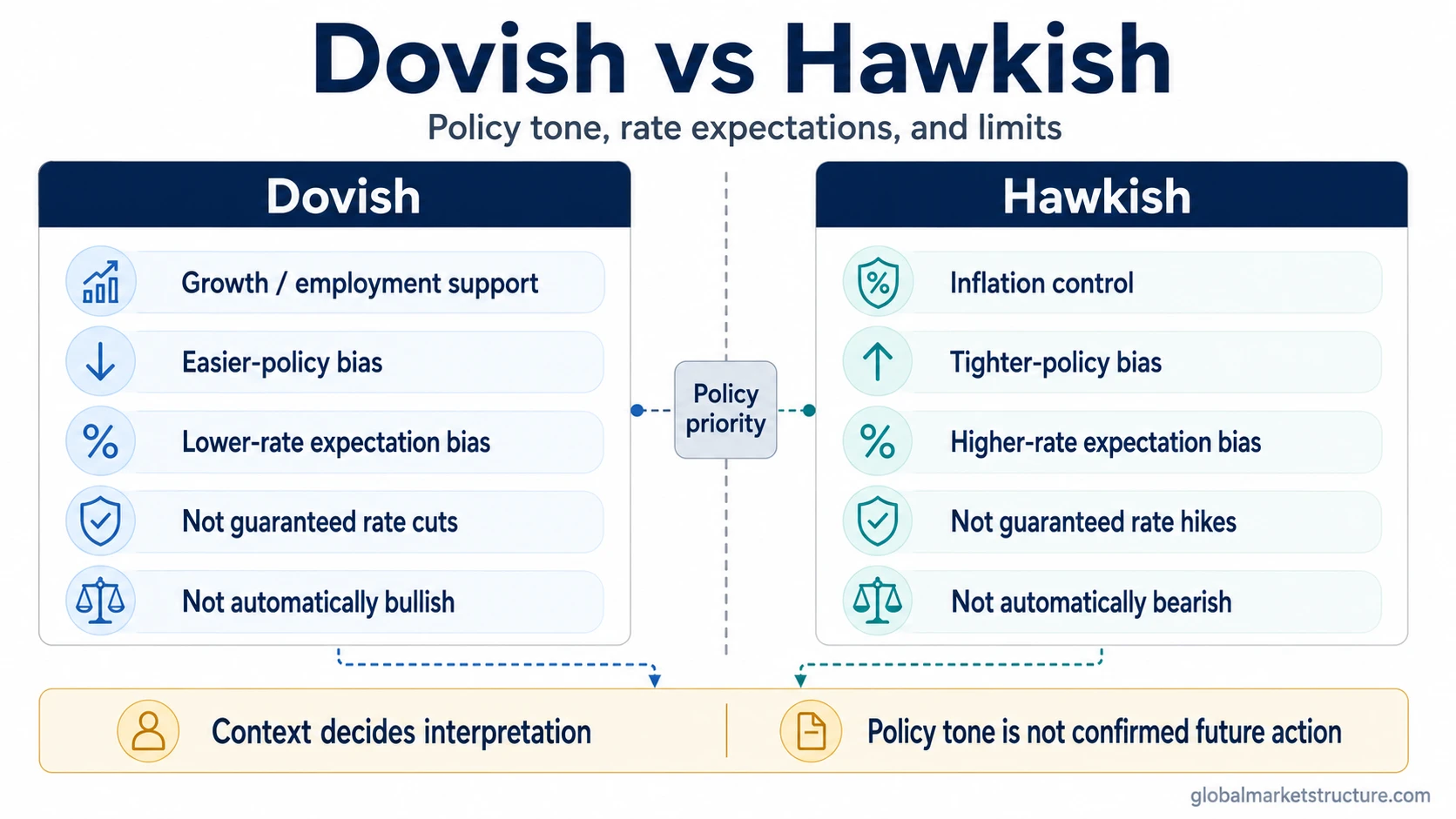
| Main policy concern | Growth, employment, downside risk | Inflation, overheating, financial restraint |
| Policy bias | Easier-policy bias | Tighter-policy bias |
| Rate-path implication | Lower-rate or slower-tightening expectation bias | Higher-rate or longer-tightening expectation bias |
| Market meaning | Can ease financial conditions if not already priced | Can tighten financial conditions if not already priced |
| What it does not prove | Not automatically bullish and not guaranteed rate cuts | Not automatically bearish and not guaranteed rate hikes |
What Dovish Means
Dovish language points toward a preference for easier or less restrictive policy. A dovish central-bank message may emphasize slowing growth, rising unemployment risk, weaker demand, financial stress, or the need to avoid overtightening.
In rate-market terms, dovish language can shift expectations toward lower future rates, slower rate increases, earlier easing, or a shorter period of restrictive policy. That interpretation still depends on the starting point. A statement can sound dovish compared with prior guidance even if policy remains restrictive in absolute terms.
Dovish does not mean a central bank is ignoring inflation. It means the balance of language is leaning more toward support, caution, or reduced restraint than toward additional tightening.
What Hawkish Means
Hawkish language points toward a preference for tighter or more restrictive policy. A hawkish central-bank message may emphasize inflation risk, overheating, wage pressure, strong demand, or the need to keep financial conditions restrained.
In rate-path terms, hawkish language can shift expectations toward higher future rates, delayed cuts, additional tightening, or a longer period of restrictive policy. The interpretation is strongest when the language changes what markets expected before the statement.
Hawkish does not always mean immediate rate hikes. A central bank can sound hawkish by resisting early easing, stressing inflation persistence, or warning that policy must stay restrictive even if no new increase is announced.
The Real Split: Policy Priority and Rate Expectations
The difference between dovish and hawkish is not only “lower rates versus higher rates.” The deeper split is the policy priority. Dovish language gives more weight to growth, employment, downside risks, or financial stress. Hawkish language gives more weight to inflation control, overheating risk, and the need for restraint.
This matters because monetary policy affects markets partly through expectations. Markets often react not just to today’s rate decision, but to what the statement implies about the path of policy over the next several meetings.
A dovish shift can lower expected future rates or reduce the expected duration of tight policy. A hawkish shift can raise expected future rates or extend the expected period of restraint. The interpretation depends on inflation data, growth conditions, prior market pricing, and the credibility of the central-bank message.
When One Statement Has Both Dovish and Hawkish Elements
A central-bank message does not have to be purely dovish or purely hawkish. A single statement can warn that inflation remains too high and policy must stay restrictive, while also saying growth is slowing and future decisions will depend on incoming data.
Illustrative scenario: If policymakers say inflation is still too high, that is a hawkish element. If they also say growth is slowing and decisions will depend on future data, that can soften the message and add a dovish element. The full reading is mixed, not one-sided.
This is where forward guidance becomes important. Central banks shape expectations through the way they describe future policy conditions, not only through the rate decision itself.
The correct question is not “was the statement dovish or hawkish?” in isolation. The better question is which part of the message changed the expected path of policy, and whether that change was already priced into markets.
What Dovish and Hawkish Do Not Prove
Dovish and hawkish are policy-tone labels, not outcome guarantees. A dovish statement does not guarantee rate cuts. A hawkish statement does not guarantee rate hikes. Dovish does not automatically mean bullish, and hawkish does not automatically mean bearish.
Market reaction depends on more than the label. The same dovish phrase can be positive, neutral, or negative depending on why policy is turning easier. If the dovish shift reflects falling inflation with stable growth, the market reading may differ from a dovish shift caused by recession risk or financial stress.
The same applies to hawkish language. A hawkish shift may pressure risk assets if it tightens expected financial conditions. It can also be absorbed calmly if markets had already priced that stance or if the message supports central-bank credibility around inflation control.
Dovish and Hawkish Are Not the Same as Bullish and Bearish
Dovish and hawkish describe policy stance. Bullish and bearish describe market direction bias. The two can interact, but they are not the same concept.
A dovish shift may support risk appetite when it lowers discount-rate expectations without damaging the growth outlook. But if the dovish tone appears because growth is weakening sharply, markets may focus on the economic risk rather than the easier-policy bias.
A hawkish shift may pressure markets when it raises expected rates or tightens financial conditions. But if the hawkish tone reinforces confidence that inflation will be controlled, the market response can be more balanced. Context decides the interpretation.
How to Read Dovish or Hawkish Policy Language
A practical reading starts with the change in emphasis. Compare the new message with the prior message, not with a generic definition. A statement is more dovish if it shifts toward support, caution, or reduced restraint. It is more hawkish if it shifts toward inflation control, restraint, or a longer period of tight policy.
| Reading step | Question to ask | Why it matters |
|---|---|---|
| Policy priority | Is the message focused more on inflation control or growth risk? | This identifies the dovish or hawkish tilt. |
| Rate-path effect | Does the language change expectations for future rates? | Markets usually care about the path, not only today’s decision. |
| Pricing context | Was the message already expected? | Expected language may produce a smaller reaction. |
| Growth and inflation mix | Is easing linked to lower inflation or weaker growth? | The same dovish label can carry different market meanings. |
| Financial conditions | Does the message ease or tighten credit, liquidity, and risk appetite? | Policy tone matters through its effect on conditions. |
Practical Reading Checklist
Use these checks before calling a policy message dovish or hawkish:
- Does the message place more emphasis on inflation control or on growth and employment risk?
- Does it imply a different path for future rates than markets expected?
- Does it describe restrictive policy as still necessary, or does it suggest patience and flexibility?
- Does the message include mixed language, such as firm inflation warnings but softer growth language?
- Is the market reaction driven by the statement itself, or by what was already priced before the statement?
The strongest reading usually comes from the shift in tone, the expected policy path, and the surrounding macro context together. The label alone is not enough.
FAQ
What is the main difference between dovish and hawkish?
Dovish means an easier-policy bias, often tied to growth, employment, or downside risks. Hawkish means a tighter-policy bias, often tied to inflation control, overheating risk, or keeping policy restrictive.
Does dovish mean bullish?
No. Dovish language can ease financial conditions, but market direction depends on expectations, growth context, inflation data, positioning, liquidity conditions, and what was already priced in.
Does hawkish mean bearish?
No. Hawkish language can tighten expected financial conditions, but it does not automatically mean markets will fall. The reaction depends on context and prior expectations.
Can a central bank sound both dovish and hawkish?
Yes. A central bank can sound hawkish about inflation while sounding dovish about growth risks or future data dependence. The full message can be mixed rather than purely one-sided.
Is dovish or hawkish the same as a rate forecast?
No. Dovish and hawkish describe policy tone or bias. They can influence rate expectations, but they do not guarantee the next central-bank decision.