
The AAII Sentiment Survey is a weekly poll of AAII members that records whether they expect the stock market to rise, remain roughly unchanged, or fall over the next six months. It measures stated expectations rather than holdings or capital flows. The reading becomes more informative when the survey level, bull-bear spread, persistence, and broader market conditions are considered separately.
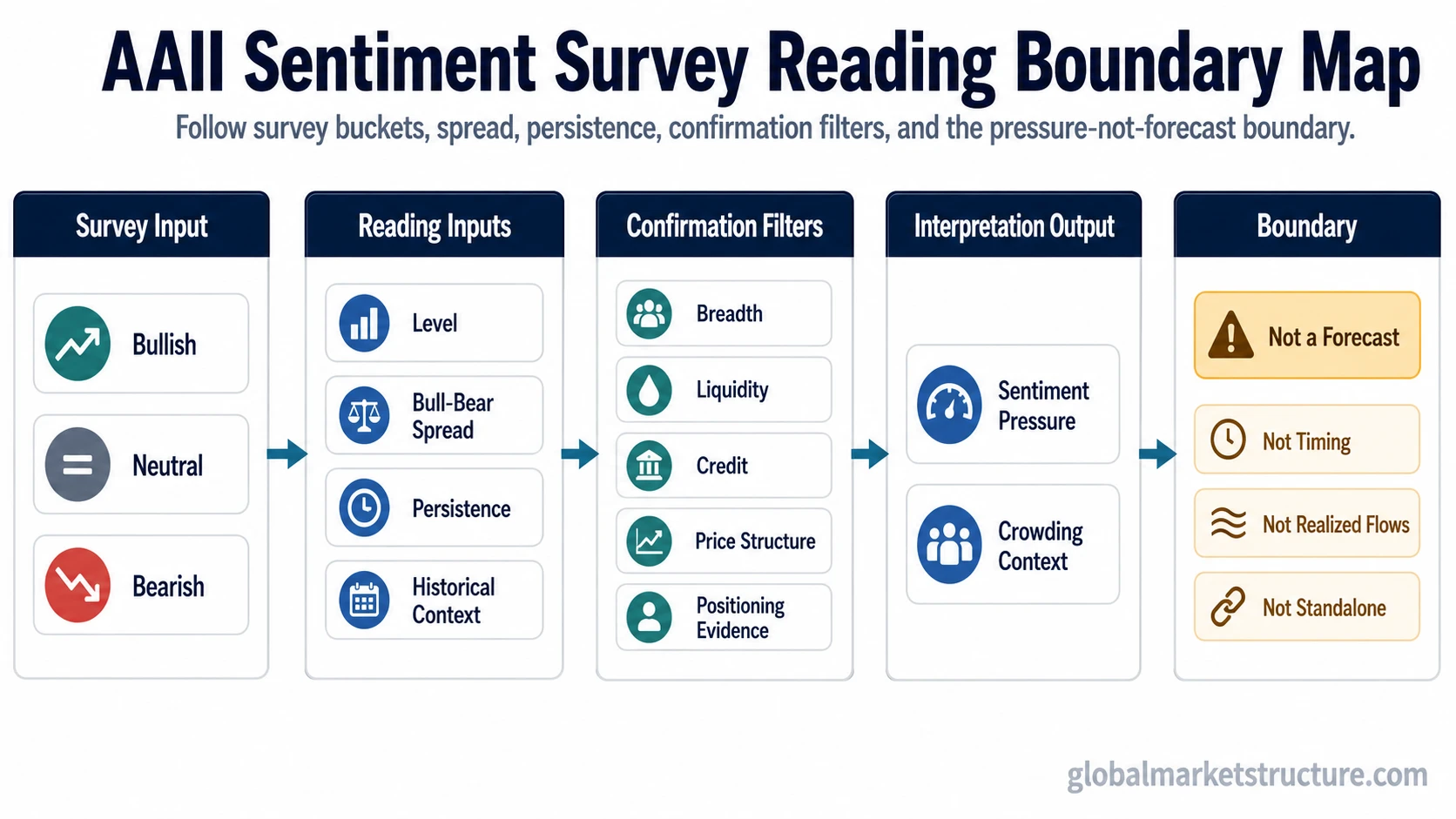
How the AAII Sentiment Survey Is Defined
The official AAII Sentiment Survey asks members whether they expect the stock market over the next six months to be up, unchanged, or down. AAII reports the responses as bullish, neutral, and bearish percentages and maintains the historical survey record. The survey has been conducted since 1987. Current weekly readings should be checked at AAII rather than copied into a static educational article.
What the Survey Readings Show
| Reading | What it records | Interpretation boundary |
|---|---|---|
| Bullish | The share of respondents who expect the stock market to rise over the next six months. | A high reading describes optimistic expectations. It does not establish how respondents are positioned or when market direction will change. |
| Neutral | The share of respondents who expect little overall change in the market over the next six months. | The reading helps show how expectations are distributed across the three survey choices. |
| Bearish | The share of respondents who expect the stock market to fall over the next six months. | A high reading describes pessimistic expectations. It does not establish that selling pressure is exhausted. |
| Bull-bear spread | Bullish sentiment minus bearish sentiment. | A positive or negative spread shows the balance between the two directional responses. Its significance depends on the survey’s own history and persistence rather than one universal threshold. |
Survey Sentiment and Actual Positioning Are Different Evidence
Two investors can give the same bearish survey answer while holding very different portfolios. The AAII reading therefore belongs to the sentiment layer, while holdings, leverage, derivatives exposure, and realized capital flows require separate evidence.
Bullish, neutral, or bearish expectations reported by participating AAII members for the next six months.
Actual exposure, flows, leverage, concentration, or derivatives positions observed through other data sources.
How to Read an AAII Sentiment Print
Use the official AAII release for the current weekly reading and keep that observation separate from older survey data.
Evaluate bullish, neutral, and bearish readings relative to the same historical series rather than applying a threshold taken from another sentiment measure.
Look at the bull-bear spread and whether the imbalance persists across several observations or appears mainly in one weekly print.
Breadth, liquidity, credit conditions, actual positioning, and price behavior can show whether the sentiment condition is consistent with the surrounding market structure.
Where a Contrarian Reading Can Fail
Extreme AAII readings can add context to a broader contrarian signal analysis. The survey provides evidence about expectations. The surrounding market determines whether those expectations are becoming stretched enough to matter.
Suppose bearish sentiment remains elevated for several weeks. That can make the survey more interesting from a contrarian perspective, especially if pessimism is becoming unusually persistent.
The interpretation weakens if breadth continues to deteriorate, liquidity remains tight, credit conditions worsen, and price keeps accepting lower levels. In that case, the survey may be accurately describing persistent pessimism while the broader pressure is still unresolved.
A different reading becomes more plausible if sentiment remains stretched while participation stabilizes, liquidity improves, credit pressure stops worsening, and price begins to respond differently. The change comes from the surrounding evidence rather than from the survey percentage alone.
Timing Limitation
Optimistic or pessimistic readings can remain elevated while the existing market trend continues. Persistence can make a sentiment condition more informative, but the survey still does not establish the timing of a top, bottom, reversal, or continuation.
Where AAII Fits in Market Sentiment
The AAII survey is one input within broader market sentiment. Its advantage is that it directly records the expectations of participating individual investors. Other evidence can measure different layers, including options activity, volatility pricing, capital flows, breadth, and actual positioning.
Keeping those layers separate makes the survey more useful. AAII can describe how respondents say they expect the market to behave, while broader market-structure evidence helps determine whether those expectations are being reinforced, challenged, or ignored by the market itself.