
A relief rally is a temporary rebound after selling pressure, market stress, or less-bad news. It can reflect short-covering, oversold positioning, or a pause in fear, but it does not by itself confirm a durable risk-on shift. The interpretation becomes stronger only when risk appetite, credit conditions, volatility, breadth, liquidity, and macro context support the price rebound.
Not enough by itself: a price rebound after stress.
Stronger when: breadth, credit, volatility, liquidity, and broader risk appetite improve together.
Weaker when: credit stress, narrow participation, elevated volatility, or deteriorating macro conditions contradict the rebound.
What a relief rally means
A relief rally is a rebound that appears after a market has already been under pressure. The move can happen because selling becomes temporarily exhausted, pessimistic expectations become less severe, or traders who were positioned defensively reduce those positions.
The important point is that the rally describes the rebound, not the full environment around it. A market can rise for several sessions while the broader backdrop still reflects stress, weak liquidity, fragile confidence, or unresolved macro pressure.
Why a relief rally is not automatically risk-on
A relief rally can feel like a change in tone because prices stop falling and volatility may cool. That does not automatically mean the market has shifted into risk-on conditions. A durable risk-on shift usually needs broader confirmation from participation, credit behavior, liquidity, volatility, and macro context.
The main risk is confusing a pause in fear with a genuine improvement in risk appetite. A rally can be driven by short-covering or oversold relief even when underlying risk conditions remain fragile.
The key limitation is simple: price is one input. A relief rally becomes more meaningful only when the surrounding evidence agrees with the rebound.
Relief rally evidence check
The same upward move can carry different meaning because each condition has a separate interpretation risk and a separate limitation.
| Condition | What the relief rally may mean | Why it may still fail |
|---|---|---|
| Oversold bounce after sharp selling | Short-term positioning pressure may be easing. | The broader trend, liquidity backdrop, or credit environment may still be negative. |
| Softer-than-feared news | The market may be reacting to a less-bad catalyst. | Less-bad news is not the same as improving growth, liquidity, or earnings quality. |
| Volatility cools temporarily | Immediate stress may be easing. | Volatility alone does not prove that durable risk appetite has returned. |
| Breadth improves with credit stability | The rebound has stronger confirmation from participation and risk pricing. | It still needs follow-through and support from the broader macro setting. |
| Price rebounds while credit stress worsens | The rally may reflect positioning relief more than genuine confidence. | Conflicting credit evidence can make the move fragile. |
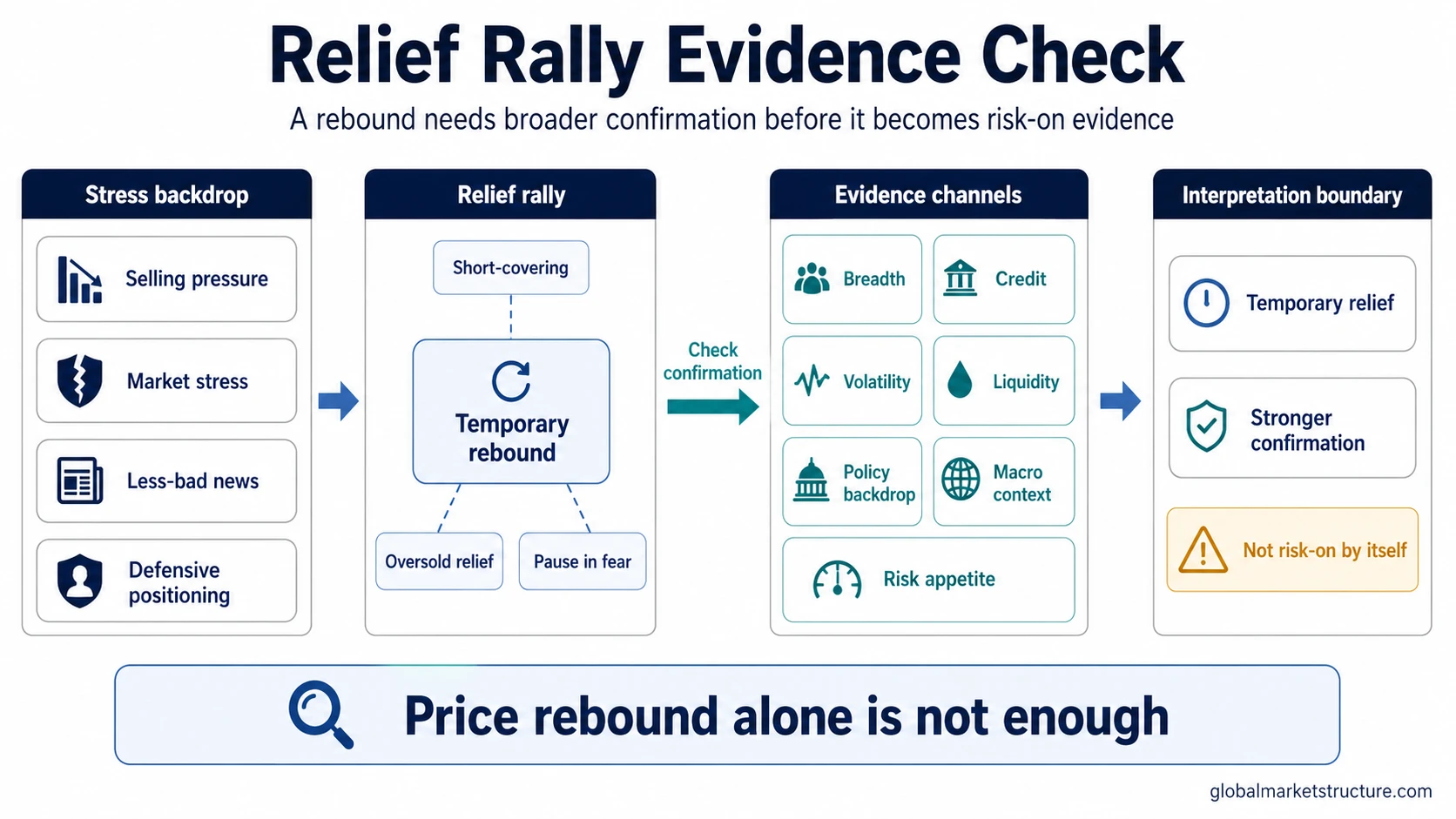
What evidence changes the interpretation
A relief rally becomes more useful when it is read as part of a broader risk-environment check. The rally itself shows that selling pressure has eased for a period. The surrounding evidence helps decide whether that easing is only temporary or part of a broader improvement.
Risk appetite: Stronger risk appetite means investors are not only buying the most beaten-down assets. It usually shows broader willingness to accept risk, stronger participation, and less defensive behavior across markets.
Credit conditions: Credit can confirm or contradict the rebound. If credit stress remains elevated while equities bounce, the rally may be less durable because risk pricing has not improved underneath the surface.
Volatility context: Falling volatility can support the idea that stress is easing, but it should not be treated as proof by itself. Volatility can cool temporarily even when the broader market remains vulnerable.
Breadth participation: A rally led by a narrow group of assets may be easier to reverse than a rally supported by broad participation. Breadth helps show whether the rebound is isolated or widely confirmed.
Liquidity and policy backdrop: Liquidity and policy context shape how much support the rebound has. A relief rally inside tight liquidity or restrictive policy conditions may need stronger confirmation than a rally supported by improving liquidity.
Macro context: Macro conditions help frame whether the rebound is reacting to temporary fear or to a real change in the environment. Growth, inflation, policy expectations, and funding conditions can all change the meaning of the same price move.
When a relief rally can fail
A common failure mode is a rebound that begins after heavy selling, gains attention because prices rise quickly, but remains unsupported by the rest of the risk environment. In that scenario, the move may reflect positioning relief rather than a durable change in market confidence.
For example, a market can rebound after negative news comes in slightly better than feared. If the rally is narrow, credit stress remains visible, volatility stays elevated, and liquidity conditions do not improve, the rebound may still be fragile. The issue is not that every relief rally must fail. The issue is that the rally needs confirmation before it can be treated as a broader regime shift.
How relief rallies connect to risk-off conditions
Relief rallies often appear inside a stressed or risk-off backdrop. That is why they can be confusing. Prices may rise, but the environment can still be shaped by defensive positioning, liquidity pressure, credit caution, or weak participation.
The cleaner distinction is between a temporary rebound and a confirmed shift in the risk environment. A relief rally describes the rebound. Risk-on and risk-off describe the broader environment that gives the rebound its meaning.
Relief rally vs recovery
A relief rally is not the same as a recovery. A recovery implies a broader improvement in conditions, not only a rebound from stress. A relief rally may become part of a recovery, but the label alone does not prove that the recovery has started.
The distinction matters because a relief rally can happen before the evidence is complete. A recovery reading needs broader support from the market structure around the move.
Relief rally FAQ
Is a relief rally bullish?
It can be bullish in the short term, but the label does not prove a durable market shift. The interpretation depends on whether broader risk evidence confirms the rebound.
Is a relief rally the same as a bear market rally?
They can overlap, but they are not identical terms. A bear market rally usually refers to a rebound inside a broader bear-market decline. A relief rally is the narrower idea of a rebound after stress or negative expectations.
Does a relief rally mean the market bottom is in?
No. A relief rally can happen before a durable bottom is confirmed. Treating the rebound as a bottom requires stronger evidence than price movement alone.
Why do relief rallies fail?
They can fail when the rally is driven mainly by short-covering, oversold positioning, or less-bad news while credit, liquidity, breadth, volatility, or macro conditions remain weak.