
Volatility and liquidity can deteriorate together, but price movement alone does not establish a liquidity problem. The liquidity reading becomes stronger when wider spreads, lower depth, larger market impact, higher trading costs, or weaker resiliency show that the market is becoming less able to absorb order flow.
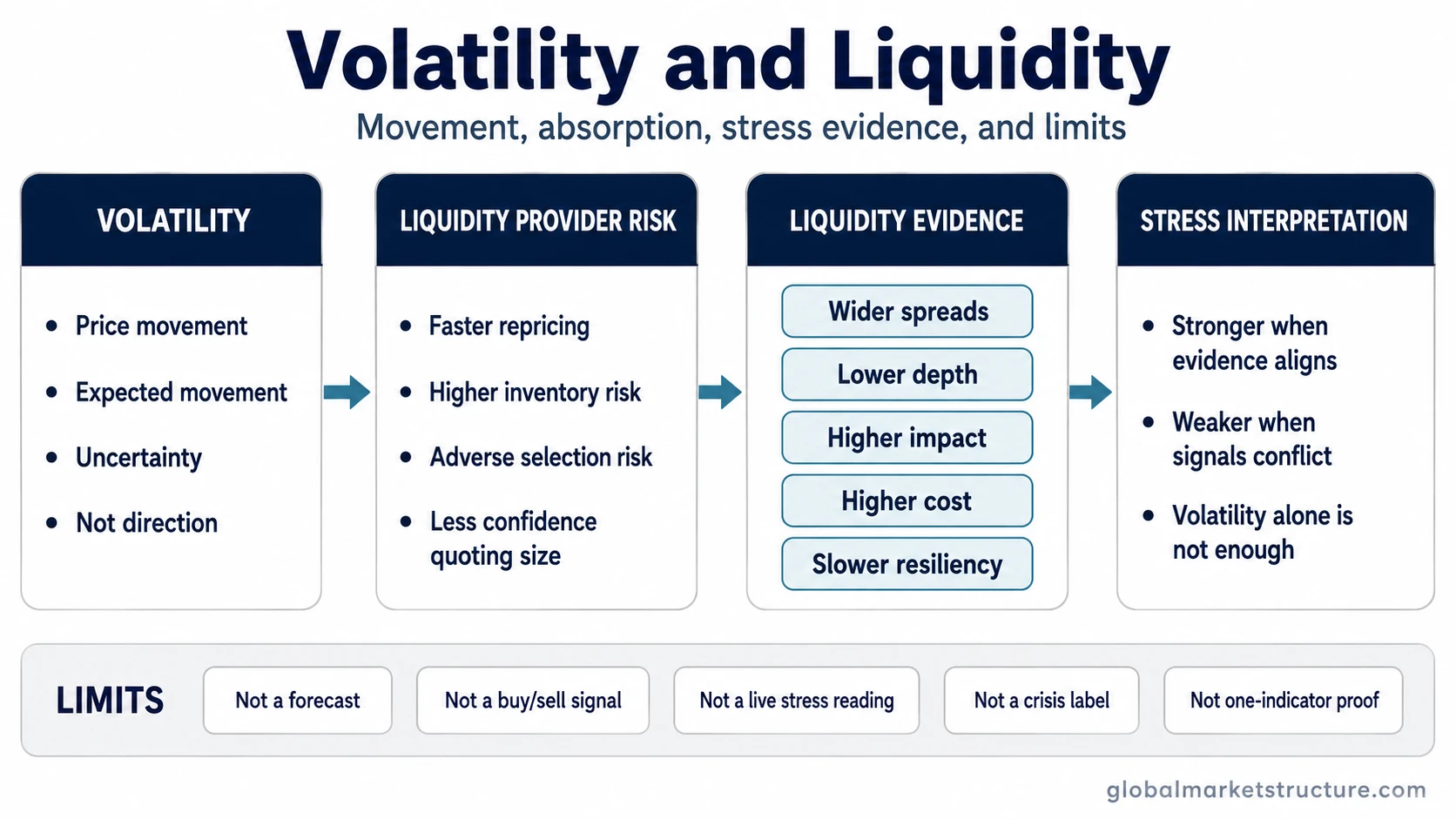
Movement and Market Absorption Are Different
Volatility describes the magnitude or expected magnitude of price movement. Market liquidity concerns the market’s ability to absorb trading without excessive cost or price impact.
Prices may move quickly as information, expectations, or positioning are repriced.
Liquidity weakens when executing orders becomes more costly or produces greater market impact.
How Higher Volatility Can Interact With Liquidity
Higher volatility can increase the risk of providing liquidity because quoted prices may become stale more quickly and inventory can become harder to manage. The resulting response depends on the market, the source of the volatility, and the capacity of other participants to absorb trading.
Faster repricing increases uncertainty around short-term execution and inventory value.
Quoted spreads may widen or displayed size may fall as participants adjust to greater execution risk.
When available depth declines, a given order can move the market more than it would under deeper conditions.
Short-lived deterioration can normalize after repricing. Continued weak depth, elevated costs, or slow replenishment provides stronger evidence of liquidity stress.
New York Fed research finds meaningful links between return volatility and stock and bond market liquidity. IMF research treats market liquidity as multidimensional, including trading cost, depth, price impact, immediacy, and resiliency rather than a single measure. Source: New York Fed. Source: IMF.
What Confirms Liquidity Deterioration
| Liquidity evidence | What changes | Interpretation boundary |
|---|---|---|
| Wider bid-ask spreads | Trading becomes more expensive at quoted prices. | A temporary widening around news does not by itself establish persistent liquidity stress. |
| Lower quoted depth | Less displayed size is available to absorb orders near the current price. | Displayed depth does not capture every source of executable liquidity. |
| Higher market impact | Orders produce larger price changes relative to normal conditions. | Impact depends on order size, market structure, and the asset being traded. |
| Higher cost-to-trade | Spread, slippage, or impact makes execution more expensive. | The comparison should be made against normal conditions for the same market. |
| Weaker resiliency | Liquidity replenishes more slowly after an order-flow imbalance. | A brief dislocation can recover without becoming a persistent liquidity problem. |
Repricing Can Look Different From Liquidity Stress
Consider a market reacting sharply to new information. Prices move quickly, but spreads remain close to normal, depth returns after the initial adjustment, and larger trades do not produce unusual market impact. The move can be volatile while trading conditions remain functional.
Price volatility rises as the market reprices.
Spreads widen, depth weakens, market impact rises, or liquidity replenishes more slowly.
The evidence now points beyond price movement toward weaker trading conditions and reduced absorption capacity.
Nearby Liquidity Concepts
| Concept | Main question | Boundary on this page |
|---|---|---|
| Volatility | How much are prices moving or expected to move? | Movement magnitude does not measure trading capacity by itself. |
| Market liquidity | Can orders be executed without excessive cost or price impact? | This is the main liquidity dimension used to interpret the volatility interaction. |
| Funding liquidity | Can market participants obtain or maintain financing? | Funding conditions can interact with market liquidity but remain a separate mechanism. |
| Liquidity risk | Could access to liquidity deteriorate when conditions become more difficult? | Liquidity risk is the broader risk concept, not a synonym for current volatility. |
The relationship is most useful when price movement is evaluated together with spreads, depth, market impact, execution cost, and resiliency. Divergence between those measures is information in itself and should not be forced into a single stress label.