
Asset behavior by regime means using the market environment as context for interpreting cross-asset moves, not treating one asset class or one indicator as proof of a regime shift. Equities, bonds, commodities, credit, FX, and liquidity-sensitive assets can respond differently as growth, inflation, policy, liquidity, credit, volatility, and risk appetite change. The framework is not a prediction table, allocation rule, or trading signal.
Definition: Asset behavior by regime is a conditional interpretation framework. It asks how different asset groups are behaving under a specific market environment, then checks whether the broader evidence confirms or weakens that reading.
Key Points
- Regime-based asset behavior is context, not a mechanical forecast.
- One asset move is not enough to confirm a regime shift.
- Growth, inflation, policy, liquidity, credit, volatility, and risk appetite should be read together.
- Cross-asset confirmation matters more than a single label.
- The framework becomes weaker when evidence is mixed, narrow, lagging, or driven by one-off shocks.
What Asset Behavior by Regime Means
Asset behavior by regime starts with a market regime filter. The question is not whether a label can predict returns. The useful question is whether the behavior of multiple markets is consistent with the same environment.
For example, equity leadership, bond behavior, commodity strength, credit spreads, FX pressure, volatility, and cash preference can all carry different information. A stronger reading appears when several of those areas point in the same direction. A weaker reading appears when only one asset is moving while other markets disagree.
This distinction matters because regime language can easily become too mechanical. A regime label may describe the environment, but it does not automatically select one best asset, one portfolio mix, or one trade direction. Asset behavior is interpreted through conditions, confirmation, and limits.
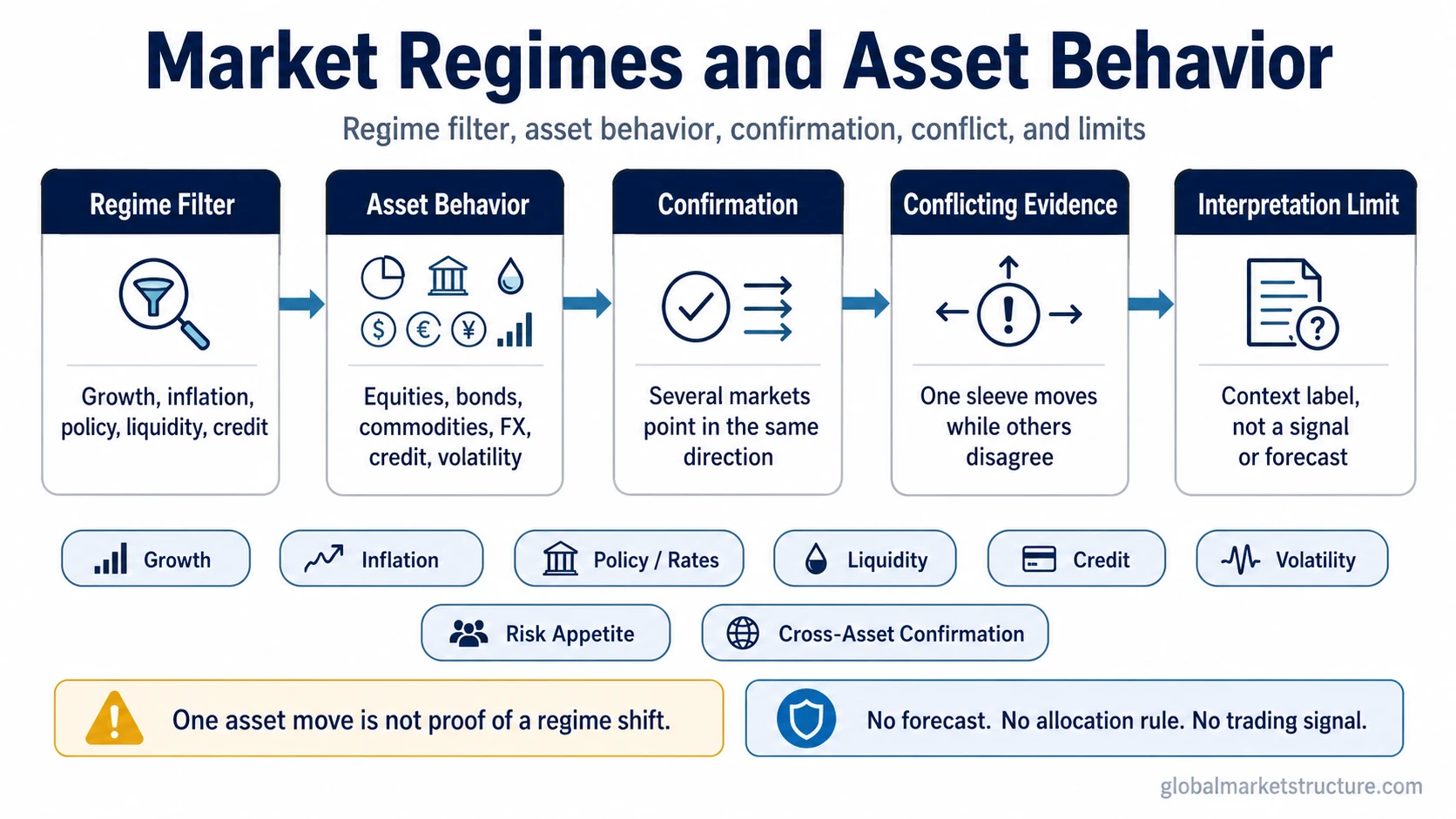
The Regime Inputs That Shape Asset Behavior
Asset behavior changes meaning when the surrounding condition stack changes. A move in equities during easy liquidity can carry a different message from the same move during tightening liquidity. A rise in commodities during improving growth can carry a different message from a rise caused mainly by supply pressure.
The broader macro regime usually supplies the first layer: growth, inflation, policy direction, interest-rate pressure, liquidity, and credit. Market behavior then adds the second layer: leadership, volatility, breadth, spreads, currency pressure, and risk appetite.
| Input | What it helps interpret | Why one reading can be misleading |
|---|---|---|
| Growth | Whether cyclical, defensive, or liquidity-sensitive behavior fits the environment. | Growth expectations can shift before hard data confirms the change. |
| Inflation | Whether rate pressure, commodity behavior, and real-asset sensitivity are becoming more important. | Inflation pressure can come from demand, supply shocks, policy lag, or currency effects. |
| Policy and rates | Whether discount-rate pressure or policy support is influencing risk assets and duration-sensitive assets. | Markets may price policy changes before official data fully changes. |
| Liquidity | Whether asset moves are being supported or restrained by financial conditions. | Surface price strength can hide tightening funding or weaker market depth. |
| Credit | Whether risk pricing is calm, deteriorating, or stress-sensitive. | Equity indices can stay firm while credit quality weakens beneath the surface. |
| Volatility | Whether uncertainty, hedging demand, or stress is rising. | Volatility alone can reflect positioning, event risk, or short-term hedging. |
| Risk appetite | Whether investors are favoring exposure, defensiveness, liquidity, or caution. | Risk-on behavior is only one input, not the whole regime. |
Qualified Asset Behavior Context
Regime context can help organize asset behavior, but it should stay qualified. The same asset group can behave differently depending on valuation, policy credibility, inflation composition, liquidity, positioning, and credit conditions.
| Regime condition | Asset behavior that may appear | What can strengthen the reading | What can weaken the reading |
|---|---|---|---|
| Improving growth with contained inflation | Equities and credit may behave more constructively, while volatility may stay contained. | Broad leadership, stable credit, improving breadth, and calm funding conditions. | Narrow leadership, rising yields for the wrong reason, or weakening credit quality. |
| Weak growth with persistent inflation pressure | Duration-sensitive assets, equities, credit, and commodities may send conflicting signals. | Persistent inflation pressure combined with weaker growth, tighter liquidity, and defensive behavior. | Inflation fading quickly, credit stabilizing, or growth expectations recovering. A stagflation reading needs more than one inflation scare. |
| Growth recovery expectations | Cyclicals, commodities, credit, and higher-beta markets may respond before hard data improves. | Improving breadth, firmer credit, easier liquidity, and cyclical leadership. | Commodity strength caused only by supply shock or equity strength driven by a narrow group. A reflation trade reading needs confirmation beyond one asset sleeve. |
| Stress-sensitive or defensive environment | Cash preference, defensive leadership, credit caution, FX pressure, and volatility may become more visible. | Wider credit spreads, weaker breadth, falling cyclicals, rising volatility, and stronger defensive behavior. | Credit calm, volatility fading, liquidity improving, or risk assets broadening again. |
| Low-stress, balanced growth and inflation | Risk assets may behave constructively if policy, liquidity, and credit remain supportive. | Broad participation, stable rates, contained volatility, and no major credit deterioration. | Inflation re-acceleration, liquidity tightening, or leadership becoming too narrow. |
Limit: The framework is not a performance map. It describes behavior that may appear under certain conditions, not what an asset class will do next.
How to Sequence Asset Behavior Signals
The strongest use of regime-based asset behavior is sequencing. A label becomes more useful when the evidence moves from broad environment to asset behavior, then to confirmation and conflict. The sequence reduces the risk of treating a single market move as a complete regime call.
| Step | Question being asked | Confirming evidence | Conflicting evidence | Interpretation limit |
|---|---|---|---|---|
| 1. Regime filter | What environment is being tested? | Growth, inflation, policy, liquidity, and credit point toward the same broad condition. | Macro inputs disagree or change faster than market behavior. | A label is only a starting filter, not a conclusion. |
| 2. Asset behavior | How are major asset sleeves responding? | Equities, bonds, commodities, FX, credit, and volatility show a coherent pattern. | One asset sleeve moves while others remain neutral or opposite. | Single-market behavior can be idiosyncratic. |
| 3. Risk appetite | Are investors adding risk, reducing risk, or seeking liquidity? | Leadership, breadth, credit, and volatility support the same risk appetite reading. | Index strength is narrow, defensive behavior is rising, or credit weakens. | Risk appetite can shift before the full regime is clear. |
| 4. Stress confirmation | Is pressure visible outside the headline asset? | Credit spreads, volatility, funding pressure, and defensive leadership confirm stress. | Stress indicators calm while the headline asset keeps moving. | Risk-off pressure needs confirmation across more than one channel. |
| 5. Conflicting evidence | What would make the reading less reliable? | Conflicts are limited and can be explained by timing or transition. | Credit, liquidity, leadership, and volatility contradict the regime label. | Mixed regimes require patience and softer conclusions. |
| 6. Use limit | What should not be inferred? | The framework clarifies context and uncertainty. | The label is used as a forecast, allocation rule, or signal. | Context improves interpretation, but it does not remove uncertainty. |
Why One Asset Move Is Not Enough
A single asset can move for reasons that have little to do with a broad regime shift. Positioning, flows, supply shocks, valuation resets, hedging demand, policy headlines, and temporary liquidity conditions can all create sharp moves without confirming a durable environment.
Volatility has the same limitation. Higher volatility can reflect genuine stress, but it can also reflect event risk, options hedging, thin liquidity, or short-term positioning. The reading becomes stronger only when volatility aligns with credit, breadth, liquidity, leadership, and cross-asset behavior.
Correlations can also change. Bonds may behave defensively in one environment and poorly in another if inflation pressure, term premium, or policy credibility changes the setup. Commodities may reflect supply disruption rather than broad demand strength. Equity indices may rise because a narrow leadership group is masking weaker participation.
Common failure mode: The weakest regime readings usually come from starting with the asset move and then forcing a regime label onto it. A stronger process starts with the environment, checks the asset behavior, then tests confirmation and conflict.
Practical Scenario
Scenario: Growth expectations are weakening, inflation pressure remains sticky, liquidity is tightening, credit spreads are widening, volatility is rising, and equity leadership is becoming narrow.
Provisional interpretation: Asset behavior may be moving toward a more defensive or stress-sensitive environment. The interpretation is stronger if credit pressure, weaker breadth, defensive leadership, and liquidity tightening appear together.
Conflicting evidence: Commodity strength may reflect supply pressure rather than broad reflation. Equity strength may reflect liquidity support or a narrow leadership group rather than broad risk appetite. A temporary volatility spike may reflect event risk rather than persistent stress.
What weakens the reading: Credit stabilizes, volatility fades, breadth improves, liquidity conditions become easier, and cyclical leadership broadens. Under those conditions, the defensive reading becomes less reliable.
The practical value is not a trade instruction. The useful output is a more disciplined reading of what the market is confirming, what it is rejecting, and where uncertainty remains.
Asset Behavior Versus Nearby Regime Concepts
Asset behavior by regime is not a replacement for the underlying regime concepts. It uses them as inputs and then checks whether asset behavior is consistent with the environment.
| Concept | What it owns | How asset behavior uses it |
|---|---|---|
| Market regime | The broad market environment and classification lens. | Provides the initial filter for interpreting cross-asset behavior. |
| Macro regime | The growth, inflation, policy, liquidity, and credit condition stack. | Explains why the same asset move can mean different things under different conditions. |
| Goldilocks | A balanced growth and inflation archetype. | Helps frame constructive asset behavior when stress, inflation pressure, and policy pressure are contained. |
| Stagflation | Weak growth, persistent inflation pressure, and constrained policy response. | Helps interpret conflicting behavior across equities, bonds, commodities, credit, and volatility. |
| Reflation trade | Growth recovery expectations, often with cyclical and commodity sensitivity. | Helps test whether cyclical behavior is broad enough to support a recovery reading. |
| Risk-on and risk-off | Risk appetite states. | Provide useful confirmation layers, but they are not complete regime frameworks by themselves. |
FAQ
Does asset behavior by regime predict returns?
No. It helps interpret market behavior under different conditions, but it does not predict returns or guarantee which asset class will perform best.
Can one asset move confirm a market regime?
No. One asset move can reflect positioning, flows, supply shocks, valuation changes, or temporary liquidity. A regime reading needs broader confirmation.
Is risk-on and risk-off enough to explain asset behavior?
No. Risk appetite is useful, but it should be read alongside growth, inflation, policy, liquidity, credit, volatility, and cross-asset confirmation.
Should investors rotate assets automatically by regime?
No. A regime framework can improve context, but automatic rotation turns interpretation into an allocation rule. Asset behavior still depends on valuation, timing, liquidity, and conflicting evidence.
Why can historical asset behavior by regime fail?
Historical patterns depend on the period, asset definitions, inflation backdrop, policy response, valuation, liquidity, and correlation structure. Similar labels can produce different market behavior.
Final Limitation
Regime-conditioned asset behavior improves context, but it does not remove uncertainty. The strongest readings come from alignment across macro conditions, liquidity, credit, volatility, risk appetite, and cross-asset behavior. The weakest readings come from labels applied after a single asset has already moved.