
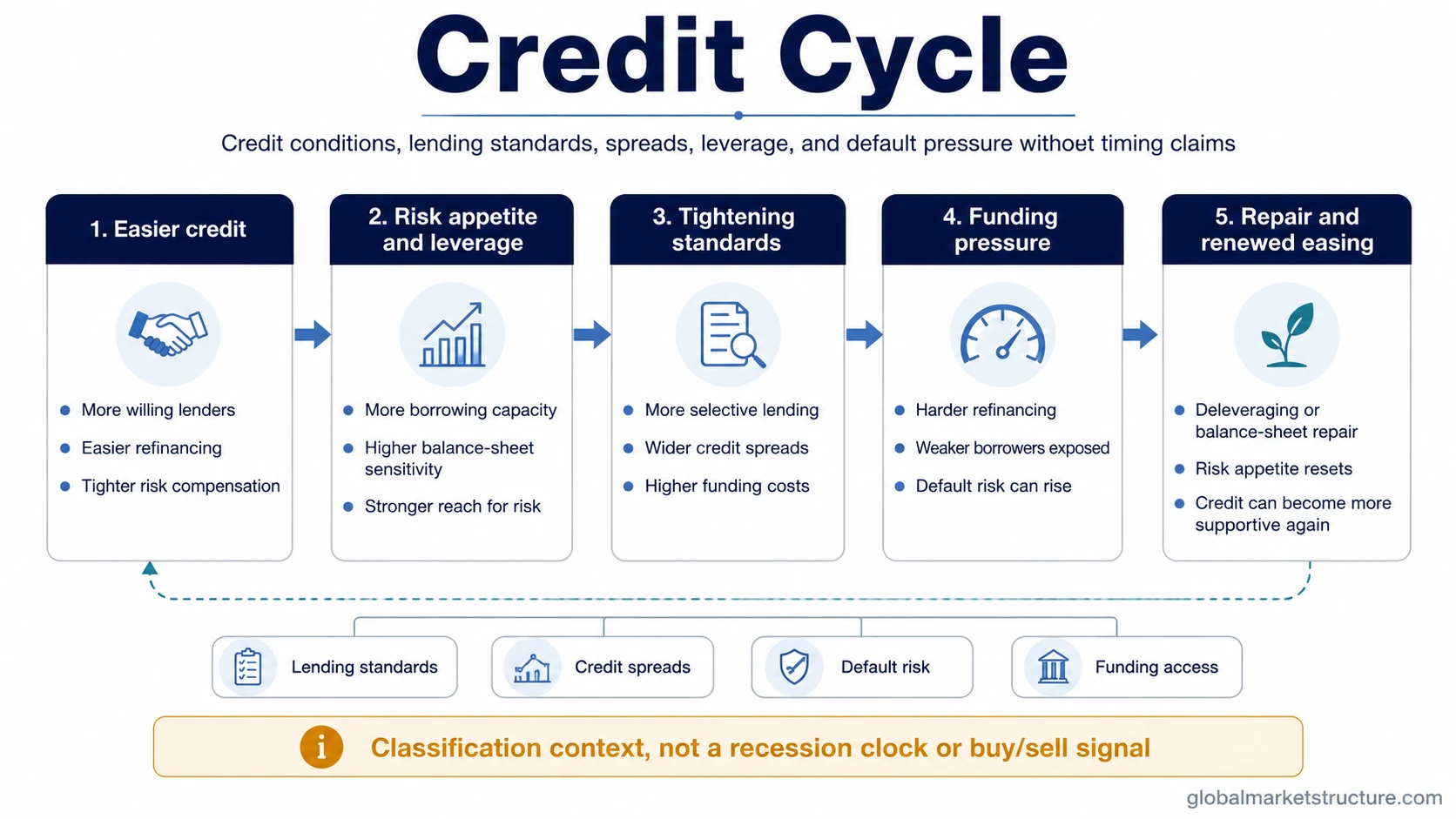
A credit cycle is the expansion and contraction of credit availability, borrowing demand, lending standards, credit pricing, refinancing capacity, leverage, and borrower stress. It describes how easily households, companies, and other borrowers can obtain and carry financing over time. The important distinction is that credit conditions can change through both lenders and borrowers, so one measure of loan growth or credit spreads cannot describe the entire cycle.
Definition: A credit cycle is the recurring change in the supply, demand, price, and quality of credit across bank lending and market-based financing. Easier phases generally involve more available financing and greater willingness to take credit risk. Tighter phases involve more restrictive financing, higher risk compensation, weaker refinancing access, or rising borrower stress.
Boundary: The credit cycle is a financing-cycle concept. It is related to the business cycle and asset markets, but it does not provide a fixed recession clock, identify an exact market top or bottom, or determine a specific asset-price outcome.
Key Points
- The credit cycle includes credit supply, credit demand, pricing, standards, leverage, refinancing, and borrower stress.
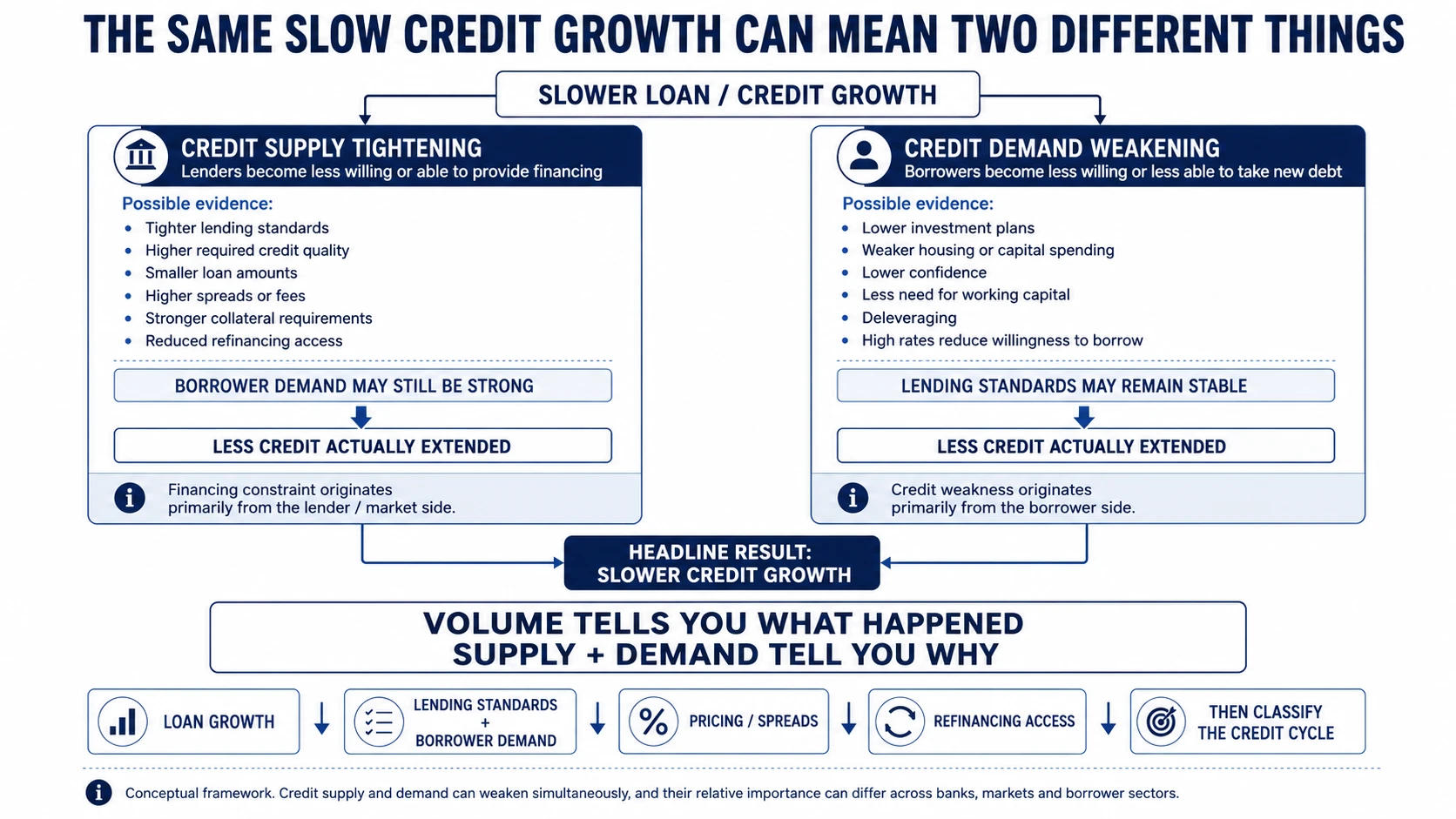
- Weak loan growth can come from tighter lender supply, weaker borrower demand, or both.
- The stock of outstanding debt and the flow of new borrowing answer different questions.
- Higher market rates do not necessarily affect the full outstanding debt stock immediately because maturity and refinancing schedules matter.
- Credit spreads contain information about credit conditions, but they can also move because of liquidity, investor demand, and risk-bearing capacity.
- Defaults are one layer of credit-cycle evidence, not necessarily the earliest indication that financing conditions changed.
- Credit-cycle analysis provides macro and market context, not a deterministic recession or trading signal.
What the Credit Cycle Actually Measures
The amount of credit outstanding is only one part of the cycle. A useful credit assessment separates several dimensions because they can move independently.
| Credit dimension | Main question | What it can reveal | Main boundary |
|---|---|---|---|
| Credit supply | How willing and able are lenders or investors to provide financing? | Changes in lending standards, terms, underwriting, and market access | Tighter supply does not prove that borrowers want the same amount of credit. |
| Credit demand | How willing are households and companies to borrow? | Changes in financing needs, investment appetite, confidence, and borrower behavior | Weak demand should not automatically be interpreted as lender restraint. |
| Credit pricing | What does financing cost? | Interest rates, spreads, fees, covenants, and required risk compensation | Price can tighten even when credit remains technically available. |
| Credit quantity | How much debt or new credit is being created? | Expansion or contraction in borrowing and balance sheets | The quantity alone does not identify whether supply or demand drove the change. |
| Borrower resilience | How easily can borrowers service existing obligations? | Leverage, coverage, cash flow, liquidity buffers, and balance-sheet sensitivity | High leverage does not identify the timing of a credit event by itself. |
| Refinancing conditions | Can maturing debt be replaced at acceptable terms? | How quickly current market rates transmit into borrower financing costs | Not all borrowers refinance at the same time. |
| Credit outcomes | Is financing pressure becoming realized stress? | Delinquencies, restructurings, defaults, and asset-quality deterioration | Outcome measures can appear after earlier changes in financing conditions. |
The credit cycle becomes easier to interpret when these dimensions are separated. A market can have abundant credit supply but weak borrowing demand. It can also have positive loan growth while standards tighten if previously approved financing, committed credit, or strong borrower demand continues to support volumes.
Credit Supply and Credit Demand Are Different Signals
One of the most common credit-cycle mistakes is treating slower credit growth as proof that lenders have tightened.
Credit is a transaction between a provider of financing and a borrower. The final amount of credit therefore reflects both sides. Banks can become more restrictive even while companies continue demanding loans. Alternatively, banks can remain willing to lend while households or businesses reduce borrowing because investment plans, confidence, or financing needs weaken.
| Credit supply | Credit demand | Possible result | Interpretation |
|---|---|---|---|
| Easier | Strong | Credit growth can accelerate | Financing availability and borrower appetite reinforce each other. |
| Tighter | Strong | Credit can still grow, but at worse terms or with more borrower rejection | Headline volumes can understate the deterioration in credit supply. |
| Easier | Weak | Loan growth can remain soft | Low borrowing does not necessarily imply a credit crunch. |
| Tighter | Weak | Credit growth can contract sharply | Supply restraint and weaker borrower appetite are reinforcing each other. |
Core distinction: Loan growth tells you what happened to credit volume. Lending standards and borrower demand help explain why it happened.
The Stock of Credit Is Not the Same as New Credit Creation
The outstanding stock of debt can remain very large even after new borrowing begins slowing. Likewise, new credit can accelerate from a weak starting point while the total debt stock changes only gradually.
This matters because economic activity is influenced not only by how much debt already exists, but also by whether additional financing is becoming easier or harder to obtain. Existing debt describes accumulated obligations. New borrowing describes the current flow of financing into households, companies, investment, inventories, real estate, and other activities.
Changes in the pace of new credit creation can therefore contain different information from the absolute level of outstanding debt. The deeper measurement of changes in new credit belongs to the dedicated credit-impulse framework rather than being treated as identical to the broad credit cycle.
Interpretation limit: A high debt stock does not prove that the current credit impulse is strong, and weak new borrowing does not mean the existing debt burden has disappeared.
How Easier Credit Can Reinforce Expansion
When lenders and capital markets are willing to provide financing on easier terms, households and companies can have greater capacity to borrow, refinance, invest, purchase assets, build inventories, or expand operations.
Lower required risk compensation can also make financing available to borrowers that would face more difficulty in a restrictive environment. If asset values and cash flows are supportive at the same time, lenders can perceive balance sheets as more resilient, which can reinforce credit availability further.
Illustrative expansion sequence:
- Financing becomes easier: standards, pricing, or market access become more supportive.
- Borrowing capacity expands: more borrowers can finance spending, investment, or refinancing.
- Balance sheets expand: debt and leverage can increase.
- Economic activity can receive support: credit-financed demand, investment, and asset activity may strengthen.
- Risk tolerance can rise: lenders and investors may accept less compensation for bearing credit risk.
This sequence is not inherently unstable. Credit expansion can finance productive investment and sustainable growth. Vulnerability increases when debt growth, leverage, refinancing dependence, asset valuations, or borrower quality become increasingly reliant on financing remaining unusually easy.
How Credit Tightening Transmits Into the Economy
A credit tightening does not require lending to stop completely. Conditions can tighten through higher borrowing costs, stricter underwriting, smaller loan sizes, stronger collateral requirements, shorter maturities, weaker refinancing access, or lower willingness to hold risky debt.
Illustrative tightening sequence:
- Credit conditions become less supportive: lending standards tighten, spreads widen, rates rise, or funding becomes less reliable.
- Marginal borrowers lose flexibility: financing becomes more expensive or less available.
- Borrower behavior changes: households or companies can reduce spending, investment, hiring, inventories, or asset purchases.
- Cash-flow pressure increases: borrowers with high leverage or near-term refinancing needs become more sensitive.
- Stress can become visible: asset quality, delinquencies, restructurings, or defaults can deteriorate if the pressure persists.
The sequence is conditional rather than mechanical. Strong cash flow, long debt maturities, fixed borrowing costs, liquid balance sheets, fiscal support, or alternative funding sources can delay or reduce the transmission.
Why Higher Rates Do Not Hit Every Borrower at the Same Time
The market cost of new credit and the effective cost of the existing debt stock can differ for a long period. A borrower with long-term fixed-rate debt can remain insulated from a higher-rate environment until refinancing approaches. Another borrower dependent on short-term or floating-rate financing can feel the pressure much sooner.
This creates a refinancing transmission lag. A rate increase can be economically important before the average interest cost on outstanding debt fully reflects it.
| Borrower structure | Immediate sensitivity | Main risk |
|---|---|---|
| Long-term fixed-rate debt | Lower immediate sensitivity to current market rates | Pressure can appear when debt eventually matures and must be refinanced. |
| Short-term debt | Higher refinancing frequency | Current market rates can reach financing costs more quickly. |
| Floating-rate debt | Potentially high sensitivity | Interest expense can adjust before maturity. |
| Large cash or liquidity buffer | Greater ability to delay external financing | The buffer can eventually decline if operating cash flow is weak. |
| Dependence on external refinancing | High sensitivity when maturities approach | Financing access can become as important as the nominal interest rate. |
Cycle lesson: The same rate environment can be mild for borrowers that do not need new financing and severe for borrowers that must refinance immediately.
Credit Spreads Are Important, but They Are Not Pure Credit Risk
Credit spreads are useful because they show the additional compensation investors require relative to a safer benchmark. Widening spreads can indicate that credit markets are becoming less willing to bear risk.
But spread levels should not be treated as a direct measurement of borrower fundamentals alone. Liquidity conditions, investor flows, the supply of bonds, risk appetite, market-making capacity, and the broader price of bearing risk can also change spreads.
This creates two opposite interpretation risks. Narrow spreads do not necessarily prove that borrower fundamentals have improved by the same amount. Wide spreads do not necessarily mean that every borrower faces equivalent default risk.
Spread boundary: Use credit spreads as one layer of credit-cycle evidence. Then check whether lending standards, refinancing conditions, leverage, coverage, defaults, funding access, and broader macro conditions support the same interpretation.
Credit-Cycle Indicators Can Occupy Different Timing Roles
Credit-cycle evidence does not arrive simultaneously. Some indicators describe changes in willingness to provide financing, some describe current market pricing, and others describe borrower outcomes after financing pressure has already accumulated.
| Credit evidence | What it primarily describes | Timing caution |
|---|---|---|
| Lending standards | Lender willingness to provide credit and the terms attached to it | Can change before outstanding loan volumes respond fully. |
| Credit demand | Borrower willingness or need to obtain financing | Can weaken because of slower activity even when lenders remain willing to lend. |
| Credit spreads | Market pricing of credit risk, liquidity, and risk-bearing conditions | Can move rapidly but can also be affected by technical market forces. |
| Loan growth | Realized change in credit volumes | Does not by itself distinguish supply from demand. |
| Refinancing costs | Terms faced by borrowers replacing maturing debt | Pressure depends on the maturity schedule. |
| Defaults and asset quality | Realized borrower distress | Can confirm stress after earlier credit conditions have already changed. |
The purpose is not to assign every indicator a permanent leading or lagging label. It is to understand which stage of the financing process each indicator is measuring.
Credit Cycle vs Business Cycle
The credit cycle and the business cycle interact, but they describe different objects. The business cycle centers on economic activity such as output, employment, income, production, and demand. The credit cycle centers on financing availability, borrower demand, pricing, leverage, and credit quality.
Credit can amplify economic expansion because financing can support consumption and investment. Credit can also amplify a slowdown when lenders become more cautious, borrowers reduce demand for financing, or refinancing pressure limits spending and investment.
The two cycles do not have to turn together. Credit conditions can tighten while economic data remains firm. Economic activity can also weaken while credit-market pricing remains relatively calm. The disagreement is information rather than proof that one signal is wrong.
Core distinction: The business cycle describes what is happening to economic activity. The credit cycle describes how financing is supporting, restraining, or transmitting that activity.
Why Credit Conditions Can Diverge From Stocks
Suppose equity indices remain resilient while lending standards tighten and some credit spreads begin widening. The two markets do not have to react at the same time because they are pricing different risks and expectations.
The credit evidence can indicate that financing conditions are becoming less supportive while the stock cycle has not confirmed an equivalent deterioration.
The opposite divergence is possible as well. Equities can weaken because of valuation, earnings expectations, positioning, or other market factors while credit conditions remain relatively stable.
Transferable lesson: Credit-market disagreement with equities should be investigated, not automatically converted into a timing signal.
Credit-Cycle Phases Without a Fixed Clock
A broad phase model can organize the credit cycle, but the boundaries are not precise and different credit markets can occupy different phases at the same time.
| Illustrative phase | Typical credit characteristics | Main question |
|---|---|---|
| Easing | Improving access, more supportive pricing, rising willingness to lend or bear credit risk | Is financing becoming easier broadly or only in selected markets? |
| Expansion | Credit growth, refinancing access, stronger borrowing activity, and potentially rising leverage | Is credit supporting productive activity or increasing financial vulnerability? |
| Maturation | High debt stock, thinner risk compensation, greater sensitivity to rates or borrower quality | How dependent is the system on financing remaining easy? |
| Tightening | Stricter terms, higher financing costs, wider risk differentiation, weaker refinancing conditions | Is restraint driven by lenders, borrowers, markets, or several channels? |
| Stress | Reduced access for weaker borrowers, deteriorating coverage, defaults, or funding pressure | How broadly has credit deterioration spread? |
| Repair | Deleveraging, restructurings, balance-sheet rebuilding, more conservative underwriting | Is the system absorbing losses and rebuilding lending capacity? |
| Renewed easing | Improving risk tolerance, access, or refinancing conditions | Is easier credit translating into new borrowing and activity? |
This phase sequence should not be converted into a fixed calendar. Bank lending, corporate bonds, private credit, mortgages, consumer credit, and other financing channels can turn at different speeds.
Practical Scenario: Credit Growth Slows but the Cause Is Unclear
Suppose total loan growth begins slowing. Viewed alone, that observation says that less incremental credit is being created. It does not tell us why.
Now suppose lending surveys show tighter standards while credit demand remains strong. That would point toward a supply-side constraint. If standards remain stable but businesses report weaker borrowing demand, the same slowing loan growth would carry a different interpretation.
If spreads also widen, refinancing costs rise, and weaker borrowers begin losing market access, evidence of broader credit tightening becomes stronger. If spreads stay contained and lending standards stabilize, the original slowdown may have reflected borrower demand rather than systemic credit stress.
Transferable lesson: Start with the observed credit outcome, then separate lender supply, borrower demand, pricing, refinancing, and realized stress before assigning a credit-cycle phase.
Common Mistakes When Reading the Credit Cycle
| Mistake | Why it fails | Better interpretation |
|---|---|---|
| Treating slower loan growth as proof of tighter credit supply | Borrower demand can weaken even when lenders remain willing to lend. | Separate lending standards from credit demand. |
| Treating the debt stock as the current credit impulse | Outstanding debt and new credit creation describe different parts of the system. | Separate accumulated obligations from current financing flows. |
| Assuming higher rates affect all debt immediately | Fixed rates, maturity schedules, and liquidity buffers can delay transmission. | Check refinancing timing and debt structure. |
| Assuming tight credit spreads prove strong fundamentals | Liquidity, investor demand, supply, and risk-bearing capacity can also compress spreads. | Cross-check market pricing with borrower fundamentals and financing access. |
| Waiting for defaults before recognizing tightening | Standards, spreads, funding, and refinancing conditions can change before realized defaults. | Read the credit process as a sequence. |
| Assuming tighter credit guarantees recession | The macro effect depends on borrower resilience, income, fiscal policy, liquidity, and the breadth of tightening. | Use the credit cycle as one layer of business-cycle analysis. |
| Turning credit-equity divergence into a market-timing rule | Different markets can price different risks at different times. | Look for confirmation rather than forcing synchronization. |
How to Read the Credit Cycle
Interpretation sequence:
- Credit supply: Are lenders and capital markets becoming more or less willing to finance borrowers?
- Credit demand: Do households and companies actually want more financing?
- Pricing: Are interest rates, spreads, fees, or other financing terms becoming more restrictive?
- Credit flow: Is new borrowing accelerating, slowing, or contracting?
- Debt stock: How much leverage has already accumulated?
- Refinancing: Which borrowers must replace debt soon and at what terms?
- Borrower resilience: Are cash flow, coverage, liquidity, and balance sheets absorbing the pressure?
- Realized stress: Are delinquencies, defaults, restructurings, or asset-quality problems increasing?
- Macro confirmation: Are investment, consumption, employment, earnings, and broader activity responding?
- Market confirmation: Are equities, funding markets, liquidity, and risk appetite telling a compatible story?
The strongest credit-cycle assessment is therefore a layered diagnosis rather than a single indicator. A current phase call should also use dated primary data rather than being inferred from a conceptual page.
Limits of Credit-Cycle Analysis
No fixed clock: Credit tightening can transmit quickly through one financing channel and slowly through another.
No universal indicator: Standards, demand, spreads, loan growth, refinancing, leverage, and defaults measure different parts of the credit process.
No recession guarantee: Restrictive credit raises financing pressure, but the economic outcome depends on income, cash flow, balance sheets, policy, liquidity, and the breadth and duration of tightening.
No automatic market signal: Asset prices can move before, after, or independently of some credit indicators.
No permanent phase label: Bank credit, bond markets, private credit, household borrowing, and other credit channels can occupy different conditions simultaneously.
Related Concepts
The business cycle describes broad economic activity, while the credit cycle isolates the financing mechanism that can support or restrain that activity.
The stock cycle focuses on equity-market participation and price behavior, which can confirm or diverge from changes in credit conditions.
A boom-and-bust cycle can include aggressive credit expansion and later tightening, but the broader concept also includes expectations, confidence, asset prices, leverage, and reflexive behavior.
The practical boundary is to keep the concepts separate: credit-cycle analysis asks how financing conditions are changing and how those changes are transmitting through borrowers, lenders, and markets.