
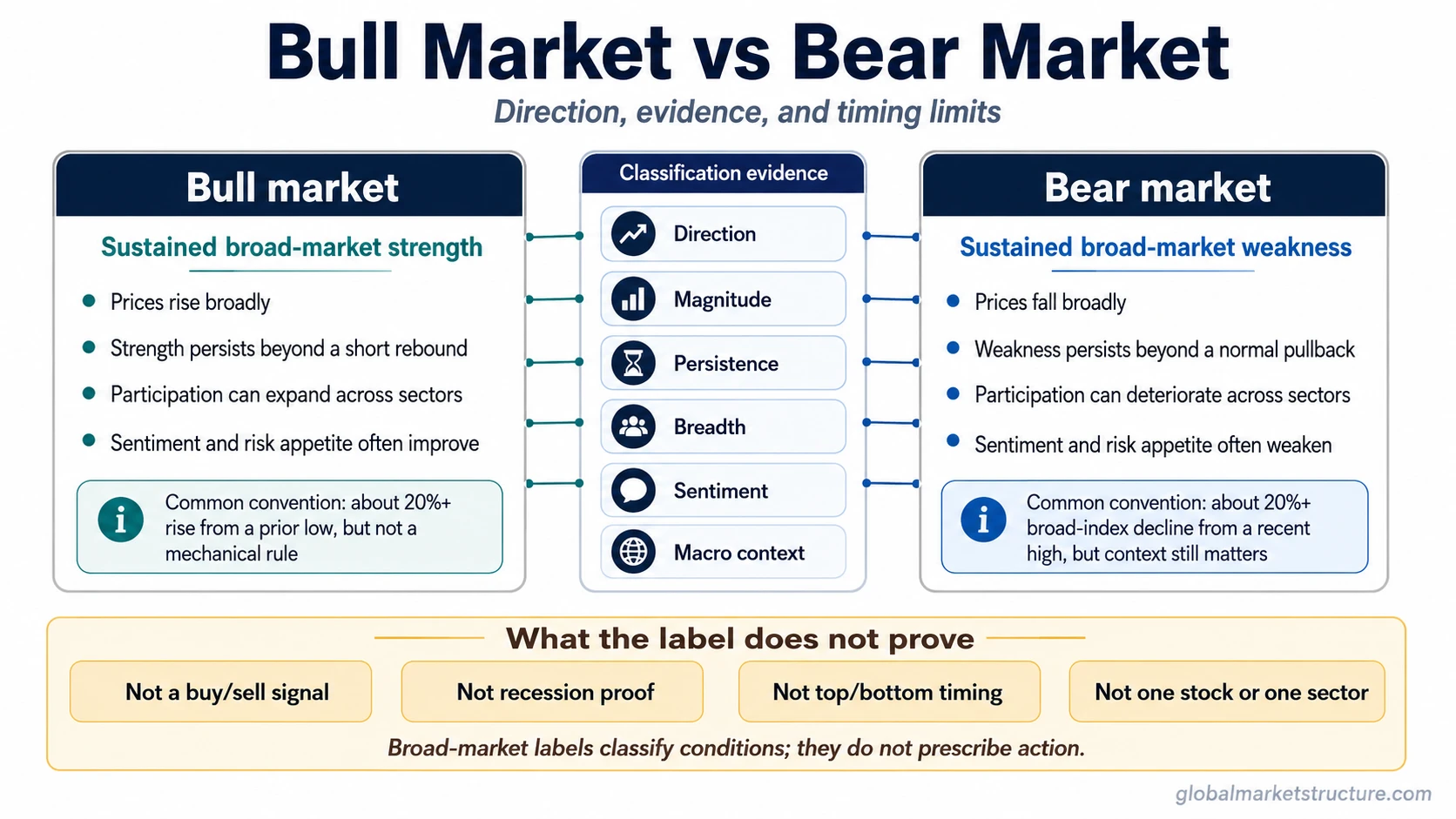
A bull market describes sustained broad-market strength. A bear market describes sustained broad-market weakness. The difference is not only whether prices are moving up or down, but whether the move is broad, persistent, and strong enough to classify the market environment.
A bull market is commonly associated with a broad-index rise of about 20% or more after a prior low over a sustained period. A bear market is commonly associated with a decline of about 20% or more in a broad market index from a recent high. Neither label is a buy signal, a sell signal, a recession call, or a reliable top-or-bottom timing tool.
Bull market vs bear market in one view
| Criterion | Bull market | Bear market | Boundary or limitation |
|---|---|---|---|
| Market direction | Broad market prices rise in a sustained way. | Broad market prices fall in a sustained way. | One rally or one decline does not settle the classification by itself. |
| Magnitude | A broad-index rise of about 20% or more from a prior low is a common convention. | A broad-index decline of about 20% or more from a recent high is a common convention. | The 20% line is useful, but it is not a universal mechanical rule. |
| Persistence | Strength lasts beyond a short rebound or temporary relief rally. | Weakness lasts beyond a normal pullback or correction. | Duration and structure matter because short moves can reverse quickly. |
| Breadth | Participation expands across more stocks, sectors, or risk assets. | Weakness spreads across more stocks, sectors, or major indexes. | Narrow leadership can make either label less reliable. |
| Sentiment | Confidence and risk appetite generally improve. | Confidence weakens and risk aversion generally increases. | Sentiment supports interpretation, but price and breadth still matter. |
| Economic context | Economic improvement can support the classification. | Economic deterioration can support the classification. | Market labels and economic-cycle labels are not the same thing. |
| Practical meaning | Classifies a broad risk-on market phase. | Classifies a broad risk-off or risk-stressed market phase. | The label does not prescribe an investment action. |
What a bull market means
A bull market is a broad market condition where prices rise in a sustained way and confidence usually improves. It is not just a good day, a strong week, or a rebound after a sharp decline. The label becomes stronger when the advance is persistent, broad, and supported by improving participation.
In market-cycle terms, a bull market usually reflects an environment where buyers are willing to pay higher prices, risk appetite is improving, and downside pressure is not dominating the broader index structure. Liquidity, earnings expectations, policy expectations, positioning, and sentiment can all influence the phase, but none of those factors alone defines it.
Important limitation: A bull market does not automatically mean the economy is strong. Asset prices can rise because liquidity improves, discount rates fall, positioning changes, valuation multiples expand, or a small group of large stocks carries the index higher. Economic strength can support a bull market, but it is a different classification.
What a bear market means
A bear market is a broad market condition where prices fall in a sustained way and confidence usually weakens. The common threshold is a decline of about 20% or more in a broad market index from a recent high, but the label is more useful when it is interpreted with persistence, breadth, and market structure.
A bear market is different from a normal correction because the weakness is deeper, more persistent, and usually more damaging to risk appetite. A single volatile decline can look severe, but the classification becomes more convincing when weakness spreads across sectors, rebounds fail, and participation remains poor.
Important limitation: A bear market does not automatically mean a recession has started or will occur. A bear market classifies market-price weakness. A recession classifies a significant decline in economic activity that is spread across the economy and lasts more than a few months. They can overlap, but one does not mechanically establish the other.
The 20% threshold is a convention, not the whole analysis
The 20% threshold is widely used because it gives market observers a simple boundary for large broad-index moves. It is most often discussed as a bear-market threshold, but bull markets are also often described through sustained broad-index gains from a prior low. The problem is that a clean percentage rule can make classification look more mechanical than it is.
A market can fall close to a bear-market threshold and still behave like a damaged risk environment if breadth, sentiment, and trend structure remain weak. Another market can briefly cross a threshold and then recover quickly. The label becomes more useful when the percentage move is combined with persistence, participation, and the broader risk backdrop.
Classification rule: Use the percentage move as a starting point, then test whether the market condition is broad, persistent, and supported by the surrounding evidence.
How to classify the difference
The cleanest distinction is direction first, evidence second, and limits third. A bull market requires more than a rising price line. A bear market requires more than a weak patch. The classification should answer whether the broader market environment has changed enough to describe a sustained phase.
| Evidence layer | Why it matters | Bull-market reading | Bear-market reading |
|---|---|---|---|
| Direction | Identifies whether the broad index is advancing or declining. | Higher prices over a sustained period. | Lower prices over a sustained period. |
| Magnitude | Separates ordinary noise from a meaningful phase shift. | The advance is large enough to change the broad market tone. | The decline is deep enough to damage the broad market tone. |
| Persistence | Filters short rebounds, pullbacks, and volatile reversals. | Strength continues beyond a short bounce. | Weakness continues beyond a normal correction. |
| Breadth | Shows whether the move is supported by broad participation. | More stocks and sectors participate in the advance. | More stocks and sectors participate in the decline. |
| Sentiment | Shows whether investors are rewarding or reducing risk exposure. | Risk appetite improves. | Risk aversion rises. |
| Macro context | Adds background without replacing price classification. | Growth, liquidity, or policy expectations may support strength. | Growth concerns, liquidity stress, or policy tightening may support weakness. |
Same market move, different classification
Illustrative scenario: A broad equity index rebounds sharply after a deep decline. The move looks bullish because prices are rising, but the classification depends on the surrounding evidence.
If the rebound remains narrow, stalls below prior resistance, and occurs while breadth stays weak, it may be a countertrend rally inside a broader bear-market structure. If the rebound expands across sectors, holds higher lows, improves participation, and restores risk appetite, it may support a new bull-market classification.
The same logic works in reverse. A market can decline during a bull market without immediately becoming a bear market. Corrections, rotations, and volatility spikes can occur inside a broader uptrend. The classification changes only when weakness becomes deep, persistent, and broad enough to alter the market phase.
Common mistakes when comparing bull and bear markets
Mistake 1: Treating the label as an action rule. Bull market does not mean buy, and bear market does not mean sell. The labels describe market conditions. They do not replace risk management, valuation, time horizon, liquidity needs, or strategy design.
Mistake 2: Using one stock as the whole market. A single stock, sector, or theme can rise during a bear market or fall during a bull market. The comparison is mainly about broad market classification, not isolated securities.
Mistake 3: Confusing bear markets with recessions. Bear markets and recessions can overlap, but they classify different things. Bear markets describe asset-price weakness. Recessions describe broad economic contraction.
Mistake 4: Assuming a rally ends the bear market. Bear markets can include sharp rallies. A rebound becomes more meaningful when it is supported by breadth, persistence, and improving structure.
Mistake 5: Assuming a pullback ends the bull market. Bull markets can include corrections. A decline becomes more meaningful when it spreads, persists, and damages the broader trend.
Bull and bear markets are not the same as secular regimes
Cyclical bull and bear markets describe market phases over shorter cycle horizons. Secular bull and bear markets describe longer structural regimes that can include several cyclical moves inside them. A cyclical bull market can occur within a weaker long-term secular environment, and a cyclical bear market can occur inside a broader secular advance.
That boundary matters because the time horizon changes the interpretation. A secular bull market is not just a normal bull-market rally stretched over time. A secular bear market is not just a normal bear-market decline. The secular label belongs to a longer regime discussion.
When each label is more useful
| Situation | More useful label | Why |
|---|---|---|
| Broad indexes are rising, participation is expanding, and confidence is improving. | Bull market | The evidence points to sustained broad-market strength. |
| Broad indexes are falling deeply, rebounds fail, and risk aversion is rising. | Bear market | The evidence points to sustained broad-market weakness. |
| Prices rebound sharply after a deep decline, but breadth remains weak. | Boundary case | The rebound may be a rally inside a damaged structure rather than a confirmed phase shift. |
| Prices pull back during a strong advance, but the broader trend and participation remain intact. | Boundary case | The decline may be a correction inside a bull market rather than a bear-market transition. |
| Economic data weakens while prices continue rising. | Market/economy split | Market classification and economic-cycle classification can diverge. |
| One sector collapses while the broad index remains strong. | Sector-specific weakness | A sector move does not automatically define the broad market phase. |
How the comparison fits market-cycle analysis
Bull and bear markets are best understood as broad cycle-state labels. They help describe whether the market is rewarding risk, punishing risk, expanding participation, or losing support. They are useful because they summarize the market environment, but they become misleading when treated as precise forecasts.
The stronger comparison is not optimism versus pessimism in isolation. It is sustained broad-market strength versus sustained broad-market weakness, tested through direction, magnitude, persistence, breadth, sentiment, and context. That framework keeps the labels useful without turning them into mechanical signals.
Related market-cycle concepts
Bull market: For the standalone definition, evidence, and limitations of sustained broad-market strength, see bull market.
Bear market: For the standalone definition, common 20% convention, evidence map, and timing limits, see bear market.
Recession: For economic contraction rather than market-price classification, see recession.
FAQ
What is the main difference between a bull market and a bear market?
A bull market describes sustained broad-market strength, while a bear market describes sustained broad-market weakness. The difference depends on direction, magnitude, persistence, breadth, sentiment, and context, not only one short price move.
Is a bear market always a 20% decline?
A decline of about 20% or more in a broad market index from a recent high is a common bear-market convention. It should still be interpreted with persistence, breadth, and structure because the threshold is not a universal mechanical law.
Does a bull market mean the economy is strong?
No. A bull market can appear with improving economic conditions, but asset prices can also rise because of liquidity, valuation expansion, policy expectations, positioning, or narrow index leadership.
Does a bear market mean a recession is happening?
No. A bear market is a market-price classification. A recession is an economic-activity classification. They can overlap, but a bear market does not automatically prove that a recession has started.
Can a bear market have strong rallies?
Yes. Bear markets can include sharp rallies. A rebound becomes more meaningful when it is broad, persistent, and supported by improving market structure rather than only short-term relief buying.