
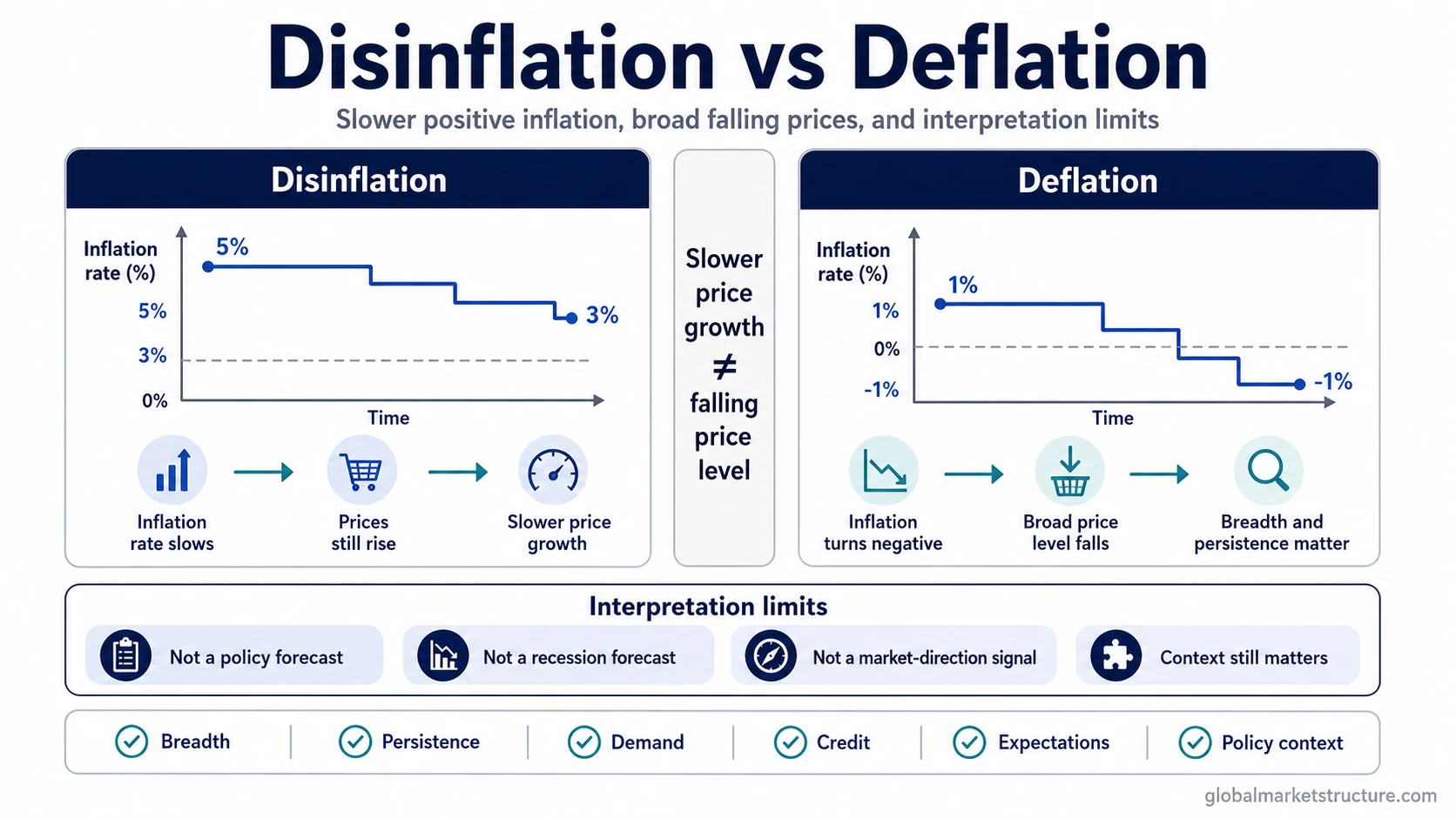
Disinflation means the inflation rate is falling while it remains positive, so the broad price level is still rising, only more slowly. Deflation means the broad price level is falling, usually reflected by negative inflation. The boundary is slower price growth versus an actual decline in prices across the wider basket; neither label alone predicts policy or markets.
Key Points
- Disinflation: prices are still rising, but the rate of increase is slowing.
- Deflation: the broad price level is falling, not merely rising more slowly.
- Market interpretation: the label alone does not forecast policy, recession risk, earnings, bonds, equities, or risk appetite.
Disinflation vs Deflation at a Glance
The most useful test is whether the inflation rate is still positive or whether the general price level is actually falling. A lower positive inflation rate is disinflation. A broad negative inflation rate points toward deflation, especially when the decline is persistent and not limited to a few categories.
| Criterion | Disinflation | Deflation |
|---|---|---|
| Core meaning | Inflation is slowing. | The broad price level is falling. |
| Price-level behavior | Prices usually keep rising, but more slowly than before. | Prices decline across the broader basket, not only in one category. |
| Inflation-rate sign | Usually positive but lower than the prior reading. | Usually negative when measured across the broad price index. |
| Typical headline wording | Inflation cooled, inflation eased, price growth slowed. | Prices fell, inflation turned negative, broad price level declined. |
| Breadth and persistence | Can be broad or narrow, but the price level is still increasing overall. | Becomes more meaningful when price declines are broad and persistent. |
| Growth and demand context | Can reflect fading shocks, tighter policy, improved supply, or weaker demand. | Can reflect weak demand, excess capacity, credit stress, or persistent price pressure reversal. |
| Policy interpretation | Does not imply easier policy by itself; context matters. | Does not imply one fixed policy response by itself; mandate, persistence, labor, credit, and expectations matter. |
| Market interpretation limit | Does not by itself predict risk-asset strength, bond direction, earnings resilience, or recession probability. | Does not by itself prove a crisis, recession, asset selloff, or deflationary spiral. |
Same Inflation Path, Different Reading
A single sequence can show why the terms are confused. The numbers below are illustrative only. They are not current data, not a country case, and not a market forecast.
| Illustrative year | Inflation reading | Classification | Reason |
|---|---|---|---|
| Year 1 | 5% | High positive inflation | Prices are rising at a relatively fast rate. |
| Year 2 | 3% | Disinflation | Inflation has slowed, but prices are still rising. |
| Year 3 | -1% | Deflation, if broad and persistent | The broad price level is falling rather than merely rising more slowly. |
Classification note: real-world classification depends on the inflation measure, breadth across the basket, persistence, seasonality, base effects, and broader economic context.
Why the Two Terms Are Confused
The confusion usually comes from the phrase “inflation is falling.” That can mean the inflation rate is falling, which is disinflation. It can also mean that the price index itself is falling, which is deflation. Those are not the same statement.
Same background, different classification: fading supply shocks, weaker demand, tighter policy, or lower input costs can all reduce inflation pressure. The classification still depends on whether the broad price level continues rising or actually declines.
Boundary Cases and False Readings
A few falling prices do not prove deflation. Energy, used cars, rents, freight costs, or other categories can fall while the broad price level still rises.
One weak reading does not prove a regime. A negative or unusually low reading can reflect temporary shocks, seasonality, base effects, or category-specific movement.
A lower positive inflation rate still means prices are rising. Moving from 5% inflation to 3% inflation is disinflation, not deflation.
Macro Interpretation Limits
Disinflation can be interpreted differently depending on why it happens. It may reflect easing supply pressure, weaker demand, tighter monetary conditions, fading commodity pressure, or a mix of forces. A benign disinflation path usually needs support from growth, labor income, credit stability, and anchored expectations.
Deflation becomes more serious when price declines are broad, persistent, and tied to weaker demand, tighter credit, unstable expectations, or falling income. Even then, the word deflation should not be treated as a complete forecast. The surrounding macro regime matters more than the label alone.
Useful interpretation checks:
- Is the inflation rate still positive or negative?
- Is the broad price level rising, flat, or falling?
- Is the move broad across the basket or concentrated in a few categories?
- Is the pattern persistent or temporary?
- What do growth, labor, credit, financial conditions, expectations, and policy context suggest?
- What should not be inferred from the label alone?
What the Label Does Not Tell You
Neither term is a complete market signal. Disinflation does not by itself mean risk assets will rally, bonds will rise, earnings will hold up, or central banks will ease policy. Deflation does not by itself prove a crisis, a recession, or a specific market direction.
The useful distinction is diagnostic. Disinflation identifies slower positive price growth. Deflation identifies broad price-level decline. The next layer of interpretation depends on the economic mechanism behind the move.
Related Concepts
The standalone concept of disinflation focuses on slower positive inflation and how falling inflation pressure can be interpreted in macro context.
The standalone concept of deflation focuses on broad price-level decline and why breadth, persistence, demand, credit, and expectations matter.
FAQ
Is disinflation the same as falling prices?
No. Disinflation means prices are usually still rising, but at a slower rate. Falling prices across the broad price level would be deflation.
Can disinflation turn into deflation?
It can, but only if the broad price level moves from rising more slowly to actually falling. Breadth and persistence matter, so one weak reading is not enough by itself.
Does deflation always mean an economic collapse?
No. Persistent broad deflation can be serious, especially when tied to weak demand, credit stress, or unstable expectations, but the label alone does not prove a collapse.
Does disinflation predict market direction?
No. Disinflation does not by itself predict equities, bonds, earnings, recession risk, or policy direction. The cause of disinflation and the surrounding macro context matter.