
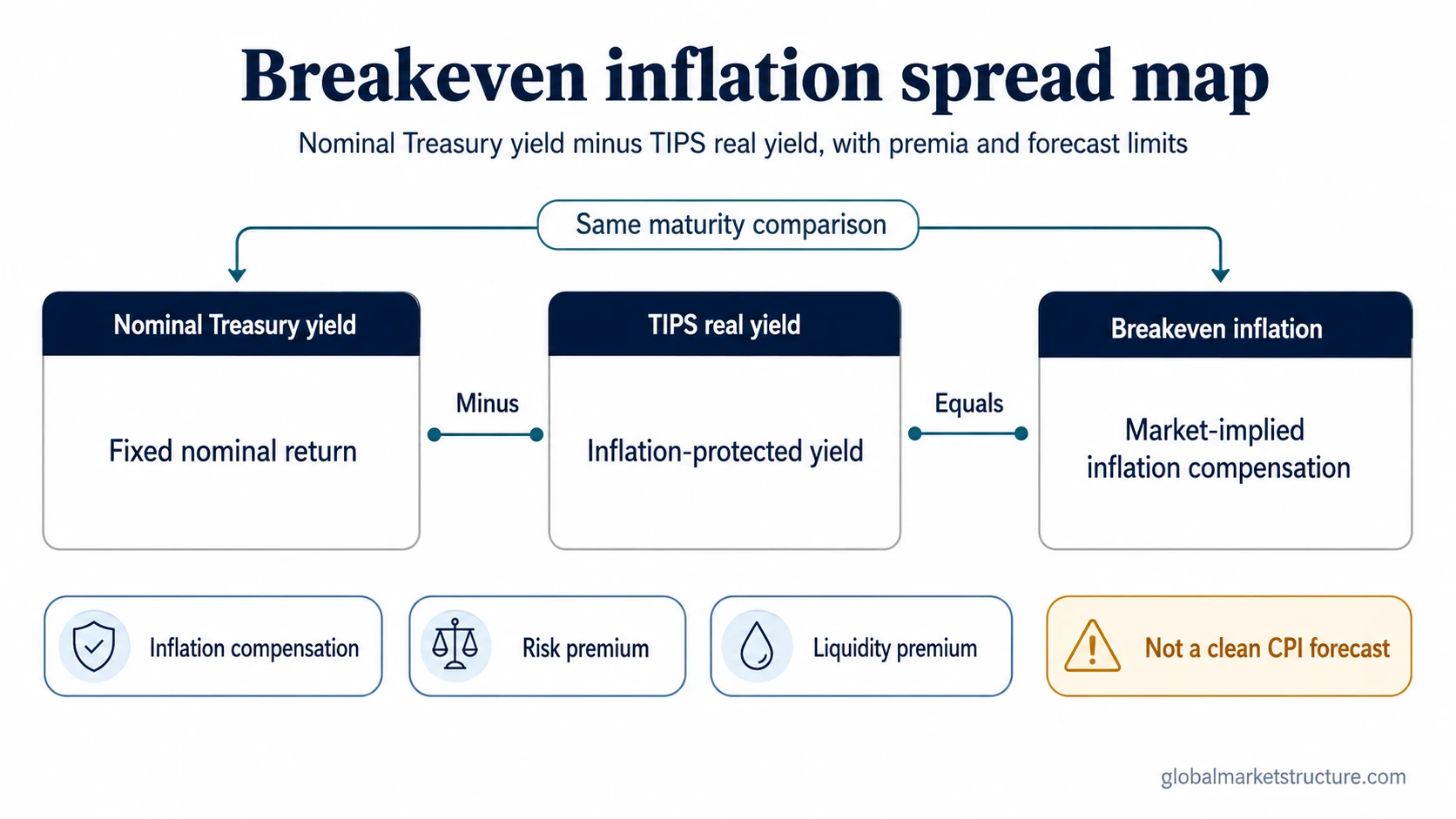
Breakeven inflation is the inflation rate implied by the gap between a nominal Treasury yield and a TIPS real yield of the same maturity. It is called “breakeven” because it marks the inflation rate at which the two securities would be roughly comparable before other premia. Markets often read it as inflation compensation, but risk premia, liquidity premia, and market conditions mean it is not a clean inflation forecast.
Core formula: breakeven inflation = nominal Treasury yield − TIPS real yield of the same maturity.
The same-maturity rule matters. A 10-year nominal Treasury yield should be compared with a 10-year TIPS real yield, while a 5-year nominal Treasury yield should be compared with a 5-year TIPS real yield.
What breakeven inflation measures
Breakeven inflation measures the inflation compensation embedded in the spread between nominal Treasury securities and Treasury Inflation-Protected Securities. The spread is often treated as a market-based expression of inflation expectations, but the cleaner wording is inflation compensation because the spread can include more than expected future inflation.
Nominal Treasuries pay a fixed nominal return. TIPS adjust principal with inflation. The gap between the two yields can therefore help estimate how much inflation compensation is priced into Treasury markets over a given maturity.
That makes breakeven inflation useful for macro interpretation, especially around rates, real yields, policy expectations, and inflation dynamics. It does not make the spread a precise forecast of realized inflation.
How breakeven inflation is calculated
The calculation compares a nominal Treasury yield with a TIPS real yield at the same maturity. If the 10-year nominal Treasury yield is 4.2% and the 10-year TIPS real yield is 1.8%, the 10-year breakeven inflation rate is 2.4%.
Nominal yield: the yield on a standard Treasury security before adjusting for inflation.
TIPS real yield: the quoted yield on an inflation-indexed Treasury security, where pricing reflects the market’s required real return and the bond’s inflation-protection structure.
Breakeven spread: the difference between those two yields when the maturities match.
The spread can rise or fall because nominal yields move, real yields move, TIPS pricing changes, or market liquidity changes. A higher breakeven does not automatically mean realized inflation will be higher. It means the market is pricing more inflation compensation relative to the matched TIPS real yield.
Why it is called “breakeven”
The term “breakeven” comes from the comparison between a nominal Treasury and an inflation-protected Treasury. If actual inflation over the maturity matched the breakeven rate, the two securities would be roughly comparable before other premia and market frictions.
For example, a 10-year breakeven near 2.4% would imply that inflation around that level would make the nominal Treasury and the comparable TIPS position closer in economic outcome, before accounting for risk premia, liquidity premia, taxes, transaction costs, and investor-specific constraints.
That comparison explains the name, but it should not be turned into an allocation rule. The spread helps describe market pricing. It does not tell an investor which bond to own.
What breakeven inflation can tell you
Breakeven inflation can help show whether Treasury markets are pricing more or less inflation compensation over a specific horizon. When breakevens rise, inflation compensation is generally increasing relative to real yields. When breakevens fall, inflation compensation is generally decreasing or being overwhelmed by other market forces.
In macro analysis, breakevens are most useful when combined with nominal yields, real yields, policy expectations, liquidity conditions, growth data, and risk appetite. A rising breakeven alongside stable real yields can carry a different message than a rising breakeven during a broad nominal-yield selloff. A falling breakeven during liquidity stress can also mean something different from a falling breakeven during calm disinflation pricing.
The useful distinction is between observed market pricing and interpretation. The spread is observable. The reason behind the move needs context.
What breakeven inflation cannot tell you
Breakeven inflation is not a clean CPI forecast. Inflation risk premium, TIPS liquidity premium, Treasury market structure, risk appetite, and market stress can all affect the spread.
Breakevens can be misleading when they are treated as pure expectations. A market can demand extra compensation for inflation uncertainty. TIPS can become more or less liquid than nominal Treasuries. Demand from institutions, hedging flows, and changes in real-yield pricing can move the spread even when the underlying inflation outlook has not changed cleanly.
Breakeven inflation also does not prove a future Fed path, a future CPI outcome, or a market direction for stocks or bonds. It belongs in a broader inflation and rates framework, not as a standalone market instruction.
5-year, 10-year, and forward breakevens
Breakeven inflation can be calculated across different maturities. A 5-year breakeven focuses on inflation compensation over a shorter horizon. A 10-year breakeven reflects average inflation compensation over a longer horizon. The two can move differently when markets separate near-term inflation pressure from longer-term inflation credibility.
Forward breakevens try to isolate compensation for a future period rather than the full maturity window from today. For example, a forward breakeven can help separate near-term inflation repricing from inflation compensation further out on the curve.
Those curve readings add nuance, but they also add assumptions. Term premia, model choices, liquidity, and maturity-specific demand can all affect the interpretation.
How to interpret breakeven inflation moves
| Reading | What it can suggest | What can distort it |
|---|---|---|
| Breakeven rises | Higher market-implied inflation compensation | Inflation risk premium, TIPS liquidity, nominal-yield moves, risk appetite |
| Breakeven falls | Lower inflation compensation or weaker inflation pricing | Liquidity stress, real-yield changes, flight-to-quality behavior |
| 5-year differs from 10-year | Different pricing across inflation horizons | Curve shape, policy expectations, maturity-specific liquidity |
| Forward breakevens move | Changing compensation for a future period | Model assumptions, term premia, market structure |
The distortion column matters because breakeven moves can suggest changing inflation compensation while also reflecting risk, liquidity, and market-structure forces that are not the same as expected CPI.
A simple breakeven inflation scenario
Assume the 10-year nominal Treasury yield rises from 4.0% to 4.3%, while the 10-year TIPS real yield rises from 1.7% to 1.8%. The breakeven spread rises from 2.3% to 2.5%.
That move can suggest higher inflation compensation priced into the Treasury market. The interpretation remains conditional because the move could also reflect changes in inflation risk premium, TIPS liquidity, nominal-yield pressure, or broader risk appetite.
The same numerical change can carry different macro meaning depending on the surrounding environment. If real yields are rising sharply at the same time, tighter real-rate pressure may matter more for risk assets than the breakeven move alone. If nominal yields are stable and breakevens rise because real yields fall, the interpretation can lean more toward inflation compensation and easier real-rate pressure.
Breakeven inflation vs inflation expectations
Breakeven inflation is related to inflation expectations, but the two are not identical. Inflation expectations can come from surveys, household behavior, business pricing plans, economists’ forecasts, policymakers’ projections, and market-based measures. Breakevens are one market-based measure derived from Treasury and TIPS pricing.
The distinction matters because a market-based spread is tradable pricing, not a direct survey of what households, firms, or policymakers believe. It can embed expectations, risk compensation, liquidity conditions, and balance-sheet demand at the same time.
That is why breakevens are best read as one inflation-expectations input inside a wider inflation framework, not as the entire inflation-expectations concept.
Common false readings
| False reading | Cleaner reading |
|---|---|
| Breakeven inflation predicts CPI. | Breakevens can inform market-implied inflation compensation, but realized CPI can differ because of risk premia, liquidity premia, and changing market conditions. |
| A rising breakeven means inflation will rise. | A rising breakeven can suggest higher inflation compensation, but the move needs confirmation from real yields, nominal yields, liquidity, policy expectations, and inflation data. |
| Breakevens tell investors when to buy TIPS. | Breakevens describe relative inflation compensation in Treasury pricing. Portfolio decisions require a separate risk, horizon, valuation, tax, and suitability analysis. |
How breakevens fit macro interpretation
Breakeven inflation sits between rates, inflation dynamics, and market pricing. It helps connect nominal yields, real yields, and inflation compensation into one observable spread. That makes it useful when inflation pressure, policy reaction risk, and cross-asset sensitivity are being assessed together.
A rising breakeven with falling real yields can suggest easier real-rate pressure and stronger inflation compensation. A rising breakeven with sharply rising real yields can point to a more difficult mix, because inflation compensation may be rising while real financing conditions are tightening. A falling breakeven during market stress may reflect lower inflation pricing, but it may also reflect liquidity demand and risk-off Treasury behavior.
The strongest use is not prediction. The strongest use is separating the mechanical spread from the macro interpretation and then checking whether other inflation, rates, liquidity, and growth signals support the same reading.
Related concepts
Breakeven inflation is closely connected to inflation expectations because it is one market-based way to observe inflation compensation. It is also linked to inflation because realized price changes determine whether the market-implied compensation later looked too high, too low, or distorted by premia.
Real yields and nominal yields add detail because the breakeven spread is built from both sides of the Treasury market. The key relationship remains simple: breakeven inflation is the spread between nominal Treasury yields and TIPS real yields at the same maturity.